

Two Systems, One World: The Battle for the Global Monetary Order Intensifies
“I do think the more multipolar side wins… the more that they get some degree of US dollar independence and neutral reserve assets like gold get elevated. But that’s not even necessarily bad for the US.”
Lyn Alden
- China has spent four decades building parallel financial infrastructure, and its 15th Five-Year Plan codifies monetary independence as a national security priority.
- The largest military budget no longer guarantees monetary hegemony. Cheap drones and missiles erode the security umbrella that has historically backstopped the US dollar’s reserve status.
- Team USA’s counteroffensive is full-spectrum: a US dollar squeeze that collapsed Iran’s banking system before the first strike, a stablecoin market exceeding USD 300bn projecting digital US dollar dominance, and a Pentagon Economic Defense Unit armed with USD 200bn in firepower.
- The Strait of Hormuz crisis exposed the mechanism by which any adversary capable of disrupting energy flows can force oil-importing creditors to sell Treasuries – a systemic vulnerability hiding in plain sight.
- Gold is moving from the accumulation to the operation phase, becoming the active settlement layer between blocs that trust neither each other’s currencies nor each other’s central banks.
- Whichever team prevails, gold wins. It requires no allegiance, no counterparty, and no trust in any single sovereign’s plan – which is precisely why it emerges as the reserve asset of the era to come.
Even the smallest disturbance can sometimes cascade into a significant disruption. The global monetary system is experiencing just such a disruption – not from a single event, but from a cascade of them, each reinforcing the last, each making the old timeline harder to return to.
What unfolds before us is the real-time expression of game-theoretic dynamics that have been building for years, as the world transitions from positive-sum (trading) to zero-sum (competition) to negative-sum (conflict). “In a negative-sum world, you not only pay to gain, you also pay to punish,” writes Alexander Campbell.
Consider where we stood just twelve months ago, when we published “Dollar Milkshake Meets Golden Anchor: Mar-a-Lago and the New Economic Order”. The Strait of Hormuz was open to global commerce. The Mar-a-Lago Accord was just beginning to be implemented. Today, actions taken by both Team USA and Team China are colliding with and driving major macro events. The tug-of-war between US dollarizing and de-dollarizing forces has officially gone from gradual to sudden.
The post-World War II institutional order of Bretton Woods, SWIFT, the United Nations, and NATO is in freefall – and with the UAE’s abrupt withdrawal from OPEC effective May 1, OPEC has now joined the list. In its place, we see the construction of a parallel architecture in real time. China’s gold-for-yuan settlement facility is operational. The expanded CIPS system now connects thousands of institutions across continents. The trilateral pact among Russia, China, and Iran, signed weeks before US-Israeli military strikes, lays the foundation of an alternative financial order.
Meanwhile, stablecoins – US dollars issued not through central bank mechanisms but through distributed ledgers – have become Team USA’s most potent lever for projecting monetary influence into markets the traditional US dollar cannot easily reach.[1] Some alliances are clear, while others require closer scrutiny. Luke Gromen observes: “[W]e have told Russia, China, and Iran that ‘if they don’t hang together, they will surely hang separately.’” China, Russia, and India appear to understand that they will not survive to work out their differences if they do not hang together. Yet, India is not totally divorced from Team USA, either.
Per usual, we focus this year’s de-dollarization chapter not only on whether the US dollar is weakening but also on which institutions and what monetary anchors will define the era that follows. What role will gold and silver play in both teams’ architectural blueprints?
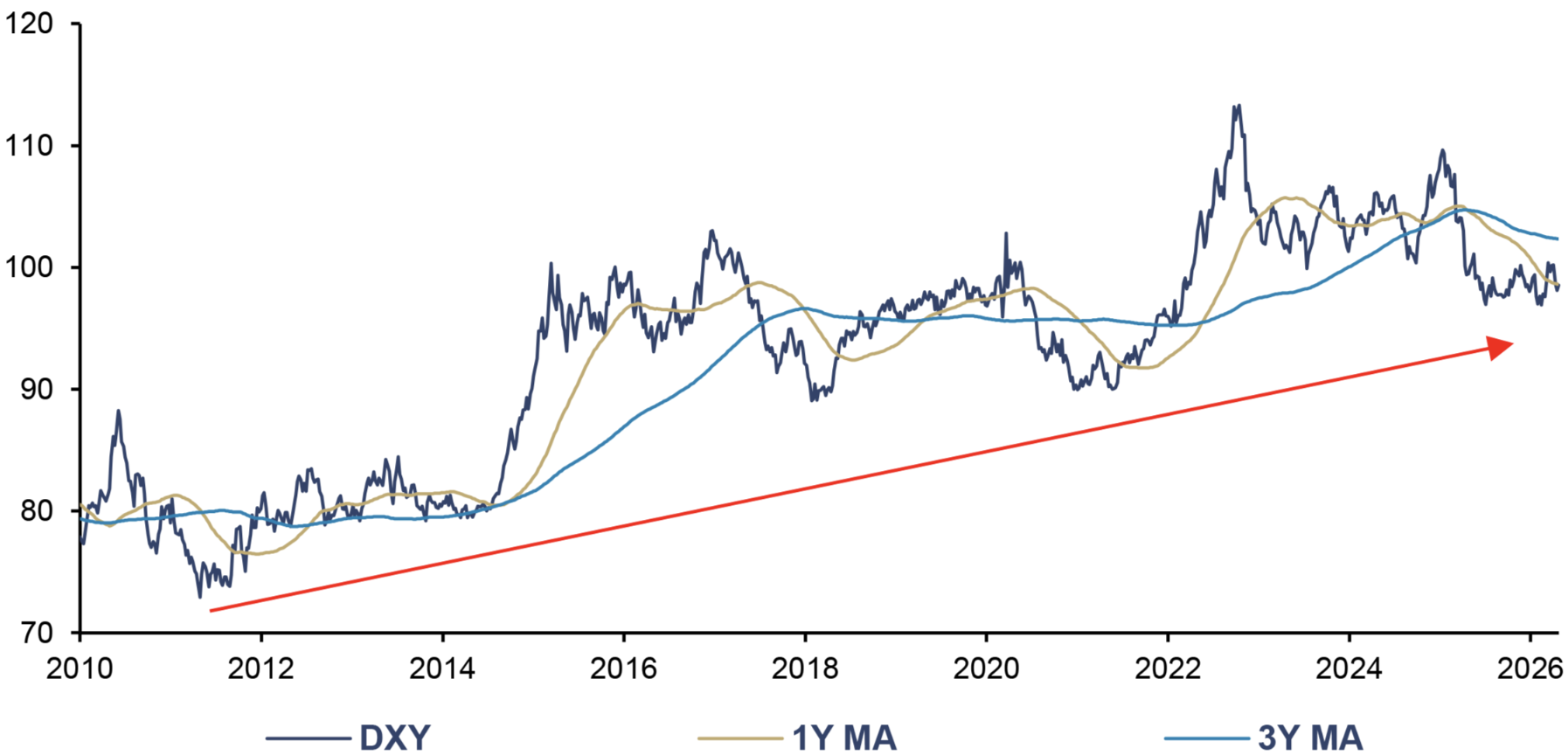
A note of caution: US dollar weakness in a given year does not necessarily equal systemic de-dollarization. The US dollar can suffer a brutal bear market while the reserve system remains mechanically intact. The true tug-of-war is shaped by political, military, demographic, and technological forces – from artificial intelligence reshaping labor to drone warfare revolutionizing military doctrine to the continuing reshuffling of alliances.
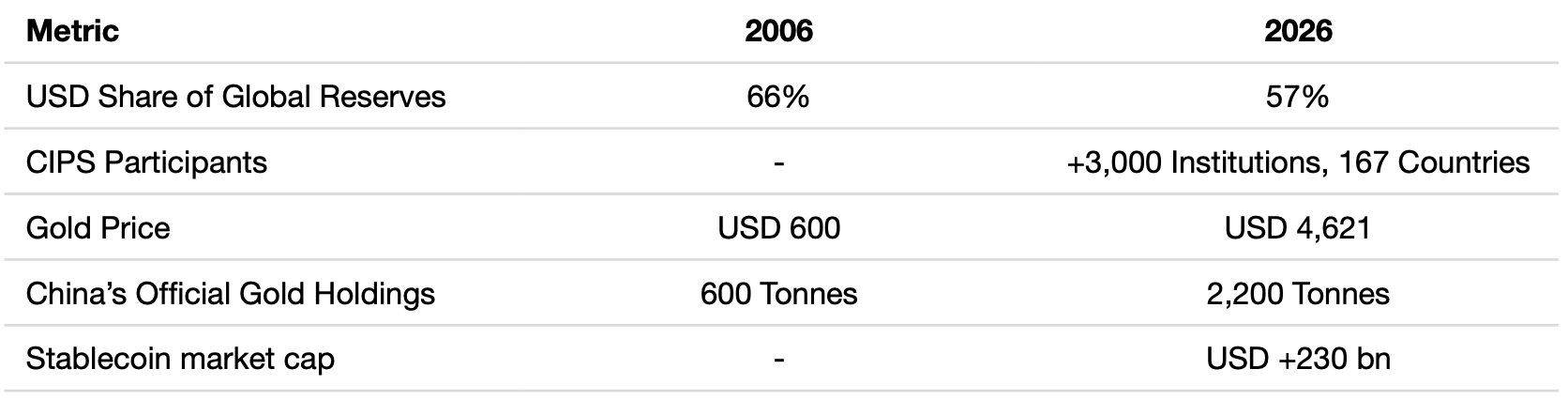
Global Reserve Metrics, 2006–04/2026
Source: DeFiLlama, IMF, PBoC, Incrementum AG
As this year’s In Gold We Trust report is titled “Back to the Monetary Future,” the critical question becomes: Which monetary future are we heading toward? And perhaps even more importantly, who controls the gold?
DXY, 01/2010–04/2026
Source: LSEG, Incrementum AG
Team China’s Offense: The Dragon’s Long Game
A global economic reordering is already being built – and no nation has invested more patiently, or more deliberately, in constructing the alternative than China. What does it look like when a civilization that has used monetary metals for millennia prepares for the next monetary order?
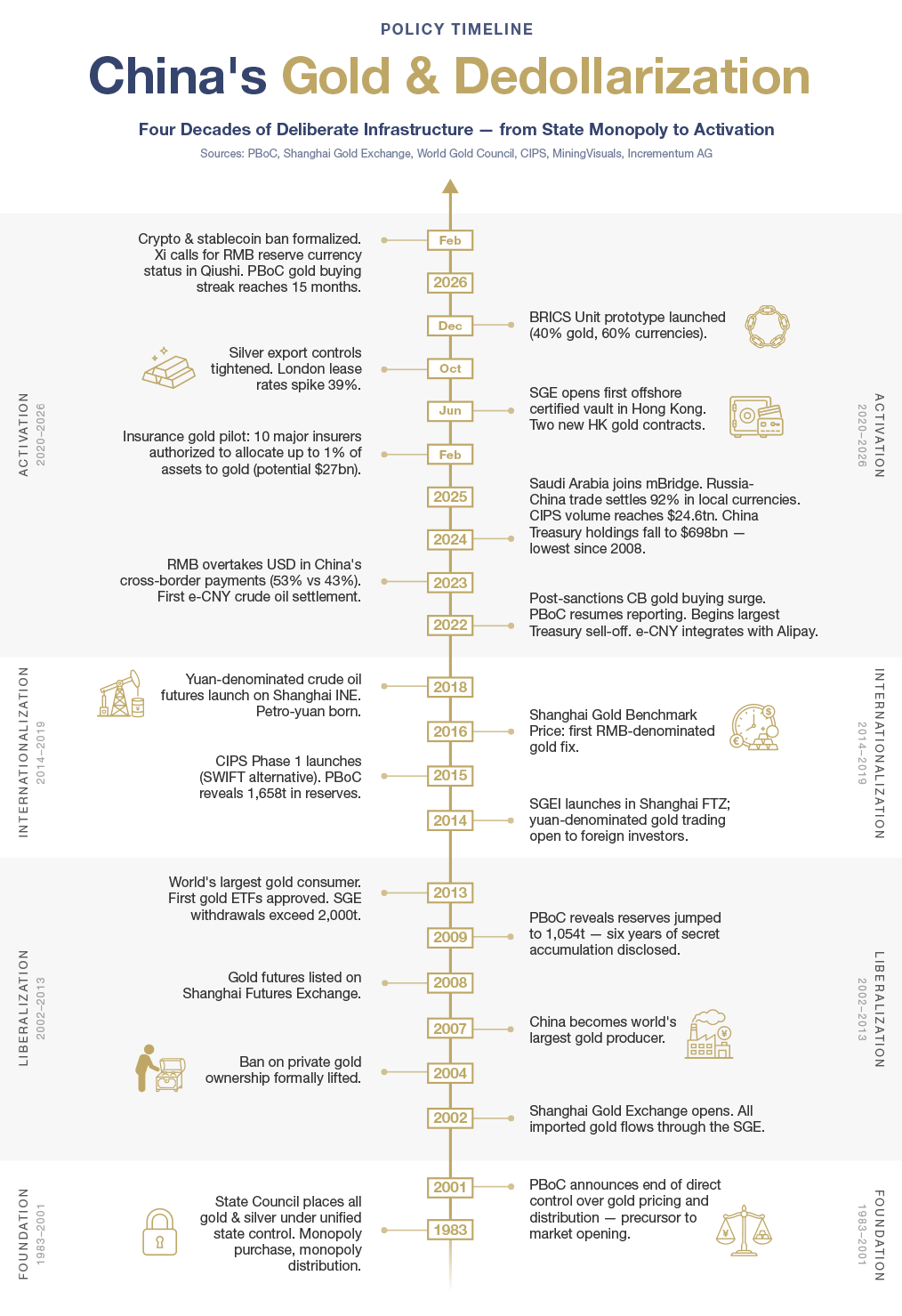
What Western commentators frame as reactive – China “responding” to sanctions – is better understood as the continuation of a strategy spanning four decades. Like the Qing dynasty’s century-long accumulation of silver reserves before the Opium Wars collapsed the old Asian order, Beijing’s gold strategy, grounded in Chinese statecraft, shows a patience that Western policymakers, operating on electoral cycles measured in years, struggle to comprehend.
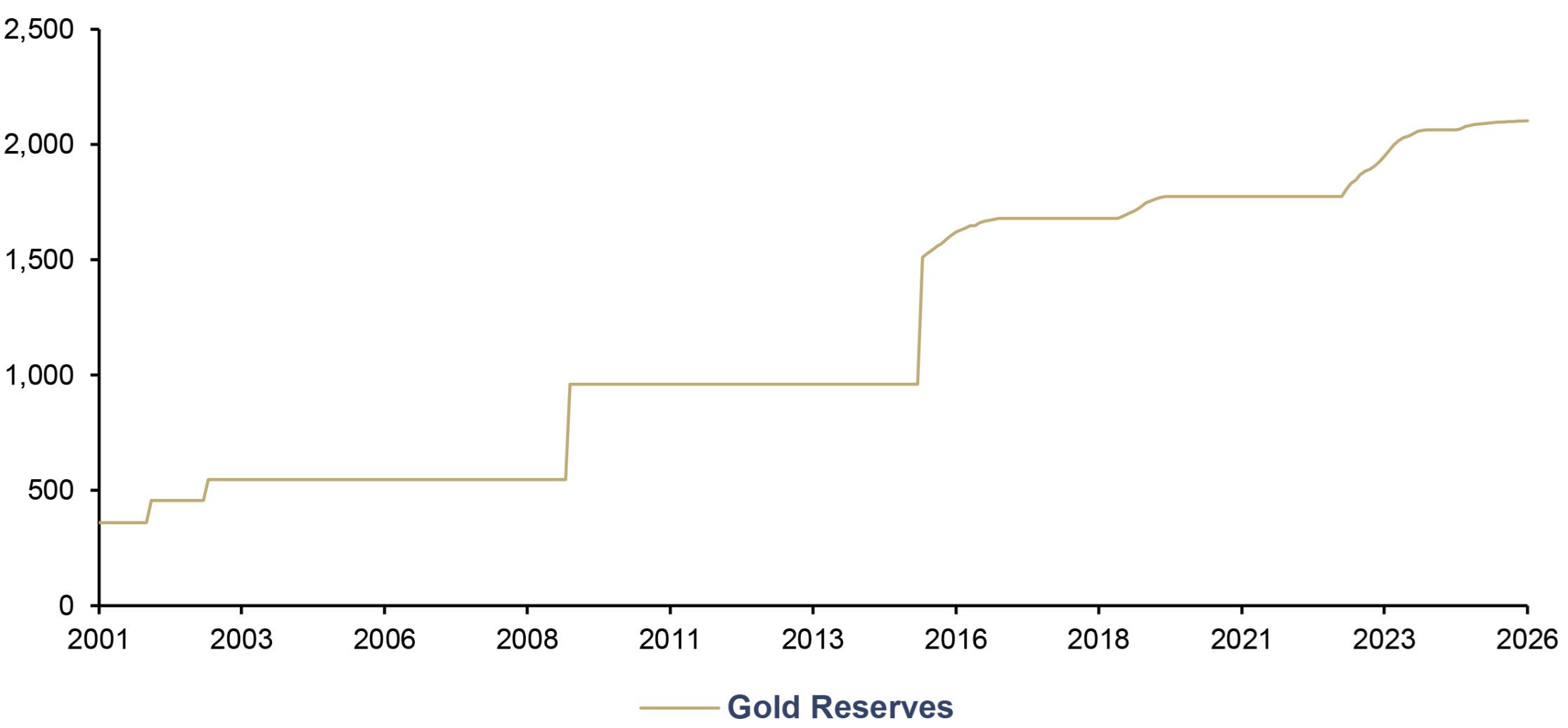
As Alasdair Macleod points out, this began in 1983, when Deng Xiaoping placed all gold and silver under unified state control. The following accumulation was deliberately spread across the People’s Bank of China, the military, and state enterprises, which is why PBoC reserves represent, as Macleod notes, “the small tip of a far larger iceberg.” The true magnitude of Chinese holdings of monetary metals remains shrouded in opacity, an asymmetry that gives Beijing a substantial negotiating advantage.
The Shanghai Gold Exchange opened in 2002; since then, the Chinese public has withdrawn approximately 28,000 t of gold – a transfer of monetary metal into private hands unmatched in modern history. Simultaneously, China became the world’s largest gold miner and a significant importer of gold doré.
Official PBoC Gold Reserves, in Tonnes, 01/2001–01/2026
Source: IMF, Incrementum AG
For students of monetary history, the pattern is unmistakable: Nations that accumulate monetary metal at this pace are typically in the midst of – or actively preparing for – a reset of the monetary order. Rome amassed precious metals to underpin its imperial reach, Britain accumulated gold to consolidate its nineteenth-century hegemony, and the United States entered the 1944 Bretton Woods conference holding roughly 20,000 t of gold – close to two-thirds of global monetary gold reserves at the time. That bullion hoard was not incidental to the outcome at Bretton Woods; it was the outcome. Whoever owns the gold writes the rules.
Has the activation phase begun? Xi’s post-Liberation Day actions – traveling to ASEAN countries while Washington penalized them – are a key signal. Additionally, China announced SGE vaults in Hong Kong and a planned vault in Saudi Arabia for gold-yuan exchange. The Cross-border Interbank Payment System (CIPS), a SWIFT competitor, now serves over 3,000 institutions across 167 countries. The renminbi’s share of China’s cross-border payments reached 53% in 2025, up from 17% in 2010 – a structural shift in payment flows that speaks to the monetary repositioning.
In early 2026, regulators instructed Chinese financial institutions to reduce Treasury holdings – diplomatic cover for what appears to be deliberate policy redirection. Beijing simultaneously banned stablecoins – which it views as extensions of US dollar hegemony – while Hong Kong moved forward as a digital asset hub. One country, two systems continues to operate, but now with a unified strategic purpose: one system for preserving capital flows, one for enabling new monetary arrangements.
Supporting evidence from the 15th Five-Year Plan
The proposals put forth for China’s 15th Five-Year Plan (2026–2030), which was formally introduced this March, codify what the gold and currency moves already demonstrate. Alpine Macro’s Yan Wang identifies three pillars that are core to the plan: development, security, and domestic demand. Beijing’s goals for each pillar contain the following de-dollarizing moves:
- “Development” includes technological self-sufficiency, Xi’s “new-quality productive forces.” The plan accelerates the decoupling of China’s tech supply chain from Western dependence, particularly in semiconductors, AI, and critical minerals.
- “Security” is holistic, extending beyond the military domain to encompass financial markets and the broader economy, and framing US dollar exposure as a national security vulnerability.
- “Domestic demand” is the rebalancing of China’s economy away from export dependence toward internal consumption, thereby reducing the need for US dollar-denominated trade settlement.
These three pillars describe China’s institutional de-dollarization. But they also reflect urgency born of internal fragility. Chinese officials have publicly acknowledged what they call “involution” – the condition in which enterprises expend more effort yet fail to create new value, a dynamic familiar to anyone who lived through the economies of the late-1980s Soviet bloc.
Beijing’s 2026 launch of a National M&A Guidance Fund – effectively a state-mandated fund to absorb and dismantle nonperforming companies – signals that the de-dollarization offensive is occurring alongside painful domestic restructuring. The parallel financial architecture is not limited to offense but is also being put in place to hedge against the risk that China’s internal economic contradictions outpace its external strategy. The arithmetic is unforgiving: A dramatically undervalued RMB and a USD 1trn-plus goods surplus leave Beijing no choice but to keep pushing production outward – which is precisely why the parallel architecture is moving from design to deployment.
BRICS+ and the UNIT
Xi, Putin, and Modi standing together, hands clasped – an image that discredited an entire generation of analysts who assumed India would never side with China. Yet these nations do not share values. They do not deeply trust each other. What they share is the hard-won conclusion that a US-dominated financial architecture poses a greater existential risk to their sovereignty than their mutual rivalries. This is not ideology; it is realpolitik. As Matthew Piepenburg puts it: “The BRICS… don’t all trust each other…but they do trust gold.”
Russia-China trade settled in local currencies has reached 99.1% – a near-complete de-dollarization of bilateral commerce. Russian Minister of Foreign Affairs Sergey Lavrov’s April 15 visit to Beijing went further – with Moscow publicly pledging to “fill the resource gap” left by the Hormuz blockade, offering to redirect energy exports to make up for the drop in Middle Eastern supply. The move cements a structural energy partnership that runs on ruble-yuan rails – a bilateral circuit that now operates entirely outside the dollar system.
Saudi Arabia joined Project mBridge in June 2024, and rumors suggest the SGE has activated a delivery treasury in Saudi Arabia for yuan-to-gold conversion – potentially closing the loop on an oil-yuan-gold settlement circuit that solves the renminbi’s core limitation as a reserve currency: its closed capital account. If oil can be priced in yuan and converted to gold through a trusted intermediary, the renminbi acquires the backing and flexibility it previously lacked. As Piepenburg notes, “The fact that these oil states are happy to discuss going outside of the US dollar to transact oil says a lot about the next 20 years.”
Foreign Central Bank UST Holdings (lhs), in USD trn, and DXY (rhs), 01/2015–04/2026
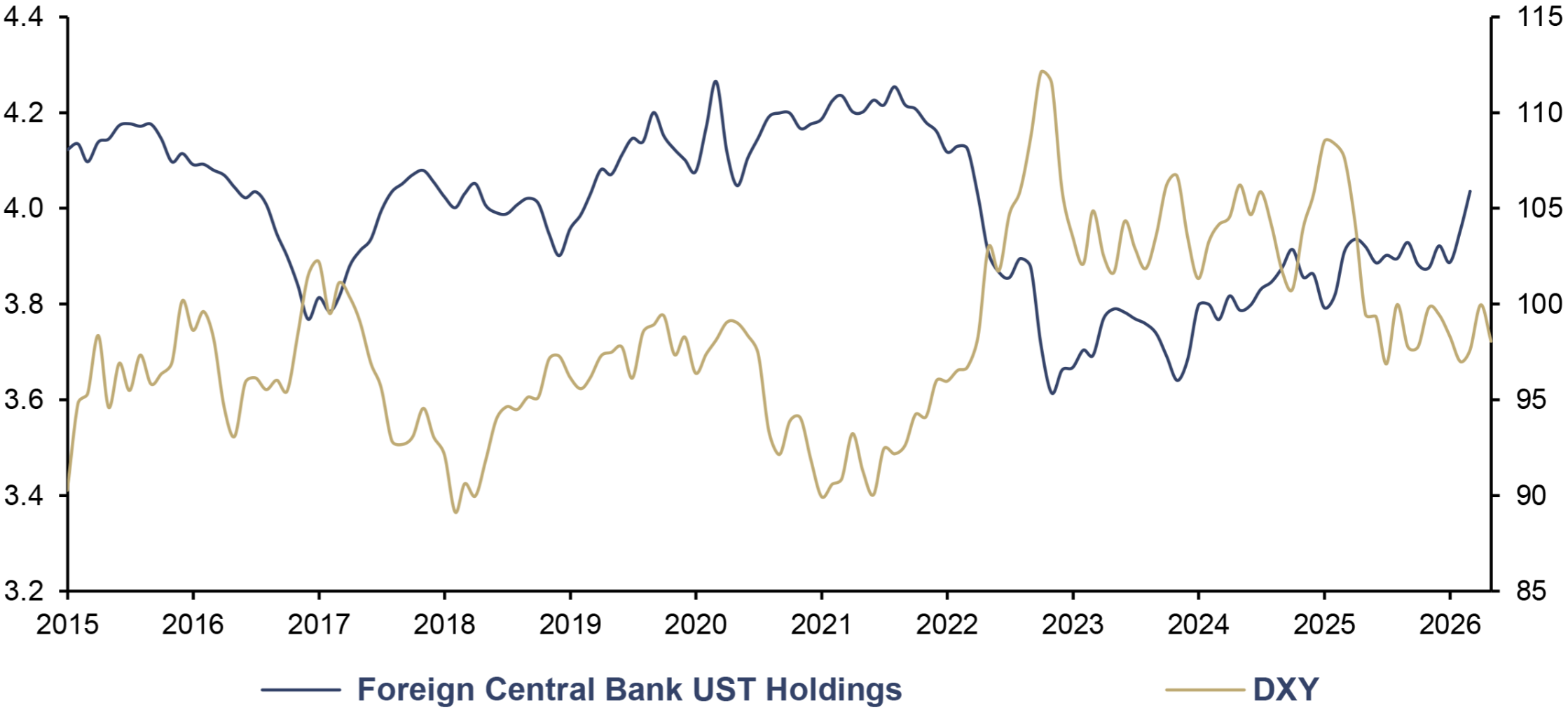
Source: Federal Reserve St. Louis, LSEG, Incrementum AG
The UNIT
The most ambitious BRICS+ monetary initiative is the UNIT: a proposed trade settlement currency backed by gold (40%) and BRICS+ currencies (60%). The basket design, reminiscent of Keynes’s BANCOR proposal at the Bretton Woods conference, ensures no single national currency dominates the new architecture. JP Morgan’s technical analysis concludes that the structural barriers are manageable; the true constraint has been political demand. That is changing as BRICS nations drift further from Western institutions and recognize the durability of gold-backed alternatives.
China’s long game is formidable – but it has not gone unanswered. If Beijing has spent four decades building the alternative, Washington has spent the last months mobilizing to defend the incumbent system. The counteroffensive is not entirely reactive either; it has its own framework, its own institutional architects, and its own monetary logic.
Team USA’s Counteroffensive
The Mar-a-Lago Accord cont’d
Having implemented the first wave of the Mar-a-Lago Accord’s prescriptions in 2025 – tariffs, defense spending pressure, energy supply expansion, and deliberate US dollar depreciation – the US administration is now advancing Miran’s next phase with notable clarity: coordinated currency intervention, a formal Treasury-Federal Reserve partnership to suppress long-term yields, and taxation mechanisms targeting foreign capital flows.
DXY, 01/1971–04/2026
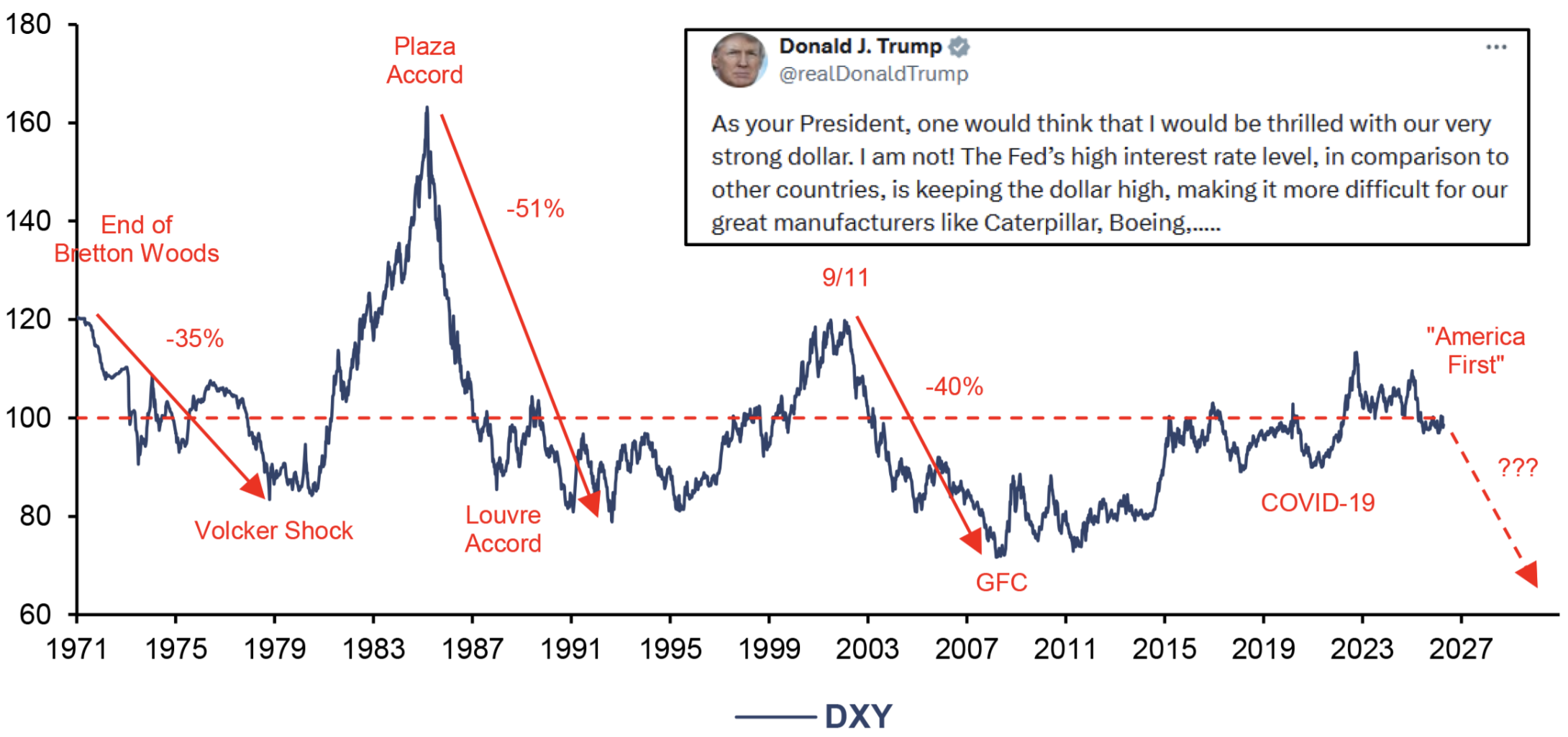
Source: LSEG, Incrementum AG
These proposals are best understood within Michael Every’s theoretical framework of “Reverse Perestroika” – the deliberate transformation of the US economy from consumption and financialization toward capital investment and military-industrial production. Whereas Gorbachev sought to dismantle the Soviet military-industrial complex, this administration is actively reconstructing the US one.
The January 23 “rate check” by the New York Federal Reserve on USD-JPY – the first such signal since the US intervened to sell yen in March 2011 – suggests direct currency intervention is on the table, even though Bessent has denied this. Warsh’s nomination as Federal Reserve Chair and Miran’s elevation to the Federal Reserve Board of Governors reinforce this trajectory. On the taxation front, the IRS’s December 2025 proposed rewrite of Section 892 represents a step toward Miran’s conceptual “user fee” on foreign holders of US dollar assets. As Miran notes, “Tariffs provide revenue, and if offset by currency adjustments, present minimal inflationary or otherwise adverse side effects.” Yet he also acknowledges the historical burden: “Historically, the United States has pursued multilateral approaches to currency adjustments.” – this moment appears to require a different playbook entirely.
The risks are considerable and, for students of monetary history, familiar. Currency intervention has a mixed track record when economic fundamentals are absent. The Plaza Accord of 1985 succeeded partly because it emerged from genuine multilateral consensus;[2] today, no such consensus exists among major powers. Yet, reverse perestroika is structurally bullish for gold, whether it succeeds or fails. Success means managed devaluation and artificially suppressed real rates – the textbook environment for gold appreciation. Failure means a loss of confidence in US monetary institutions and their credibility, pushing capital toward the one asset that sits outside any team’s control or manipulation. Gold, as always, benefits from the uncertainty itself.
Miran’s framework addresses the structural defense of US dollar hegemony – tariffs, currency intervention, and yield management. But Team USA has a second weapon, one that operates not through state policy but through market adoption and technological infrastructure.
Dollar Milkshake and Stablecoins
Brent Johnson’s Dollar Milkshake Theory – the proposition that the US dollar strengthens by absorbing global liquidity through offshore US dollar-denominated debt – remains mechanically intact in its core logic.[3] However, April 2025’s tariff implementation delivered the first visible crack in the glass: volitional US dollar demand – the discretionary capital allocation choices of investors – fled even as mechanical demand – the involuntary debt-servicing requirements of foreign debtors persisted. The system is beginning to segregate.
DXY (lhs), and Stablecoin Market Cap (rhs), in USD bn, 01/2020–04/2026
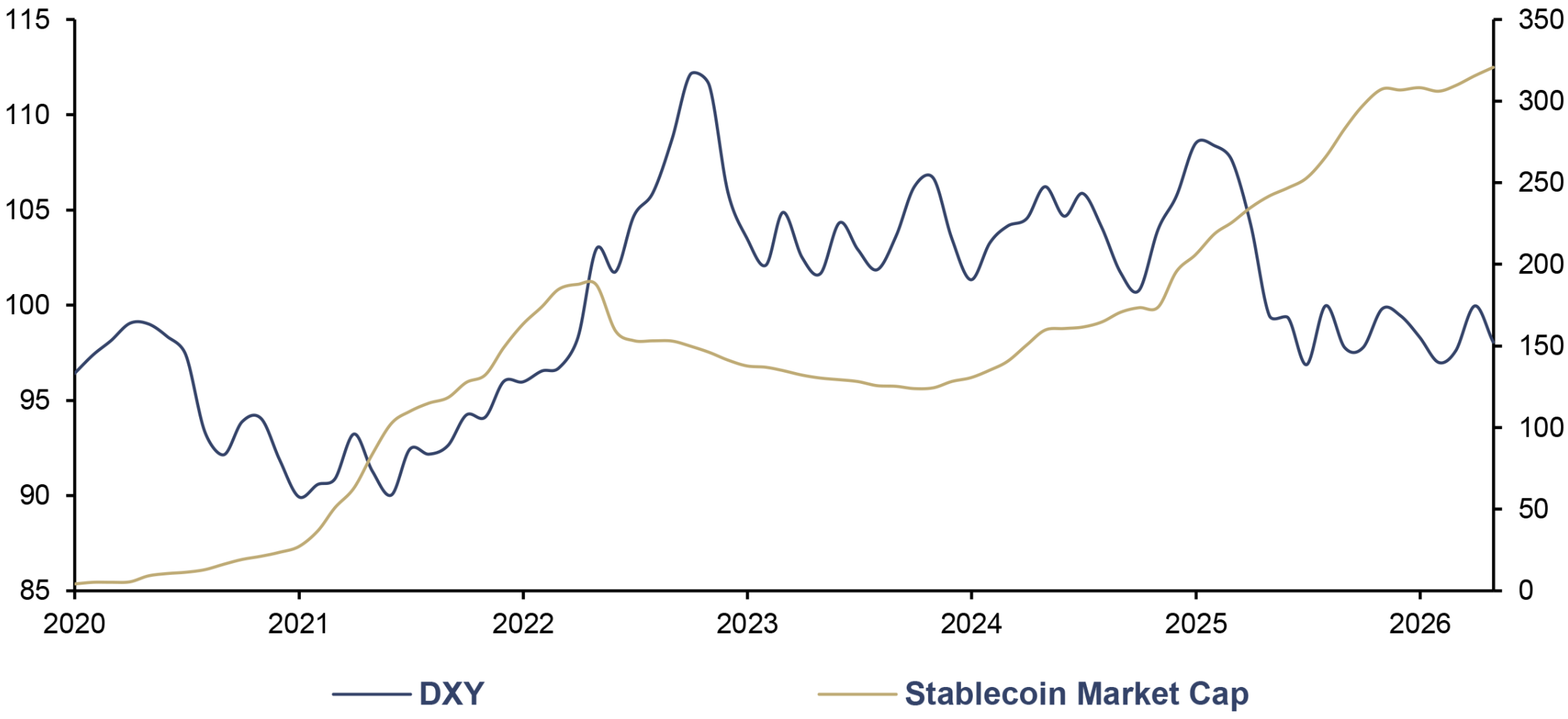
Source: DeFiLlama, Incrementum AG
As Johnson recently framed it, the eurodollar system “is a prison that everyone built around themselves.” It functions through inertia and the absence of alternatives, not through genuine preference.[4]
Stablecoins have become Team USA’s most effective instrument for extending US dollar dominance into markets the legacy US dollar infrastructure cannot easily penetrate. The market now exceeds USD 300bn in total capitalization. Tether alone holds more US Treasuries, which it uses as collateral for its US dollar stablecoins, than the vast majority of sovereign nations. Citi projects a base case of USD 1.9trn in total stablecoin market capitalization by 2030. Cryptocurrency exchanges are further expanding this channel. In January 2026, the prominent Asian exchange Bybit announced the introduction of fully reserved, bank-like accounts, thereby directly competing with local banks in emerging markets.
Izabella Kaminska sees stablecoins as a potential migration path from the aging eur odollar plumbing – the banks and SWIFT rails that have carried US dollar flows for decades – to new, distributed ledger rails over which the United States would exercise far greater control.[5] It amounts to a reconstitution of monetary infrastructure for the twenty-first century.
As Peter Earle observes, what Asia is building through regulated stablecoin frameworks in Hong Kong and Singapore may be “less about displacing the dollar as reserve money than about disaggregating the mechanisms whereby dollar liquidity is accessed, transferred, and rehypothecated” – a competitive fiat pluralization under shadow-dollar pricing that changes the channels of US dollar dominance without confronting it directly.
The regulatory battle lines over stablecoins have been drawn. The US enacted stablecoin legislation to encourage the use and inclusion of stablecoins in the financial system. On the other hand, China banned them entirely, regarding them as Trojan horses for US dollar hegemony. Beijing’s calculus is not wrong; each smartphone that transacts using popular stablecoins such as USDT or USDC is a node in a US dollar network that operates beyond the reach of local monetary authorities and their capital controls. China is building CIPS, gold-for-yuan vaults, and the UNIT to displace US dollar infrastructure from above through state action.
Yet China’s counter-strategy faces a structural constraint that Izabella Kaminska identifies. Beijing cannot easily reduce its US dollar dependence by selling Treasuries, as large-scale sales would push the renminbi upward, harming export competitiveness and threatening the political model itself. China is, in a sense, more imprisoned by the US dollar system than Iran ever was. This is precisely why rumors – which Bessent himself acknowledged to lawmakers – that Beijing may be developing digital assets backed by gold rather than the renminbi deserve attention. A gold-linked instrument would allow cross-border settlement outside the US dollar sphere while sidestepping the capital account liberalization that the CCP cannot politically afford.
Stablecoins are replacing local currencies from below through consumer choice and merchant adoption. Every calls them a “gamechanger” that will “completely change the geometry and geography of how the financial system works.” The contest between topdown de-dollarization and bottom-up dollarization will be one of the defining monetary dynamics of the coming two decades.
The Eagle vs the DragonBear
The Trump administration’s policy is not a collection of disconnected provocations but a unified, coherent campaign. Rubio’s Munich speech articulated a civilizational framework. Michael Every employs the board game Risk as an analytical viewpoint: Control your own continent, deny the opponent their critical regional territory. In Asia, Taiwan remains the contested terrain; in Europe, Ukraine.
Washington is directing allies to assume primary responsibility for their own regional security while the United States concentrates on the Western Hemisphere – asserting the Monroe Doctrine from Greenland to Argentina. The Pentagon’s recruitment of Goldman Sachs and JPMorgan bankers for a new Economic Defense Unit – tasked with allocating USD 200bn over three years – is further evidence of Team USA’s plan, where economic statecraft now requires Wall Street firepower alongside military hardware.
The removal of Venezuela’s president Nicolas Maduro. Increased pressure on Cuba, which has recently embraced its own perestroika, allowing Cuban American exiles to return and open private businesses. The announcement of a Major Defense Cooperation Partnership with Indonesia – the fourth-largest nation and gatekeeper of the Strait of Malacca, China’s other critical energy chokepoint – on the same day as the Hormuz blockade. These are best understood as coordinated moves within a larger strategic framework, clearing the board before the principal confrontation.
Military strikes on Iran are a major move on a significant DragonBear ally.[6] Modi’s meeting with Israeli leadership days before those strikes suggests a sequencing that extends alliance-building beyond the Cold War-era hub-and-spoke model. Washington is reorganizing the geopolitical map through both force and statecraft.
But the Iran episode has also revealed a shift in the very nature of military power projection, with implications for monetary arrangements. As revealed to some extent during the Ukraine war, it is beyond a doubt that drones and missiles costing a few thousand US dollars can now neutralize naval vessels worth billions. Erik Prince has called this the most significant change to warfare “since Genghis Khan put stirrups on horses.” For the first time since World War II, the United States Navy could not guarantee freedom of navigation through the Strait of Hormuz, a critical strategic chokepoint. The entire edifice of American power projection, built on carrier battle groups and blue-water naval supremacy – the same military umbrella that has implicitly backstopped the US dollar since 1945 – faced a concrete challenge from swarms of cheap, expendable weapons. If the security guarantee no longer holds with absolute certainty, the monetary premium it entails is called into question.
The kinetic confrontation was preceded by financial warfare. As Izabella Kaminska has documented, Washington engineered a deliberate US dollar squeeze inside Iran, choking Iraqi banking channels that had served as the lungs of Iran’s financial system, tightening sanctions to produce “immediate maximum impact,” and triggering a cascading sequence from bank failure, i.e. Ayandeh Bank’s USD 5bn collapse, to currency crisis to Grand Bazaar protests. Treasury Secretary Bessent confirmed to lawmakers that this chain of causation was understood and, to a considerable extent, intended. In April 2026, the US Treasury escalated further, sending Operation Economic Fury letters threatening secondary sanctions on any institution handling Iranian flows to banks in the UAE, Oman, Hong Kong, and China. By taking this action, Team USA has extended the US dollar-squeeze playbook from the target’s banking system to the entire transit architecture around it.
The Iranian case provides a live template for how constraining access to US dollars can destabilize not only markets but political conditions – and raises the question of whether a similar, albeit more sophisticated, strategy is being applied elsewhere.
Luke Gromen outlines the most dangerous dynamic at play: Iran does not need to defeat the US military to inflict strategic damage. It needs only to defeat the US Treasury market. When oil prices spike due to supply disruption, major creditor nations must sell Treasuries to finance energy deficits. The Strategic Petroleum Reserve only has so much oil. Hedge funds hold 37% of net UST issuance through leveraged basis trades – a precarious structural situation. The mechanism is no longer theoretical: In early April 2026, Federal Reserve custody holdings fell USD 82bn in five weeks to USD 2.7trn – the lowest since 2012 – while 10-year Treasury yields rose from 3.9% to over 4.4%, the opposite of typical safe-haven behavior and a sign of forced selling by oil-importing creditors defending their currencies. This is a systemic vulnerability that any adversary capable of disrupting commodity flows can exploit.
Beijing, one suspects, has taken careful note of the mechanism and its implications. The same dynamic that Hormuz exposes applies equally to Taiwan, the South China Sea, and critical mineral supply chains.
Every frames Hormuz as a Kobayashi Maru – the no-win scenario from Star Trek. As of end-April 2026, with Brent crude up more than 50% from pre-war levels, and a ceasefire widely regarded as fragile, retreat meant what Daniel Oliver has called “an American Suez crisis, precipitating the final demise of the US dollar”. Escalation panicked energy markets further as Iran targeted upstream oil fields – Qatar declared force majeure on LNG exports following strikes on Ras Laffan – threatening not just the flow of energy but its abundance.
Alexander Campbell offers a counterpoint grounded in classical geopolitical theory: The US is a Rimland power and does not need to control the Strait of Hormuz directly; it only needs to control the sea around it. Campbell’s “separating equilibrium” reads Trump’s coalition invitation not as desperation but as a mechanism to distinguish genuine allies from free riders. To Campbell, the emergence of “Friend Oil vs Enemy Oil” – the widening divergence between West Texas Intermediate and Asian-linked benchmarks – is a structural fragmentation of energy markets along geopolitical lines. Yet Campbell still arrives at the same conclusion: gold. Because gold works in both scenarios.
But the China dimension may carry the greatest consequences of all. Iran’s terms for safe passage through the Strait of Hormuz are explicit: Ships must be friendly and willing to settle outside the US dollar, accepting Chinese yuan, Bitcoin, and the US dollar-pegged stablecoin USDT – every non-bank settlement rail available, including, ironically, a digital instrument backed by the very currency Iran seeks to circumvent.
By mid-April the dynamic inverted: US Central Command (CENTCOM) fully implemented a naval blockade of Iranian ports, and the strait is now transited under American direction. The episode nevertheless stands as a recorded precedent. Deutsche Bank notes that 85% of Middle East crude already flows to Asia, and Saudi Arabia exports four times more oil to China than to the US. The oil-yuan-gold settlement circuit described in our BRICS section is being stress-tested at the world’s most critical chokepoint.
This places China in a complex geopolitical position. If Hormuz remains closed to Western traffic but open to Chinese-aligned shipping, Beijing gains an enormous strategic benefit: discounted energy priced in its own currency, routed through infrastructure it controls. But it likewise risks being drawn into a confrontation it has carefully avoided. Meanwhile, every move the Trump administration has made – Venezuela, Cuba, Iran, Argentina, the assertion of the Donroe Doctrine – reads as board-clearing before the main event: the anticipated summit between Trump and Xi. Each DragonBear node weakened as much as possible, each Latin American ally realigned, and each alliance restructured represents leverage on the table when the two principals finally sit down. Yet as Addis Goldman argues in The Republic, “commerce is no substitute for politics – in many respects, it is its antithesis.” Without a binding political principle, transactional alliances remain brittle. Beijing, which conceives of commerce as a conduit for political alignment, may prove the more patient architect.
The confrontation between these two principals dominates the headlines. But the monetary future will not be shaped solely by Washington and Beijing. Between the two poles lies a constellation of middle powers, each facing its own version of the same question: Which system do I belong to? Is it possible to thread the needle? Their answers, measured not only in rhetoric but also in reserve allocation, trade alignment, and military commitment, impact the balance of global power.
The Middle Powers
Japan
Japanese Prime Minister Sanae Takaichi’s landslide election victory in early 2026 – the largest postwar victory in the country’s history, so comprehensive that her party ran out of candidates to fill the seats it won – illustrates the transformation this chapter describes.
For years, Japanese prime ministers rotated through office as stewards of a system running on autopilot. As Every observes, “When you had revolving door Japanese prime ministers, that was a period in which we were still in the liberal world order. It didn’t really matter who was running Japan.” Now it matters a great deal.
Takaichi must govern amid challenges that would have been unimaginable a decade ago. Japan confronts inflation for the first time in a generation. JGB yields are climbing toward levels that could permeate across global bond markets. The BOJ is caught between a weakening yen and an unsustainable debt-to-GDP ratio compounded by a shrinking population. Takaichi won partly by standing up to Chinese pressure over Taiwan, projecting the security establishment’s view that if war comes, Japan is in it whether it chooses to be or not.
For the US dollar system, Japan’s significance is difficult to overstate. Tokyo is an early adopter of what Every calls the new integrated alliance model, directing capital into long-term productive US investment rather than simply recycling trade surpluses into Treasuries. The US, in Every’s telling, “is literally directing where this investment is going to go. That is a capital control.” In exchange, Japan receives deeper military integration and a seat at the table in whatever architecture Team USA builds vis-à-vis China. The new Plaza Accord, if it comes, will have a Japanese chapter.
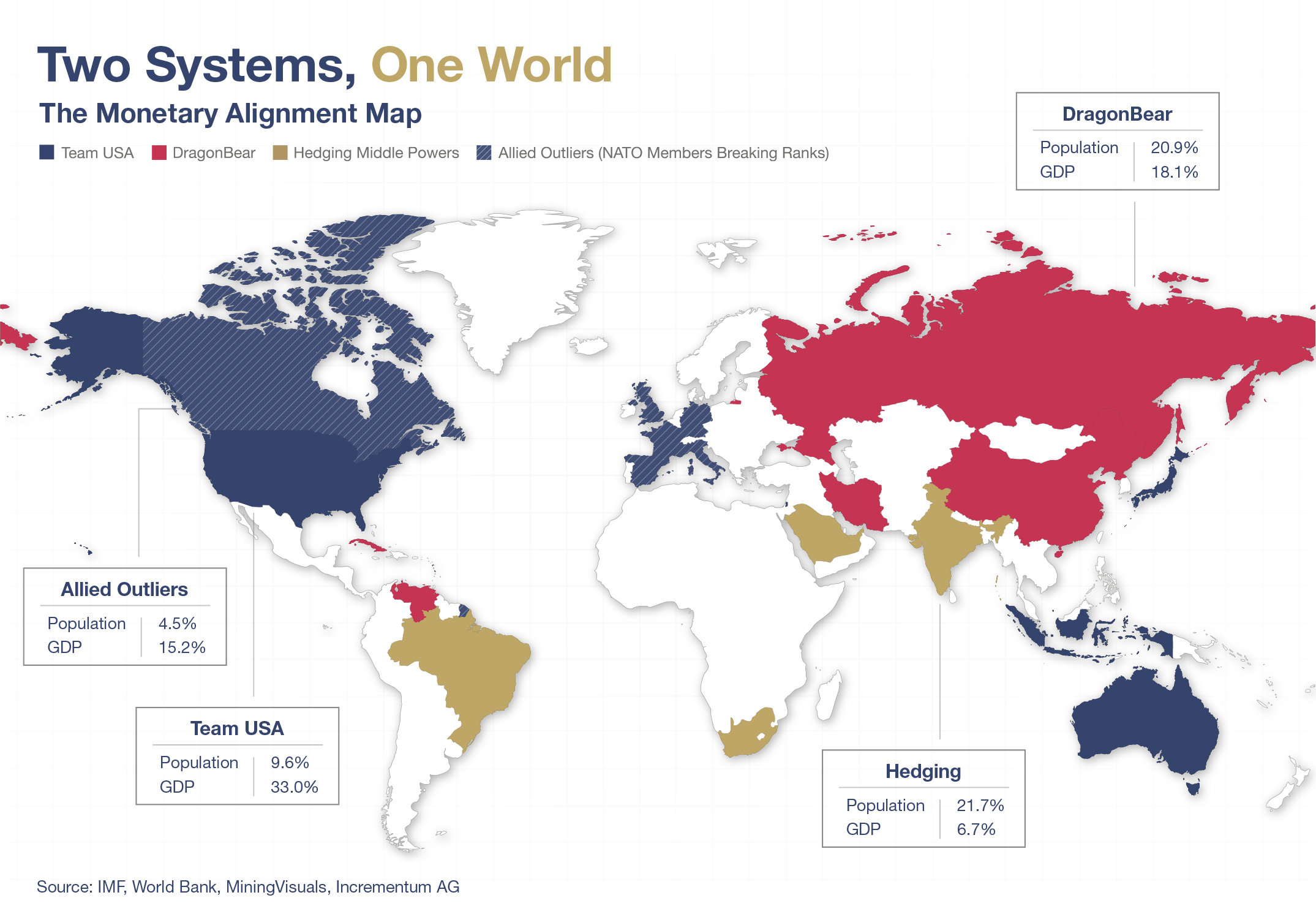
Japan’s alignment with Team USA is deep but fragile. Further south, another Asian giant is playing an altogether different game – one defined by deliberate, strategic ambiguity.
India Matters
India has imported 6,500 t of gold over the past decade, while Subrahmanyam Jaishankar, India’s Minister for External Affairs, insists “India has never been for dedollarization.” Actions, as ever, speak louder than words. The scale of India’s gold accumulation tells a different story – one of a nation hedging against every possible future.[7]
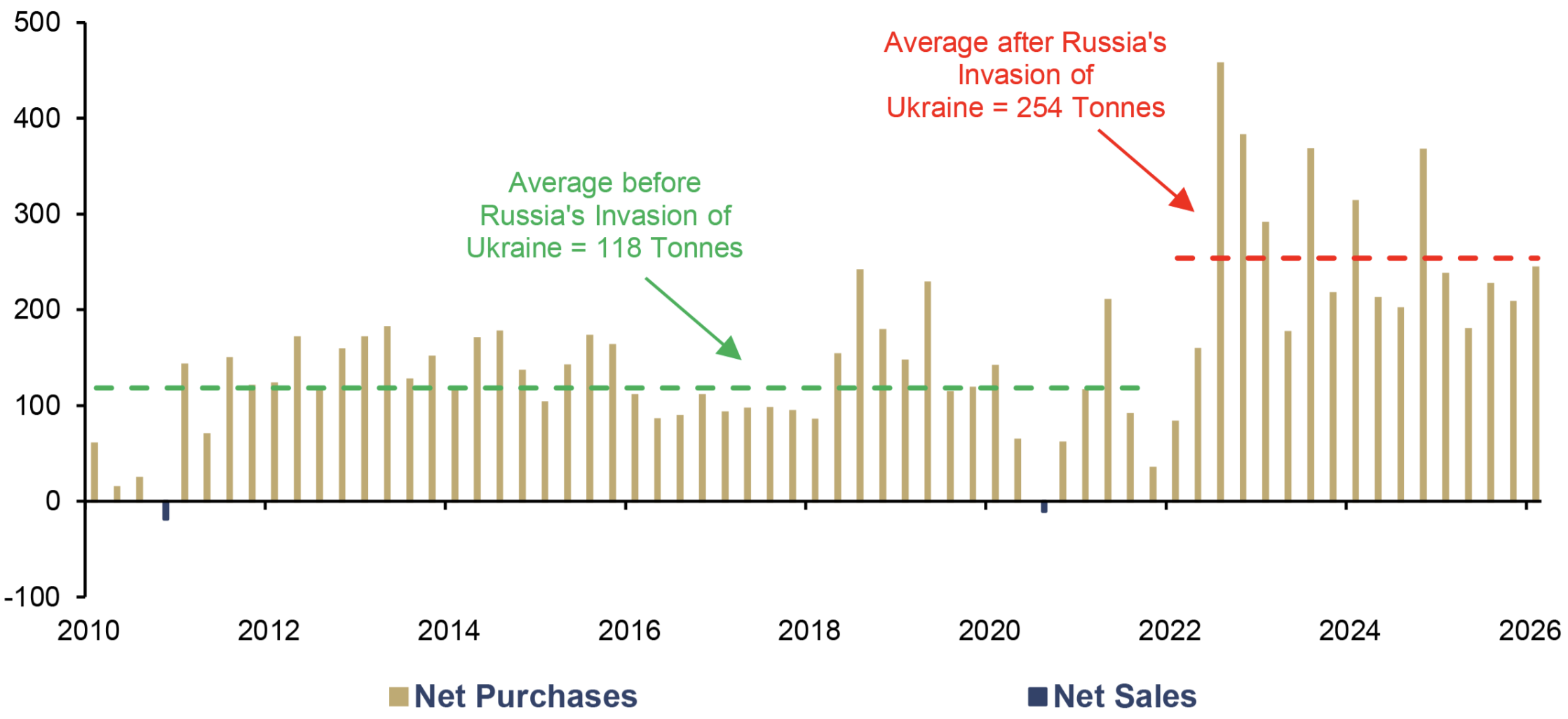
Central banks in the global East have raised quarterly net gold purchases from a preUkraine-war average of 118 t to 291 t – the strongest structural buying wave since modern central bank statistics began. The gravitational center of the global gold market has shifted decisively eastward.
Global Central Bank Gold Purchases, in Tonnes, Q1/2010–Q1/2026
Source: ICE Benchmark Administration, Metals Focus, Refinitiv GFMS, World Gold Council, Incrementum AG
Modi met with Israeli leadership days before the Iran strikes. Washington pressured India to curtail Russian oil purchases, using tariff relief as leverage. Michael Every’s framework sees India as a winner if Team USA succeeds in the emerging mercantilist reordering. Yet India is still a BRICS member, appears in that famous photograph with Xi and Putin hand in hand, and continues accumulating gold at a pace that suggests hedging against every conceivable outcome. India refuses to pick a side – not from indecision but from strategic clarity. In a world being redrawn, that ambiguity, backed by six and a half thousand tonnes of physical gold, may prove to be the shrewdest play of all.
India can afford ambiguity because it sits between blocs. America’s traditional allies – the nations that built the postwar order alongside Washington – face a more uncomfortable reckoning. What happens when the system you helped construct begins to feel like a liability?
With allies like these: Europe and Canada
It is one thing to build a stronghold against your adversaries. It is quite another when the neighbors inside the walls begin looking for the exits. German economists have called publicly for repatriating gold from the New York Federal Reserve.[8] ECB President Christine Lagarde declares it “urgent” to build European alternatives to US infrastructure such as Visa and Mastercard. Appia, an initiative by the euro system to develop a European tokenized financial ecosystem launched in 2025, and the ongoing work on introducing a digital euro, now scheduled to go online in 2029 at the earliest, are two such initiatives. Carney, Starmer, and Merz have all made pilgrimages to Beijing.
The Iran conflict has laid bare the extent of allied defection. France blocked the UN Security Council resolution to reopen the Strait, then negotiated a bilateral passage agreement with Iran. The UK blocked basing rights at Diego Garcia. Italy denied landing rights at Sigonella. Germany declared Hormuz “has nothing to do with NATO.” What the Greeks called hegemonia – leadership earned by bearing costs – is collapsing into arkhe: control imposed by force, the very dynamic Campbell identifies as the marker of imperial decline.
Defense spending is surging across Europe at an extraordinary pace. The burden-sharing that could not be achieved over decades of polite diplomacy is now being achieved through provocation. As Every puts it with characteristic bluntness, “If you’re Australia, Canada, European countries talking big about alternatives, good luck. Go make some B2 bombers and then talk about it.”
The allied hedge is nonetheless bullish for gold. Repatriation debates, the digital euro, Scandinavian institutions rotating out of Treasuries as a reaction to Trump’s grab for Greenland – even allied nations are building alternatives to US dollar infrastructure. As Luke Gromen has observed, the Cold War era that Rubio’s Munich speech invokes operated under a monetary system in which gold, not the US dollar, served as the neutral reserve asset. The post-1971 system replaced that anchor with US dollar hegemony, but the arrangements underpinning it are visibly fraying. Gold once again emerges as the asset that requires no allegiance.
Team China builds while Team USA defends, and the middle powers hedge when possible. But beneath these strategic maneuvers lies a structural reality that transcends any single bloc or alliance: the debt. Regardless of which team prevails, the arithmetic of sovereign balance sheets points in one direction – and it is a direction that history has visited before.
The Structural Endgame
Financial repression expected
If every door to debt reduction is closed except one, which door does a democracy walk through?
Of the options available to overleveraged sovereigns – austerity, default, high growth, hyperinflation, or fin ancial repression – only the last is politically survivable over the long term. Holding interest rates below the rate of inflation erodes the real burden of debt while the nominal economy grows around it, disguising the transfer of wealth from savers to borrowers. The French called the post-World War II period les trente glorieuses; as Russell Napier has noted, it was a dreadful 30 years for savers.
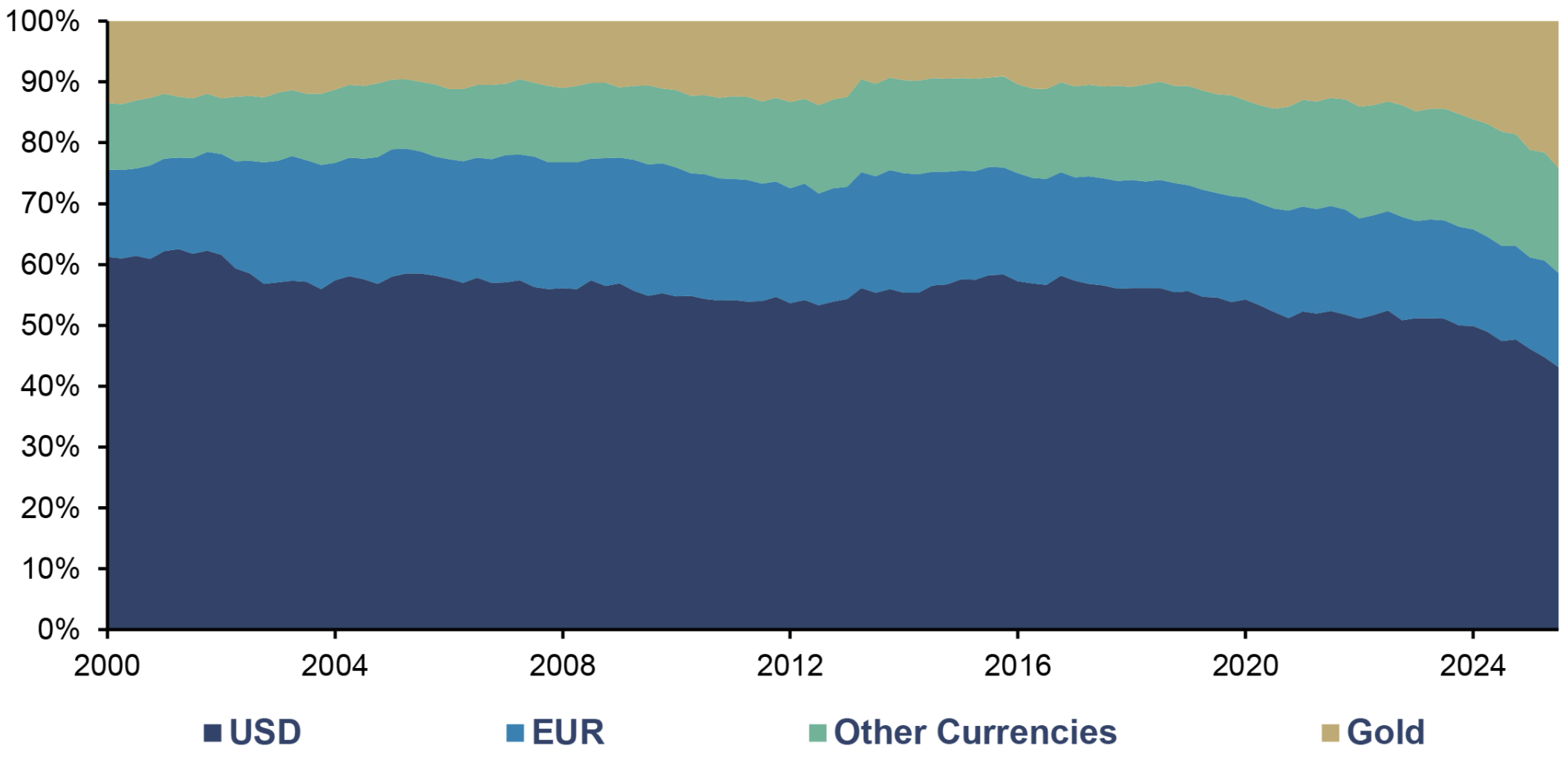
The conditions for a new era of financial repression are falling into place. Debt levels across the developed world stand at or near wartime highs – or even already above.[9] Incoming Federal Reserve Chair Kevin Warsh is betting that AI-driven productivity will contain inflation – a wager that historical evidence suggests is at best optimistic. As Deutsche Bank Research notes, foreign Treasury ownership is down from roughly 50% in the early 2010s to approximately 32% today, while aggregate central bank gold holdings now exceed US government bonds for the first time since 1996 – a structural reallocation that speaks louder than any policy statement.
Composition of Global Total Reserves, 2000–Q3/2025
Source: Eichengreen, IMF, World Gold Council, Incrementum AG
But here lies the critical difference from the 1940s and the postwar period: Savers and sovereigns now have exit options that simply did not exist in the immediate postwar era. China is actively building a parallel system – gold settlement mechanisms, thousands of CIPS participants, and agreements that bypass US dollar rails. The more aggressively the United States represses its savers, the more attractive these Chinese alternatives become. Financial repression thus risks accelerating the very de-dollarization it was designed to quietly outlast – a perverse irony of the highest order.
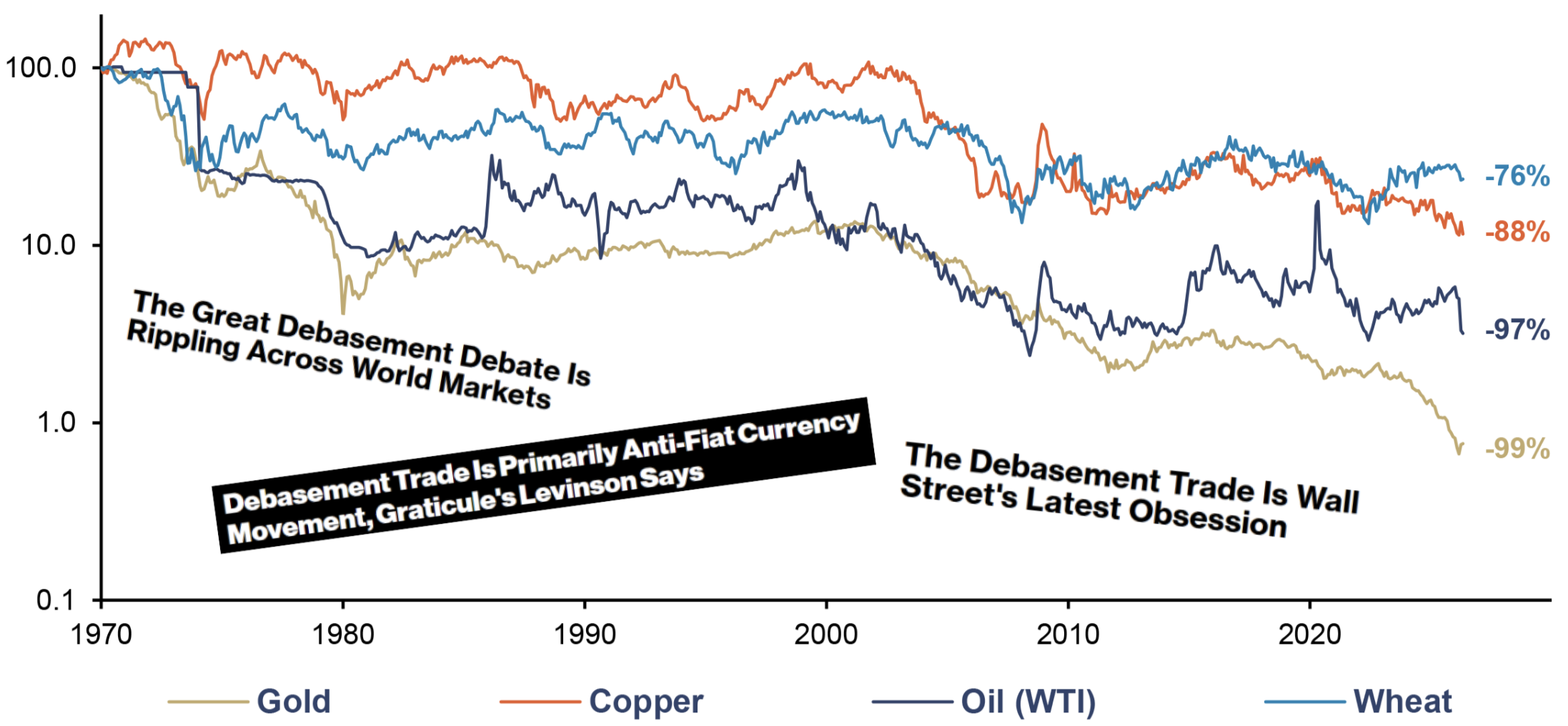
USD (log), in Various Commodities, 100 = 01/1970, 01/1970–04/2026
Source: Bloomberg, LSEG, Incrementum AG
As Izabella Kaminska observes, the restructuring is itself mirror-imaged: China produced labor-heavy industrial overcapacity while the West produced capital-heavy financial overcapacity, and both sides are now engaged in painful dezombification – Beijing through its M&A Guidance Fund, the West through the withdrawal of the cheap capital that sustained its own zombie enterprises. But only one asset sits outside both systems, is easily accessible to citizens, is immune to manipulation by any single sovereign, and is insulated from monetary policy decisions. That asset is gold.
If every major sovereign is debasing, every central bank is accumulating gold, and no single currency can command universal trust, what – if not gold – will anchor whatever comes next?
Why gold wins either way
The tug-of-war between US dollarization and de-dollarization continues, but both sides are pulling harder than ever. The post-World War II institutional order – Bretton Woods, the UN, NATO, SWIFT – the system that Secretary Rubio himself acknowledged “has no answers” to today’s crises – is being simultaneously dismantled and rebuilt in real time.
As this year’s In Gold We Trust report invites us to look “Back to the Monetary Future,” consider the twenty-year arc. In 2006, the US dollar was unchallenged, BRIC(S) was merely a Goldman Sachs acronym, and gold traded at USD 600. The idea that cheap drones would close the Strait of Hormuz, that Iran would demand yuan-priced oil for passage, or that stablecoins would become the seventh-largest buyer of US Treasuries would have been dismissed as fantasy. Now project forward to 2046. If the structural forces we have described persist and deepen – the weaponization of US dollar-denominated infrastructure, the maturation of alternative payment systems, the relentless accumulation of gold by central banks on both sides – the monetary landscape will be unrecognizable.
By 2046, the likeliest outcome is neither a clean American victory nor a Chinese one, but a monetary order that resembles the pre-1914 world more than the post1945 one: multiple competing currency blocs, each partially backed by gold, with settlement between them conducted through neutral instruments – whether the UNIT, a digital successor, or physical metal itself. China’s infrastructure will be mature, but its demographic decline and limited military reach will prevent the renminbi from achieving true global reserve status. America’s network effects and technological edge will preserve the dollar’s plurality share, but not its monopoly. The middle powers – India, the Gulf states, Brazil – will hold the balance, and they will hold it in gold, with Bitcoin potentially playing a complementary role as a digital neutral asset. In this world, the reserve asset is not a currency issued by any single sovereign but the one asset that requires no counterparty and no trust: the same metal that has anchored monetary systems for 5,000 years.
If President Trump’s reverse perestroika succeeds, gold benefits as the neutral asset in a world of managed currencies and directed capital flows. If it fails, gold benefits even more as the settlement layer between competing blocs that do not trust each other’s central banks. In a world this unsettled, investors would do well to remember the asset that has outlasted every empire, every monetary system, and every institutional order humanity has ever constructed.
Gold does not require trust in any single team’s plan. That is precisely why it wins, regardless of which team, regime, or set of institutions ultimately prevails. Or as Alexander Campbell recently put it: “Until then, I’m long gold.”
[1] See chapter “A Golden ‘Stabilization’ Op in Plain Sight” in this In Gold We Trust report
[2] See “History Does (Not) Repeat Itself – Plaza Accord 2.0?,” In Gold We Trust report 2019
[3] See “Dollar Milkshake Meets Golden Anchor: Mar-a-Lago and the New Economic Order,” In Gold We Trust report 2025; “From Wedlock to Deadlock: The East-West Divorce – Debate between Brent Johnson und Louis-Vincent Gave,” In Gold We Trust report 2024
[4] See “How Bankers Turned Money into ‘Σ 0 ∞ € ¥’,” In Gold We Trust report 2021
[5] See chapter “A Golden ‘Stabilization’ Op in Plain Sight” in this In Gold We Trust report
[6] See “BRICS and the Battle for a New Global Order – Geopolitical Shifts in 2025,” In Gold We Trust report 2025
[7] See chapter “India – Structure, Dynamics and Future of the World’s Largest Gold Ecosystem” in this In Gold We Trust report; as well as “BRICS and the Battle for a New Global Order – Geopolitical Shifts in 2025,” In Gold We Trust report 2025
[8] See “Bringing it Home: Central Bank Gold Repatriation,” In Gold We Trust report 2025
[9] See chapter “Status quo of Debt” in this In Gold We Trust report