


The Psychology Behind Gold’s Underallocation
“What is wanted is not the will to believe, but the will to find out, which is the exact opposite.”
Bertrand Russell
- Gold remains structurally underallocated in Western portfolios despite strong long-term performance and well-documented diversification properties, while bonds continue to dominate portfolio construction.
- Bond-centric portfolios were a rational response to decades of disinflation and central-bank credibility, during which the traditional 60/40 framework delivered satisfactory outcomes.
- Portfolio behavior adapts more slowly than macroeconomic regimes, allowing outdated bondbased heuristics to persist even after the end of the Great Moderation.
- Although gold still faces behavioral and institutional resistance, emerging shifts in portfolio narratives suggest gold may have lost its purely contrarian status.
The Gold Paradox
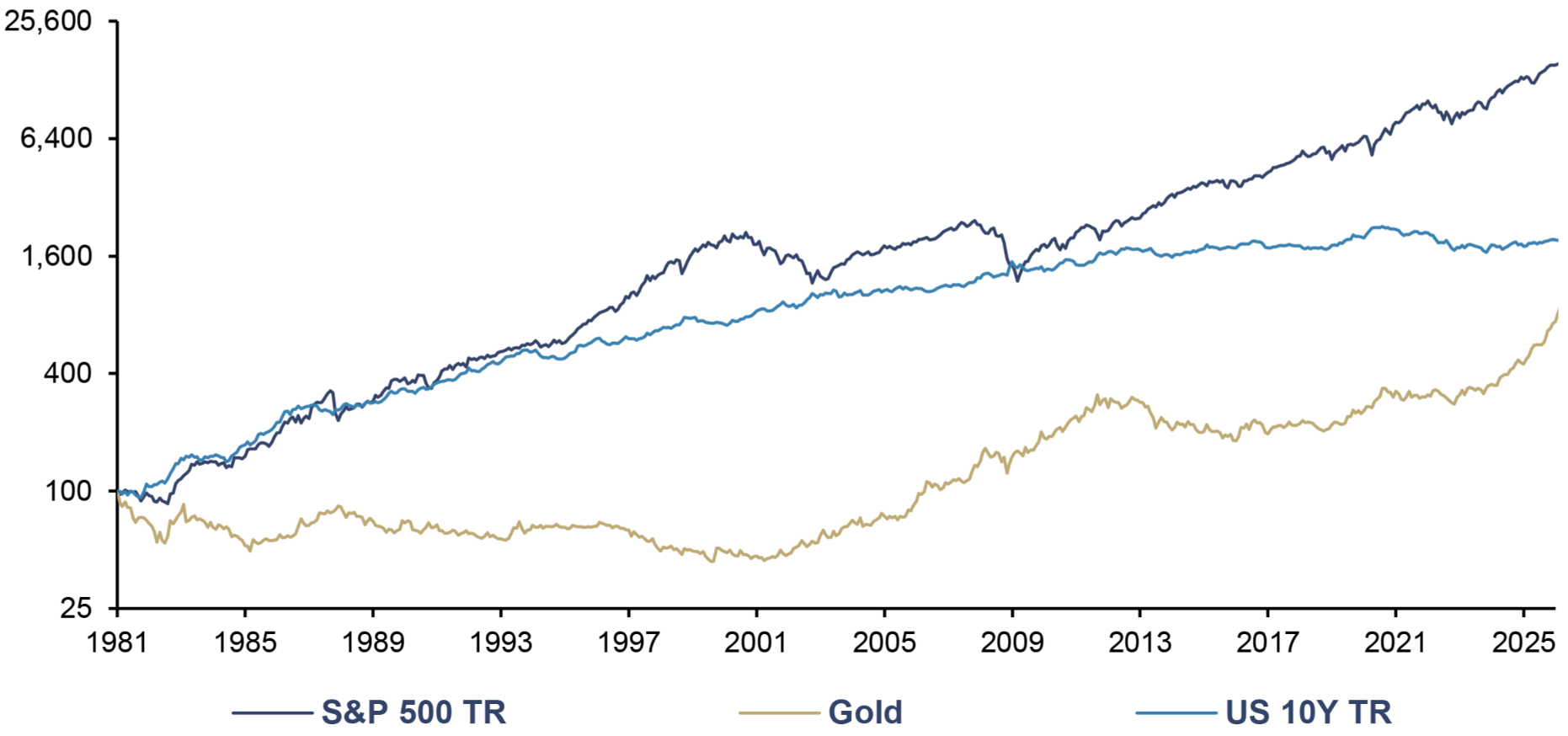
Gold has repeatedly proved to be an excellent asset for both creating and preserving wealth. The yellow metal has generated substantial returns since the collapse of the Bretton Woods system in 1971, compounding at 9.4% per annum (CAGR) in USD terms through 2025. Gold tends to be weakly correlated with other major asset classes, which makes it an effective portfolio diversifier. It carries no counterparty risk, no currency risk, and is geopolitically neutral. It is also a store of wealth recognized across countries and civilizations over millennia. With an analogy that any football (i.e., soccer) enthusiast would appreciate, especially the ones with a bit of gray hair such as the author, the In Gold We Trust report 2025 labeled gold as the Ronald Koeman of financial assets: excellent in defense and formidable in attack.
S&P 500 TR, Gold and US 10Y TR (log), in USD, 100 = 12/31/1980, 01/1981–12/2025
Source: LSEG, Incrementum AG
Despite these well-documented properties, gold continues to be burdened by a remarkably stubborn set of objections. One of the most common is that gold is unproductive because it does not pay interest or generate cash flows, an argument that implicitly treats income generation as the only defining criterion of investment quality. Gold has often been portrayed as excessively volatile or speculative, despite its historically moderate volatility and its tendency to perform well during periods of stress. A third objection depicts gold as relevant only in times of crisis, implying that it has little role to play in normal economic conditions and therefore does not deserve a structural allocation. Finally, gold is often described as irrelevant in modern financial systems, a so-called “barbarous relic” in a world of fiat currencies and sophisticated monetary policy.
The persistence of these arguments to date is somewhat baffling. The chapter “The most common arguments, myths, and points of criticism about gold” of the In Gold We Trust report 2009 systematically addressed what it identified as the most common myths and points of criticism about gold. Drawing on empirical evidence and historical analysis, this third edition of the In Gold We Trust report showed that gold’s lack of yield does not preclude it from preserving purchasing power, that its volatility is often overstated, that its relevance extends well beyond crisis periods, and that it continues to play a unique role as an asset without counterparty risk. The fact that these same objections continue to shape portfolio decisions more than a decade later suggests that gold’s marginalization cannot be explained simply by a lack of data or analytical misinterpretation.
Given the substantial empirical support, it appears puzzling that gold has been systematically overlooked by portfolio managers. In its 2022 report “The Use of Gold in Institutional Portfolios”, the World Gold Council documented that gold allocations among institutional investors typically remained modest, if any at all. Four years later, there is little evidence of a structural shift. The “UBS Global Family Office Report 2025” found that gold, and precious metals in general, remain a negligible portfolio allocation (2% on average). Likewise, according to J.P. Morgan’s “2026 Global Family Office Report”, 72% of global family offices report no gold exposure at all.
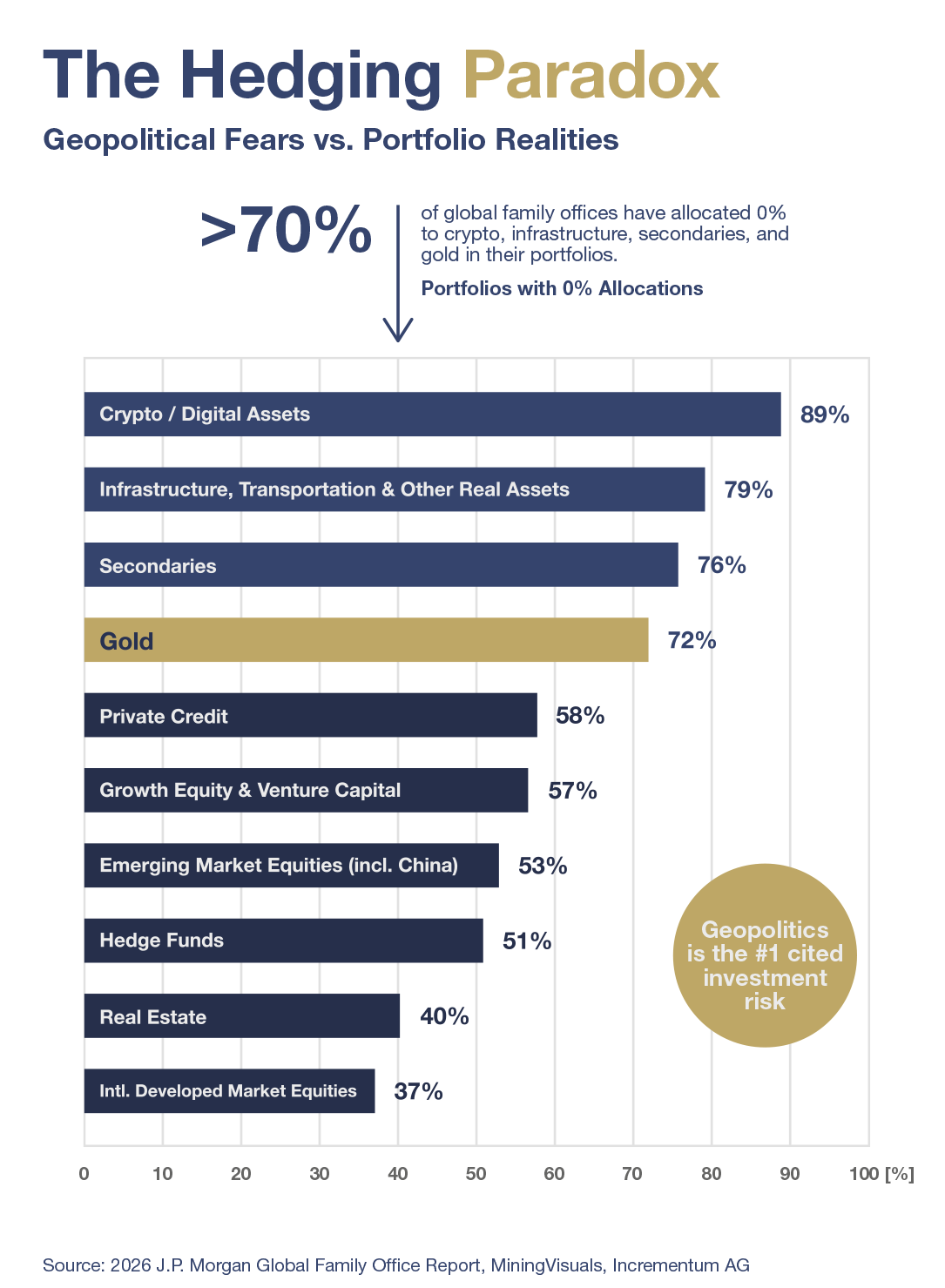
This gold paradox appears even more striking when viewed against the current geopolitical and monetary backdrop. Heightened tensions between the United States and Russia and between the United States and China, as well as the armed conflicts in Ukraine and the Middle East, rising fiscal dominance, and vehement political demands for interest rate cuts should, in principle, support stronger capital inflows into gold and other precious metals. To paraphrase Grant Williams, despite gold’s qualities and a seemingly ideal macroeconomic, fiscal, and geopolitical environment, hardly anybody cares.
We do not aim to add new empirical evidence to strengthen the case for gold. The current empirical evidence is already sufficient to make a compelling case for the yellow metal. Rather, we want to explore those psychological mechanisms that may contribute to explaining why most investors have not paid much attention to gold (yet). In particular, it examines the cognitive shortcuts and biases that may contribute to explaining why investors have favored bonds over gold as the defensive component of their portfolios over the last four or five decades.
Human Decision-Making and Bounded Rationality
Before delving into the gold vs. bonds fight for a place in investors’ portfolios, a brief academic detour is necessary. Understanding how real-world decisions are made under uncertainty requires stepping back from financial markets and considering more general features of human cognition. Insights from the broader study of human decision-making will later prove essential for interpreting the persistence of bond-centric portfolios and the marginalization of gold.
Human decision-making is one of the broadest and most studied topics in the social sciences, spanning economics, psychology, neuroscience, and organizational theory. Over the past decades, insights from these disciplines have profoundly reshaped our understanding of how individuals and institutions make choices under uncertainty. Both expert decision-makers, such as portfolio managers, and nonexpert decision-makers, such as retail investors, operate under bounded rationality, a concept introduced by Herbert Simon, for which he was awarded the Nobel Prize in Economics in 1978.
All humans face fundamental limitations when making decisions, including limited information, time, and computational resources. Under bounded rationality, individuals rely on heuristics, that is, simplified rules of thumb, to navigate complex choices. Choosing a familiar brand at the supermarket rather than analyzing every available alternative is a typical example. Such behavior is not irrational per se. On the contrary, it often represents an efficient response to real-world constraints, trading off theoretical optimality for speed and reduced cognitive effort.
In Simon’s terminology, decision-makers tend to satisfice rather than optimize, meaning that they settle for solutions that are good enough to meet their objectives, rather than striving for theoretically optimal outcomes. Satisficing does not imply indifference to results. Rather, it reflects a pragmatic recognition that, in complex decision environments, the search for optimality may not be feasible or worth pursuing. Put bluntly, rather than recalculating optimal choices from scratch in every situation, individuals reuse patterns of behavior that have proven effective in similar contexts in the past. Crucially, in relatively stable environments, these heuristics often perform remarkably well and can even outperform complex optimization strategies that rely on questionable assumptions and precise parameter estimates, as the paper “Homo Heuristicus: Why Biased Minds Make Better Inferences” by Gerd Gigerenzer and Henry Brighton (2009) shows.
The cost of relying on heuristics, however, is that they can generate systematic biases. When the environment in which these rules were formed and employed changes substantially, heuristics that were once adaptive may persist beyond their useful life. Crucially, heuristics that consistently performed well tend to be ingrained in the decision-maker’s mind. After all, why worry? This latest bad outcome is just a blip, soon things will return to normal, right?
Thus, biases do not necessarily occur because individuals reason poorly or lack sophistication. Instead, they stem from the inherently backward-looking nature of heuristics (and of the human mind), both shaped by past experience. As a result, decision-makers may exhibit systematic and persistent misjudgments precisely because they continue to rely on strategies that were successful in the past.
Portfolio allocation decisions represent a classic domain for the study of bounded rationality, the implementation of heuristics, and the occurrence of biases. Investment choices are made under high uncertainty, and consequences of portfolio choices often materialize only with significant delays. In such settings, continuous optimization is impractical, and investors tend to rely on standardized allocation frameworks and widely accepted rules of thumb.
The Traditional 60/40 Portfolio: A Successful Heuristic
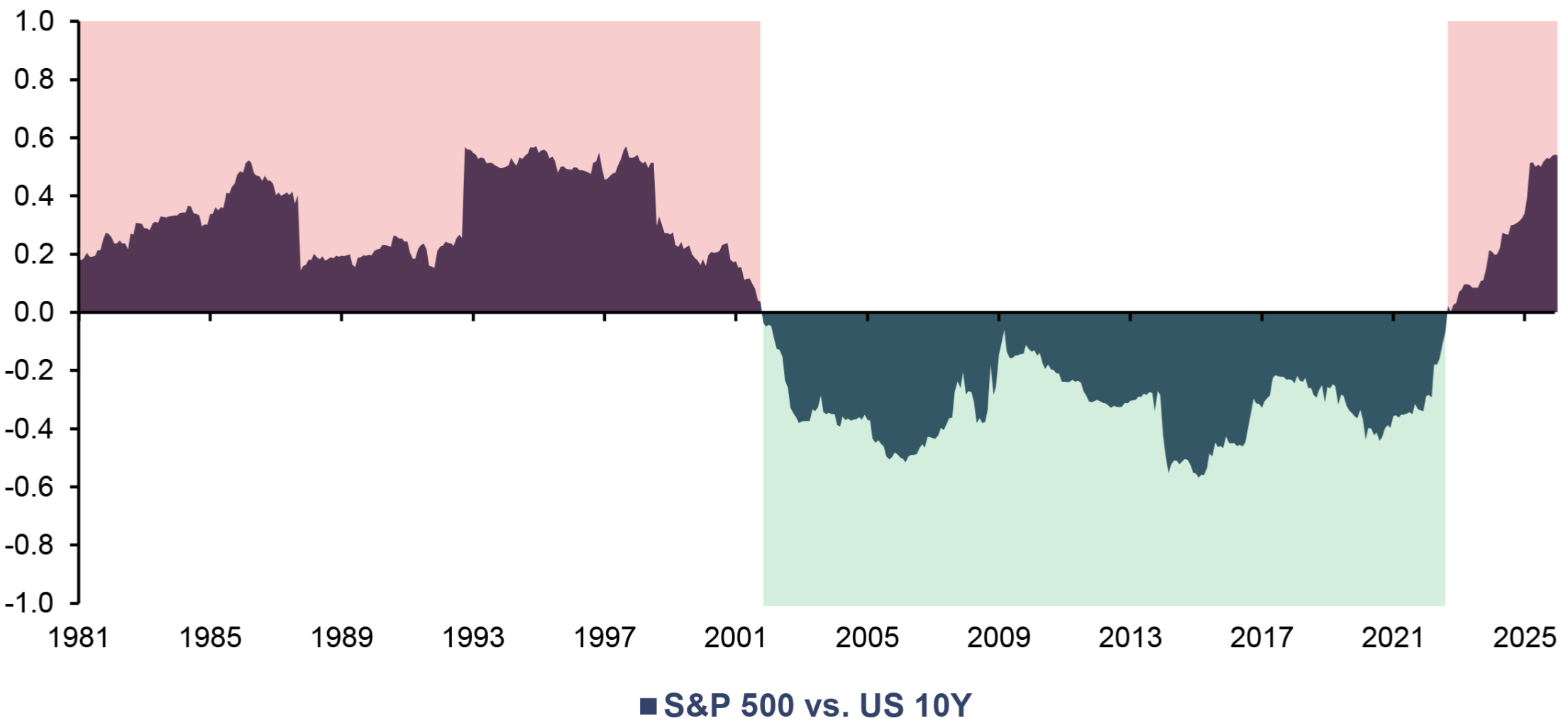
Through the lens of behavioral economics, the traditional 60/40 portfolio can be seen as one of the most influential heuristics in finance. By definition, heuristics are relatively simple, good-enough solutions to complex decision problems. From the early 1980s to around 2020, the 60/40 portfolio was not merely good enough; it was extraordinarily successful in delivering stable and attractive risk-adjusted returns. The negative correlation between stocks and bonds formed the foundation on which this heuristic rested. Even during adverse episodes such as equity bear markets, the bond component helped dampen portfolio volatility. In addition, regular portfolio rebalancing enforced a disciplined “buy low, sell high” mechanism.
This success was rooted in a historically specific macroeconomic and geopolitical regime. Following the high and volatile inflation of the 1970s, advanced economies entered a prolonged phase characterized by disinflation and declining nominal and real interest rates. At the same time, the global geopolitical environment became unusually supportive of macroeconomic stability and confidence in the US-centric monetary and political order. The emergence of a largely unipolar world order following the collapse of the Soviet Union and the expansion of global trade reduced perceived geopolitical risk and reinforced confidence in the existing monetary regime. This historically unique set of circumstances, often summarized under the label of the Great Moderation, provided an unusually stable backdrop for financial decision-making.
These macroeconomic and geopolitical developments were accompanied by profound changes in official reserve management. As confidence in the post-Cold War monetary order increased, many Western central banks reduced their gold holdings, increasingly viewing bullion as a legacy asset ill-suited to a world of low inflation and stable fiat currencies. At the same time, foreign-exchange reserves were progressively reallocated toward US Treasury securities, which came to be regarded as the de facto global safe haven. Liquid and backed by the world’s dominant economic and military power, US Treasuries appeared to offer superior safety and convenience relative to gold. Against this backdrop, allocating roughly 40% of a portfolio to bonds and little or no gold was a reasonable response to prevailing conditions.
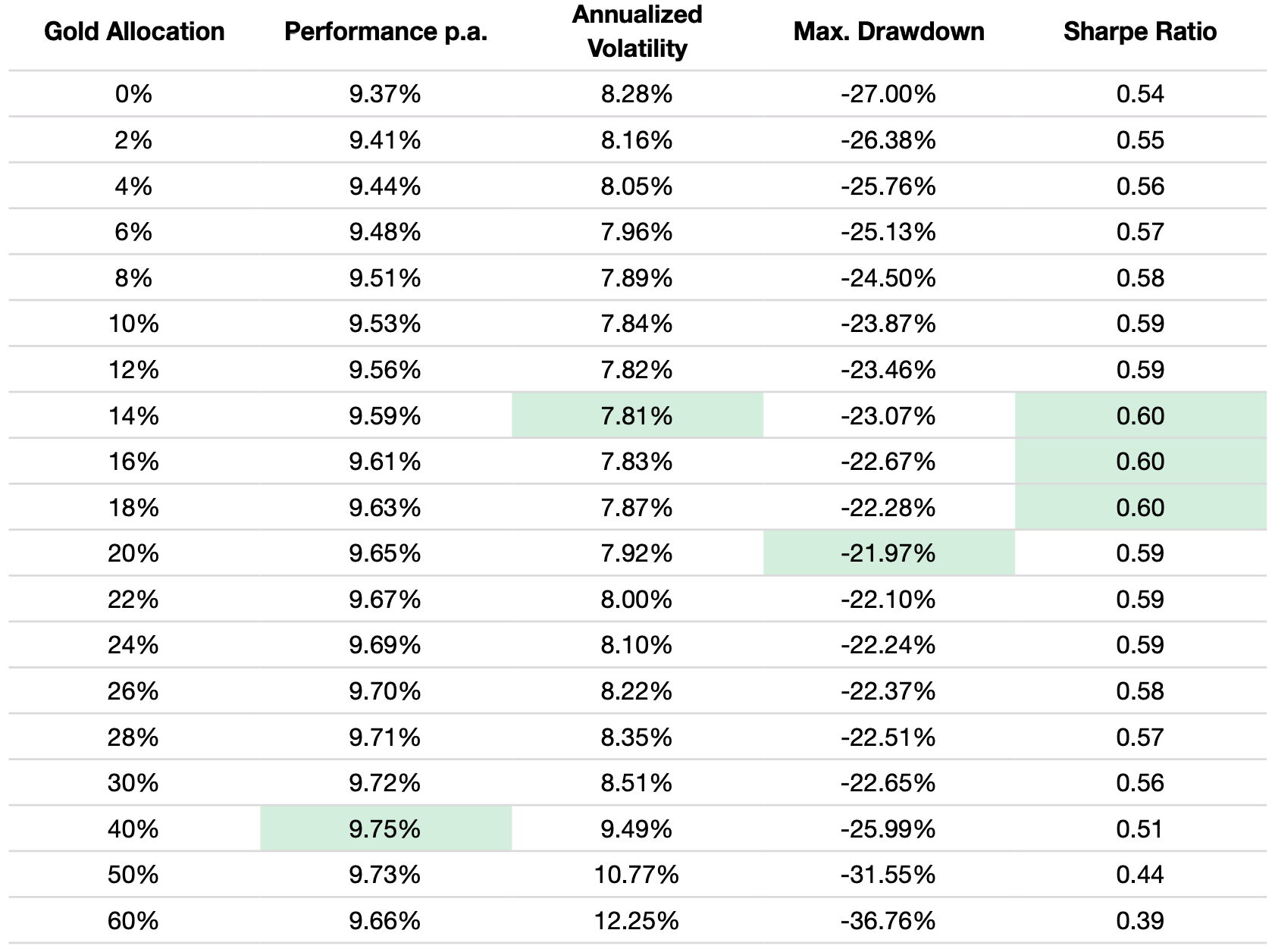
Empirical evidence is broadly consistent with this interpretation. Our analyses presented in the chapter “Mastering the New Gold Playbook” in the In Gold We Trust report 2024, The New Gold Playbook, suggest that an allocation of approximately 14–18% to gold would have reduced portfolio volatility over the 1970–2024 period. Nevertheless, portfolios with negligible gold exposure still delivered acceptable, and in many cases strong, risk-adjusted performance during much of the bond bull market. The opportunity cost of excluding gold was therefore often modest, while the perceived benefits of holding bonds were tangible and immediate, e.g., diversification and yearly dividends.
Optimal Gold Allocation in a Stock/Bond Portfolio*, 1970–2024
Source: Robert J. Shiller, LSEG, Incrementum AG
*S&P 500 TR and US 10Y TR
Thus, investors did not “make a mistake” by preferring bonds over gold; they adopted a heuristic well suited to a specific and unusually persistent macroeconomic environment. The 60/40 portfolio represented a satisficing solution to the complex problem of longterm asset allocation under uncertainty. Its widespread adoption was reinforced by decades of favorable outcomes, which entrenched it as a default framework for investors.
The very durability of this success, however, also sowed the seeds of potential fragility. A heuristic that performs well for several decades naturally comes to be treated not as a context-dependent rule, but as a quasi-universal principle of portfolio construction. As long as the underlying environment remained stable, this distinction mattered little. It would become increasingly consequential only once the conditions that supported bond-centric portfolios began to change.
The end of the old regime
The macroeconomic and geopolitical environment that underpinned the success of bond-centric portfolio heuristics did not unravel abruptly. The long period of stability associated with the Great Moderation began to show cracks during the 2008 Global Financial Crisis. What initially appeared to be an extreme but containable shock would, in retrospect, mark the beginning of a less stable monetary and financial order.
In the aftermath of the Global Financial Crisis, central banks responded with aggressive monetary easing and unconventional measures such as quantitative easing and negative real interest rates. These interventions restored confidence and prevented systemic collapse. For investors, crucially, the crisis largely validated the role of bonds as the primary defensive asset: bonds performed strongly, equity-bond correlations remained low, and the 60/40 portfolio again demonstrated resilience. Rather than prompting a reassessment, the episode reinforced confidence in the prevailing heuristic.
Rolling 5-Year Correlation of S&P 500 vs. US 10Y, 01/1981–12/2025
Source: LSEG, Incrementum AG
At the same time, the policy response gradually altered the system. Persistently low interest rates, expanding central-bank balance sheets, and rising public debt reduced expected bond returns and increased vulnerability to future inflation or rate increases. Allocating heavily to government bonds at historically low yields implied limited upside and growing asymmetric risk, even if this was not yet fully appreciated.
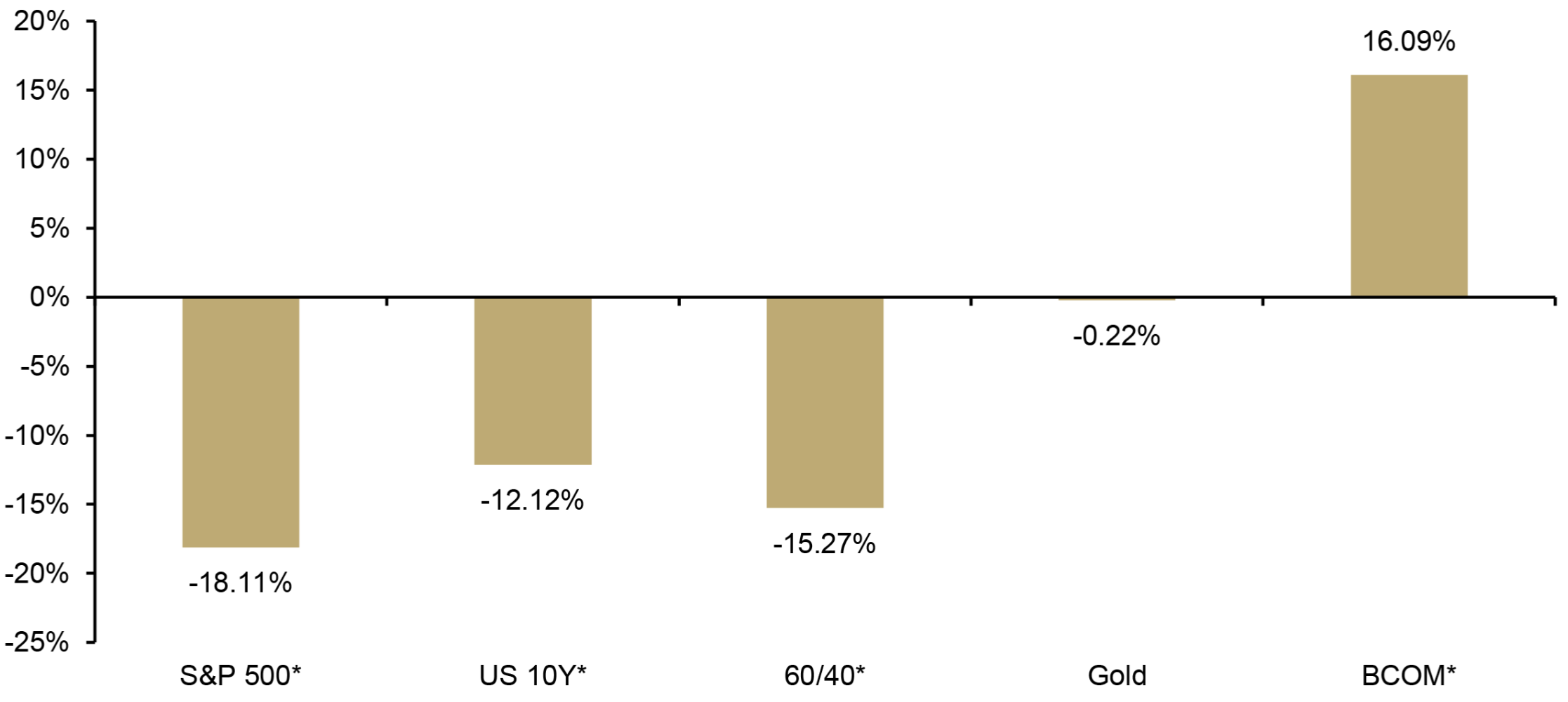
The decisive break occurred after the Covid shock. Massive fiscal interventions, the return of inflation as a central macroeconomic concern, and the most rapid interest-rate increases in decades culminated in 2022, when bonds and stocks fell together, exposing the fragility of the traditional diversification assumption.
Annual Performance, S&P 500*, US 10Y*, 60/40 Portfolio*, Gold, and BCOM*, in USD, 2022
Source: LSEG, Incrementum AG
*Total Return
The geopolitical environment deteriorated in parallel. The Russian invasion of Ukraine in 2022 and the freezing of foreign-exchange reserves underscored the political dimension of sovereign assets. In this context, gold’s lack of counterparty risk and independence from any single issuer regained strategic relevance. After decades of net sales, central banks have become net buyers of gold, particularly among countries seeking to reduce USD exposure.
Emerging markets’ attitude towards gold
This shift in official reserve management reveals a deeper divergence in how gold is cognitively framed across different monetary cultures.
The renewed accumulation of gold by central banks in recent years highlights a structural divergence. While Western portfolio construction has progressively marginalized gold over the past four decades, i n many emerging markets gold has retained a more central monetary role. In contrast to developed markets, episodes of currency instability, e.g., hyperinflation, and financial repression have been more frequent and more recent in emerging markets. In such environments, the assumption that sovereign debt instruments or foreign-currency reserves are immune from political risk has never been as deeply embedded in investor expectations. Gold has therefore retained its role as a strategic asset.
This divergence is visible in official sector data. As discussed in the chapter “The Status Quo of Gold Demand” in the In Gold We Trust report 2024, The New Gold Playbook, the increase in central-bank gold holdings has been driven almost entirely by emerging markets. Concerns about systemic financial risk and sanctions are cited as key motivations for holding gold, as we discussed in the chapter “Status Quo of Gold Demand and Gold Supply” in the In Gold We Trust report 2025, The Big Long. These motivations are largely absent among developed-market peers. From West to East, gold is thus embedded in different narratives.
The In Gold We Trust report 2024 described this shift as the emergence of a New Gold Playbook, arguing that structural changes in the monetary order require rethinking traditional allocation frameworks. In that framework, official-sector demand and reserve reallocation play a central role in gold’s price dynamics. To date, these forces are disproportionately concentrated in emerging markets, reinforcing their growing influence on marginal price formation.
At the household level, the contrast is similarly pronounced. Physical gold demand is heavily concentrated in Asia and the Middle East, where jewelry and bullion function not only as consumption goods but as savings vehicles and intergenerational stores of value. In Western markets, by contrast, gold exposure is predominantly financialized through ETFs and typically remains tactical rather than strategic.[1]
These differences do not reflect superior or inferior rationality. They illustrate how individual and collective behavior is shaped by historical and geographical experience. Heuristics emerge from repeated interaction with a particular environment. In the West, decades of disinflation, institutional stability, and strong bond performance trained investors to equate safety with sovereign debt. In many emerging markets, repeated exposure to currency volatility and geopolitical risk reinforced the intuition that tangible, non-debt assets deserve a structural role in wealth preservation.
The West-East contrast is therefore instructive. If gold remains embedded in the monetary imagination of many emerging markets, the persistence of its marginalization in Western portfolios cannot be explained solely by objective asset characteristics. It must also be understood as a consequence of historically reinforced investment heuristics. This brings us back to the central behavioral question: Why do such heuristics persist even after the regime that gave rise to them has changed?
Why Outdated Portfolio Heuristics Persist
Despite mounting evidence of macroeconomic, fiscal, and geopolitical change, Western portfolios have been slow to adapt. The persistence of traditional portfolio allocation frameworks in a markedly different environment raises a central question for this chapter: Why do portfolio choices continue to reflect the assumptions of a bygone regime?
Investors’ psychological aversion to gold was analyzed in the In Gold We Trust Report 2012, in the chapter “Why is gold such a highly emotional topic?”. Cognitive dissonance and normalcy bias play a central role in shaping investor attitudes toward gold. Cognitive dissonance arises when new information conflicts with established beliefs or past decisions. It is an unpleasant psychological state, and the mind naturally seeks to resolve such conflicts. Crucially, the “mandate” of the mind is not to model reality objectively, but to build and maintain a coherent narrative that protects the self. As a result, the least painful way to resolve cognitive dissonance is often to ignore new information or to force it into existing mental maps.
Normalcy bias, the tendency to underestimate the probability and impact of risks that have not materialized for extended periods, offers a clear illustration of this mechanism. After several decades characterized by low inflation, declining interest rates, stable geopolitics, and reliable stock-bond diversification, many investors came to treat these conditions not as historically contingent outcomes but as the most likely future state of the world. Risks such as a resurgence of inflation, a breakdown in stock-bond correlations, fiscal dominance, or the geopolitical use of financial sanctions were therefore implicitly assigned very low probabilities. Rather than being priced as structural possibilities, they were, and in many cases still are, dismissed as remote or implausible scenarios. Interpreting deviations from familiar conditions as temporary disturbances rather than structural changes is often the path of least psychological resistance.
System 1 and System 2
Building on Simon’s notion of bounded rationality, another Nobel Prize winner in Economics, Daniel Kahneman, argues that human decision-making is governed by the interaction between two cognitive systems. System 1 is fast, intuitive, and associative; it relies on heuristics, narratives, and familiar labels to navigate complexity. By contrast, System 2 is slower, effortful, deliberate, and analytical, and is capable, at least in principle, of questioning intuitive judgments through careful reasoning and evidence. In practice, however, rather than consistently overriding intuitive beliefs, System 2 often serves to rationalize conclusions already reached through System 1, particularly in complex and uncertain environments such as financial markets.
This framework provides a powerful explanation for the persistence of established investment heuristics. Cognitive limitations, i.e. Simon’s bounded rationality, shape the tendency to resolve dissonance by defending existing beliefs, while the dominance of System 1 over System 2 reinforces familiar narratives and decision rules. The key point is that, contrary to common expectations, not only intuitive but also analytic forms of thinking can be biased against information that contradicts familiar and reassuring beliefs. Investment behavior is no exception to this general pattern.
For investors who relied for decades on the 60/40 portfolio and neglected gold, acknowledging gold’s renewed relevance would imply admitting that prior convictions may no longer hold. Such admissions are psychologically costly, particularly when they threaten an investor’s self-image as rational and competent. Gold has more than doubled in price over the past couple of years, a move that many portfolio managers largely missed. At the same time, bonds have suffered a bear market from which they have never fully recovered. This experience may foster regret and discomfort, which System 1 seeks to neutralize by defending familiar and reassuring narratives.
Recent narratives upholding bonds
One such narrative is the idea that bonds returned to being a reliable portfolio diversifier in 2024–2025. After the historic drawdown of 2022, fixed income began delivering positive returns again as nominal yields reset higher. For many investors, this was sufficient evidence that the traditional 60/40 portfolio was still working properly.
It is precisely here that the psychological mechanisms described above become visible. By its very nature, System 1 seeks evidence that corroborates long-standing and reassuring visions of the world. After a painful 2022, bonds finally delivered positive returns in 2023 and 2025. The intuitive conclusion follows: The anomaly has passed; the old heuristic still works.
This is a textbook example of how normalcy bias resolves cognitive dissonance by selectively overweighting the evidence upholding a narrative that provides psychological closure. At the same time, the available evidence that may poke some holes in the beloved narrative is systematically downplayed. In this context, normalcy bias reduces, or even nullifies, the need to revisit uncomfortable structural questions.
From a purely arithmetic perspective, the “bonds are back” argument is not without merit. After more than a decade of a near-zero-yield environment, higher yields once again contribute meaningfully to total return. Yet, the improvement has been driven primarily by carry rather than by the structural forces that sustained bond performance for four decades. During the Great Moderation, the 60/40 portfolio was powered not only by income but by a persistent decline in long-term yields and a reliably negative stockbond correlation.
Today’s environment is qualitatively different. Capital appreciation in long-duration bonds remains limited, and the long end of the curve has stayed elevated and somewhat volatile. System 1 may focus on the opportunity to lock in bigger coupons for a decade or more. But at the same time, it may downplay, or utterly forget, that this state of affairs signals market concerns about stubbornly above-target inflation, fiscal dominance, and the durability of the USD’s safe-haven status.
A parallel narrative unfolded in the gold market. Gold’s advance through 2024 and 2025 was extraordinary. The yellow metal’s price increased by 65% in 2025 and, at its peak in January 2026, surged beyond USD 5,500 per ounce. The magnitude of the move challenged the long-standing marginalization of gold within many Western portfolios. Yet, the rally was followed by some volatility. In early 2026, the nomination of Kevin Warsh as Federal Reserve chair and a subsequent increase in margin requirements by the CME triggered a rapid correction. The move was abrupt, widely reported in the media, and psychologically salient.
Here again, System 1 framed this episode around previous long-standing convictions. The correction was seen not as normal volatility within a broader bull market but as confirmation that gold is inherently speculative and unsuitable as a core allocation. The prior gains were reclassified as excess, and the drawdown was treated as proof that the bull market might be over. For portfolio managers who had underweighted gold during its ascent, the episode offered convenient reassurance. The asymmetry in perception is striking, yet consistent with the insights provided by behavioral economics. Volatility in bonds is typically interpreted as temporary noise within a fundamentally stable asset class. Conversely, volatility in gold is often treated as evidence of intrinsic instability. Short-term price movements are thus granted very different interpretative weights depending on the asset.
From a structural standpoint, however, the forces underpinning gold’s rise did not disappear with a margin-induced correction. Elevated fiscal deficits, inflation uncertainty, geopolitical fragmentation, and concerns about currency weaponization remained intact. Yet System 1, seeking to resolve cognitive dissonance in the least painful way possible, seized on short-term gold volatility as validation of preexisting heuristics.
Institutional forces upholding bonds
The psychological mechanisms discussed above do not remain confined to the private decision-making process of retail investors. Cognitive dissonance, normalcy bias, and the reliance on familiar heuristics affect professional decision-makers just as much as individual savers. The crucial difference lies not in the presence of bias but in how it interacts with institutional structures.
For retail investors, these mechanisms operate most visibly through recency bias and attention-driven allocation. A substantial body of empirical research shows that retail flows tend to follow recent performance, e.g. the paper “All That Glitters: The Effect of Attention and News on the Buying Behavior of Individual and Institutional Investors”, by Brad M. Barber and Terrance Odean. Assets that have delivered strong returns in the recent past attract disproportionate inflows, while laggards are neglected. This dynamic is amplified by media coverage and social reinforcement. What dominates headlines and social feeds often dominates marginal capital allocation. Over the past decade, this pattern has repeatedly favored technology equities, thematic ETFs, and cryptocurrencies, which are assets that combine strong momentum with compelling narratives.
Gold, by contrast, rarely benefits from such “shiny object” dynamics. It lacks technological novelty or transformative innovation narratives. Its strongest relative performance typically occurs during episodes of macroeconomic stress or systemic anxiety, precisely when investors hope that instability is temporary rather than structural. As a result, gold often fails to capture retail enthusiasm during long equity bull markets; and when it rallies sharply, it is frequently dismissed as a temporary hedge rather than embraced as a structural allocation.
In professional investment environments, the same cognitive tendencies are present but operate differently. Institutional investors are not immune to recency bias or narrative reinforcement. They too formed their allocation frameworks during decades in which bonds reliably cushioned equity drawdowns and delivered steady returns. However, in institutional settings, cognitive biases are translated into collective behavior through benchmarking, peer comparison, and formal performance evaluation.
Within this framework, the efficient-market hypothesis (EMH) plays an important legitimizing role. By emphasizing the difficulty of systematically outperforming the market, EMH reduces the perceived benefit of deviating materially from prevailing consensus allocations. When performance is assessed relative to benchmarks and peers, this logic naturally fosters behavioral inertia and a degree of herd behavior. Under such conditions, remaining close to conventional bond-heavy portfolio structures can represent a rational strategy for portfolio managers, even when those allocations are no longer well aligned with underlying macroeconomic fundamentals.
Career and reputational risk further entrench this inertia. A portfolio manager who maintains a high allocation to bonds and delivers disappointing returns in line with the benchmark can plausibly attribute the outcome to broadly adverse market conditions. Alongside protecting one’s self-esteem, conformity offers a form of professional insurance: “I failed alongside most of my peers, so I didn’t do anything wrong”. Conversely, taking a contrarian albeit evidence-based stance, such as reallocating meaningfully toward gold or other commodities at the expense of bonds, exposes portfolio managers to disproportionate risk in the event of failure. Deviations from orthodoxy tend to be punished asymmetrically. If institutional incentives reward conformism, accepting a broadly shared real or relative loss is often preferable, as the risk of being wrong alone outweighs the potential reward of being right.
Retail and institutional investors therefore arrive at similar outcomes through distinct but related mechanisms. Retail investors are pulled by recency bias and attracted to assets that shine brightest in prevailing narratives. Institutional investors are constrained by benchmarking, model frameworks, and career risk that reward adherence to established structures. In both cases, gold remains structurally underrepresented, not necessarily because it lacks merit, but because it does not align naturally with the psychological and institutional forces that govern capital allocation.
How Heuristics Change
As seen, the vast majority of investors have negligible, if any, amounts of gold in their portfolios. It is therefore reasonable to conclude that, despite gold’s qualities, old investment heuristics that relegate gold to irrelevance are still in place. How can new, more adaptive heuristics replace the old ones? By now, the reader should be clear that empirical evidence alone does not win arguments. So, how can those individual and collective psychological forces that defend old beliefs be overcome? Gerd Gigerenzer’s ecological rationality framework provides a possible answer.
In his research paper “Why Heuristics Work”, Gigerenzer has documented how simple heuristics can match or even outperform complex predictive models due to their ability to exploit the regularities of the environment. However, the exceptionally long regularities that characterized the Great Moderation and that made the 60/40 portfolio arguably the most successful heuristic in the history of behavioral finance have been compromised. Bonds appear to have lost part of their ability to cushion equity drawdowns and, more broadly, some of their former safe-haven status. This raises the question of whether investors will abandon, or at least amend, the 60/40 portfolio heuristic.
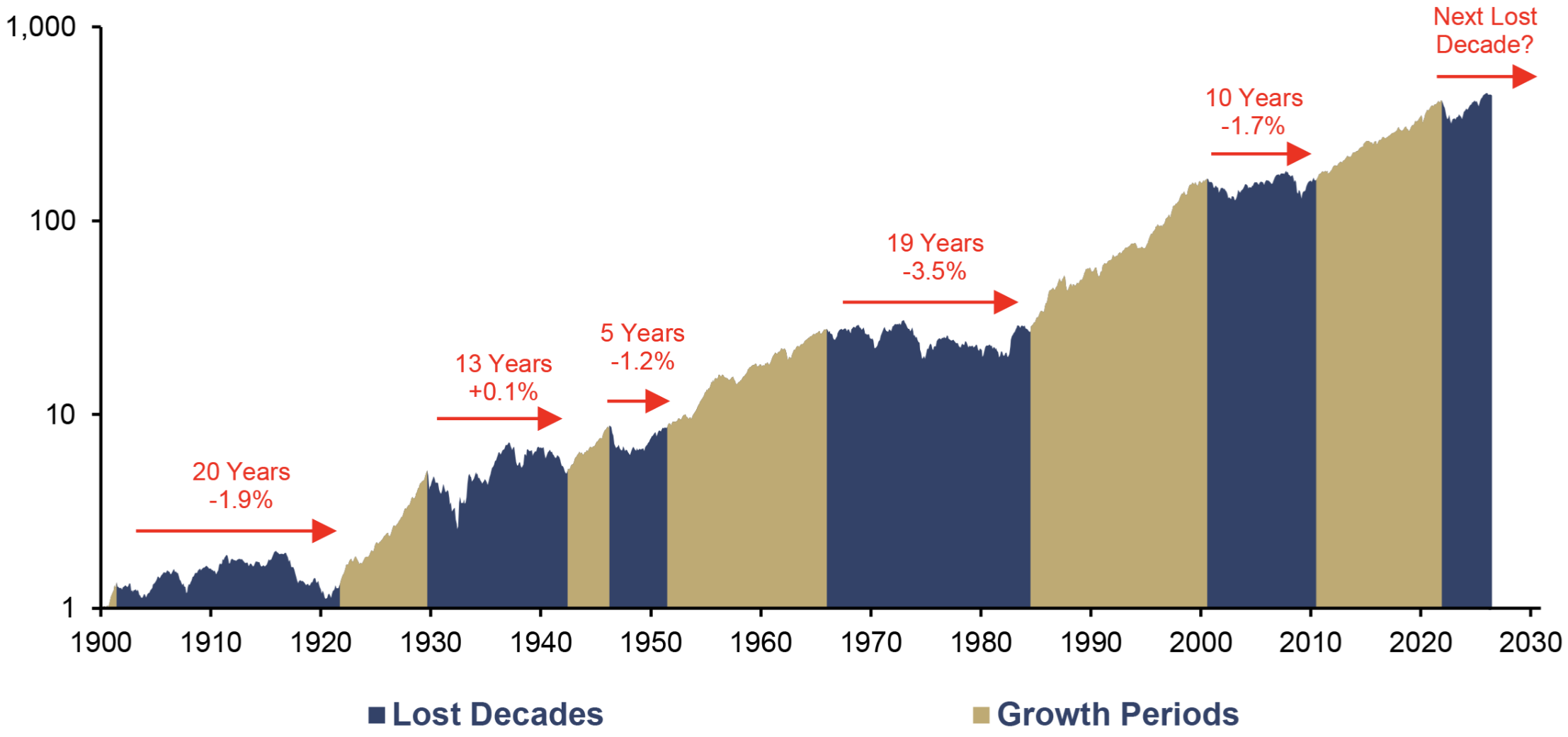
First of all, investors must experience that the 60/40 portfolio is no longer delivering acceptable outcomes. Heuristics are kept or dropped based on feedback. For the 60/40 investor, this feedback arrives when the portfolio repeatedly disappoints on the outcomes they care about: preserving real wealth, limiting deep drawdowns, providing stable retirement income, and similar objectives. This feedback needs to be consistent and repeated through time. Otherwise, it may be dismissed as temporary.
Inflation-adjusted Performance of a 60/40 Portfolio* (log), in USD, 1 = 01/1900, 01/1900–04/2026
Source: Robert J. Shiller, Incrementum AG,
*60% S&P 500 TR and 40% US 10Y TR
Second, for a heuristic to be revised, people must also be able to attribute bad outcomes to the heuristic rather than to fate. The recognition of a causal link is paramount, and narratives are likely to play a major role. This means that investors, advisers, and commentators must articulate a story that links the disappointment of traditional 60/40 portfolio returns to their structural dependence on nominal debt instruments in a world of financial repression, inflation risk, and geopolitical shocks. By contrast, if the dominant narrative frames poor results as random turbulence, the old heuristic remains protected. Once the environment is widely described as penalizing debt-based assets and favoring scarce real assets, the conceptual ground for reallocating toward gold and commodities is established.
Third, a heuristic becomes established and persists not only because it works but also because it is socially and professionally safe to use. Investors will feel able to dismantle the 60/40 portfolio only once large asset owners, consultants, regulators, and model-portfolio providers begin to legitimize portfolios with explicit hard-asset allocations as standard practice. This shift would be reflected in benchmark construction, strategic asset allocation frameworks, and the language of regulatory and consulting guidance. Once career risk shifts from “you deviated from the classic 60/40 mix” to “you ignored obvious real-asset hedges in an environment hostile to debt assets,” the selection pressure reverses. In that situation, a meaningful rotation of capital from bonds to gold and other hard assets no longer appears as a speculative deviation, but rather as a more ecologically rational heuristic for a changed world.
Finally, the prompt availability of alternative, more adaptive heuristics is also necessary. Decision-makers do not abandon one tool in isolation. Rather, they switch to another simple rule that fits the environment better, what Gigerenzer calls the “adaptive toolbox”. For investors, this implies that new heuristics must be simple enough to be communicated, understood, and adopted. The availability of alternative heuristics is also necessary to highlight performance differences between old and new investment rules. If portfolios that include a meaningful allocation to hard assets, such as gold and commodities, show visibly smaller drawdowns and better inflation protection, the performance gap begins to signal that the traditional 60/40 portfolio is no longer fit for purpose. Absent that contrast, the old heuristic can survive for a surprisingly long time, because investors can always attribute pain to unpredictably volatile markets or bad luck rather than to the allocation itself.
The new 60/40 portfolio
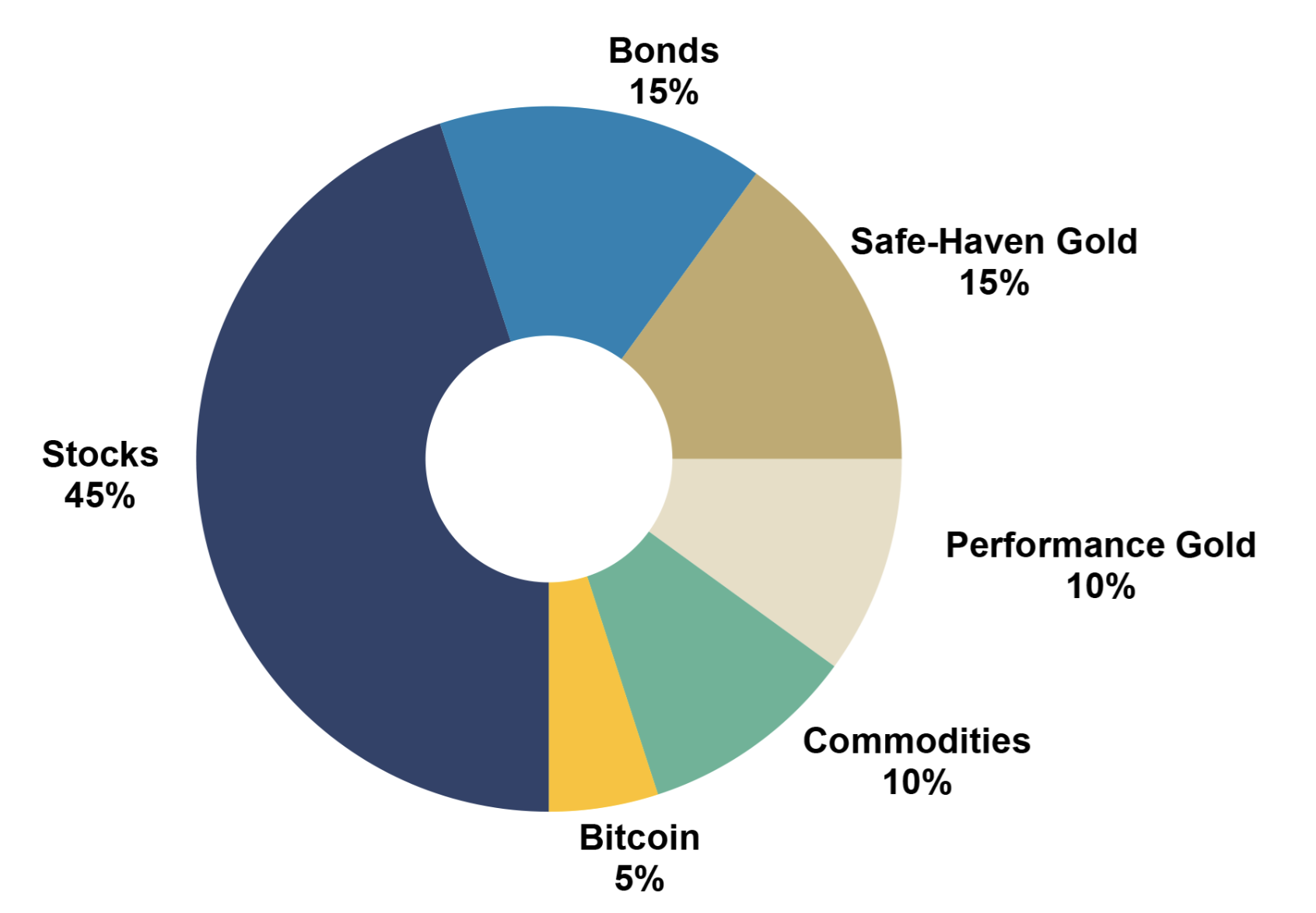
An example of such an adaptive heuristic is the new 60/40 portfolio introduced in the In Gold We Trust report 2024, The New Gold Playbook. Rather than abandoning the traditional framework, this approach explicitly seeks to adapt it to a changed macroeconomic and geopolitical environment. The growth and traditional asset allocation remains at 60%, composed of 45% equities and 15% bonds, while the remaining 40% is allocated to a diversified set of hard assets. This defensive sleeve includes 15% physical gold (= safe-haven gold), 10% performance gold (such as silver and mining equities), 10% commodities, and 5% Bitcoin.
The New 60/40 Portfolio: Subcategories
Source: In Gold We Trust
By embedding gold and other non-debt assets structurally within the defensive allocation, the revised 60/40 framework illustrates how portfolio heuristics can evolve once their underlying environment changes. The allocation represents a pragmatic response to a world in which effective diversification requires assets that respond differently to inflation, interest-rate dynamics, fiscal policy, and geopolitical shocks, rather than assets whose performance tends to deteriorate simultaneously under regime stress. In Gigerenzer’s terms, it constitutes a candidate heuristic within the adaptive toolbox: a simple, communicable rule designed to better fit the emerging environment.
Will New Heuristics Replace Old Ones?
While traditional portfolio heuristics such as the 60/40 portfolio have proven remarkably persistent, there are growing signs that the conditions required for their gradual replacement are beginning to emerge. No mass reallocation of capital toward gold or other hard assets has occurred so far. Yet, consistent with the behavioral and institutional mechanisms discussed above, early signals of heuristic adaptation are becoming increasingly visible.
Importantly, these signals are not confined to retail enthusiasm or isolated commentary. They are driven by institutional actors beginning to articulate alternative rules of thumb and to legitimize new portfolio narratives. Proposals that would once have been considered unconventional, if not implausible, such as meaningful allocations to real assets alongside equities and bonds, are now discussed more openly within mainstream investment discourse.
A prominent example is the 60/20/20 portfolio proposed by Morgan Stanley’s CIO Mike Wilson, which allocates 60% to equities, 20% to bonds, and 20% to gold. What only a few years ago would have been considered contrarian, or even outrageous, now reflects a broader reassessment of portfolio diversification. This is not an isolated case. Ray Dalio has repeatedly argued that investors should hold a significant amount of nondebt money in late-stage debt cycles, explicitly pointing to gold as a strategic hedge against monetary debasement. Similarly, Jeff Gundlach of DoubleLine Capital has advocated meaningful gold exposure as protection against fiscal instability, currency debasement, and rising sovereign risk. The relevance of such proposals lies in their narrative function: They represent an authoritative acknowledgment that relying predominantly on bonds for diversification has become insufficient in the current macroeconomic and geopolitical environment.
Consistent with this evolution in institutional positioning, investor behavior has also begun to adjust at the margin. After years of muted or negative flows, gold ETF inflows have turned positive since Q2/2024, indicating renewed engagement with gold as an asset class. Analysis by VanEck characterizes this development as part of a “new era of structural strength and enduring appeal” for gold, noting that Western investor participation has strengthened after a prolonged period of outflows. While still modest in absolute terms, these developments matter because they increase the visibility and legitimacy of alternative portfolio heuristics.
Despite these early signals, hesitation remains widespread. Although interest in gold has increased, average Western investor portfolios remain far from a structural allocation to the metal. Gold weights in the range of 15–20%, which, according to our historical analysis in the chapter “Mastering the New Gold Playbook” in the In Gold We Trust report 2024 “The New Gold Playbook”, could significantly improve portfolio robustness, remain the exception rather than the rule. In most cases, gold allocations are negligible.
A historical comparison is instructive. During the 1970s bull market, global investment demand for gold rose sharply. Although reliable data on average investor portfolio allocations are not available for the period, gold flow data provide a clear indication of investor appetite. Investment demand increased from roughly 372 metric tons in 1970 to approximately 911 metric tons by 1977, more than doubling over the decade. From 1973 onward, annual investment demand consistently remained in the 700–900-ton range, reflecting sustained and elevated investor participation. One must also not forget that in the US private gold ownership was only legalized on December 31, 1974. On that day the International Development Association Appropriations Act went into effect, repealing all restrictions on private gold ownership, which had been introduced by Executive Order 6102 on April 5, 1933. Today, despite record prices, there is little evidence of a comparable broad-based reallocation in Western portfolios. Investors may be rethinking gold at the margin, but most have not meaningfully increased their allocations.
From a behavioral perspective, this gradualism is neither surprising nor irrational. Portfolio heuristics that have delivered acceptable outcomes for decades are not abandoned lightly. As discussed earlier, adaptation typically does not occur in response to abstract arguments or isolated episodes of underperformance, but rather through sustained experience that repeatedly contradicts existing mental models. If an environment characterized by higher inflation volatility, fiscal dominance, declining trust in institutions and debt assets, and geopolitical fragmentation persists, bond-centric heuristics will start to crumble.
To date, the “gold paradox” remains a story of delayed adaptation. Investors, like decision-makers in other domains, have relied on mental maps that were well suited to a past regime and have been slow to revise them as conditions have changed. Yet structural, large-scale reallocations rarely begin with widespread consensus. Rather, they begin with institutional reframing. What is now unfolding is not a speculative surge, but a gradual, top-down re-legitimization of gold as a strategic component within portfolios, as illustrated by Morgan Stanley’s 60/20/20 portfolio. Gold is not a purely contrarian investment anymore, and the institutional rotation towards the yellow metal has just begun.
[1] See chapter “The Status Quo of Gold Demand and Gold Supply” in this In Gold We Trust report