

India – Structure, Dynamics and Future of the World’s Largest Gold Ecosystem
“Indian women didn‘t hoard gold. They quietly built the country‘s most consistent investment portfolio.”
Harsh Goenka
- India’s gold market is evolving from a cultural, jewelry-driven system into a hybrid ecosystem of consumption, investment, and financial products, gaining growing influence on global price dynamics.
- Household gold holdings stand at approximately 29,000–35,000 t, valued at over USD 4trn – exceeding 100% of GDP – yet remain largely illiquid and held for generational purposes.
- Long-term demand stays structurally robust (600– 1,000 t/year), driven by income growth, demographics, and culture; high prices shift purchases toward investment formats such as bars, coins, ETFs.
- Regulatory reforms such as mandatory HUID hallmarking, IIBX exchange, and EGRs are formalizing the market, narrowing spreads, reducing informality, and aligning India with global standards.
- Interview “Gold Is the New Gold” with Sachin Jain, Regional CEO India, World Gold Council
India’s gold market is undergoing a profound transformation. Once driven almost entirely by culture, i.e. weddings and informal retail networks, it is now shaped by a complex interplay of macroeconomic forces, demographic momentum, financialization, regulatory reform, and growing integration with global bullion flows. It therefore makes sense to take a closer look at the economic, cultural, and structural foundations of India’s demand for gold.
Long-Run Demand, Wealth Accumulation, and Structural Drivers
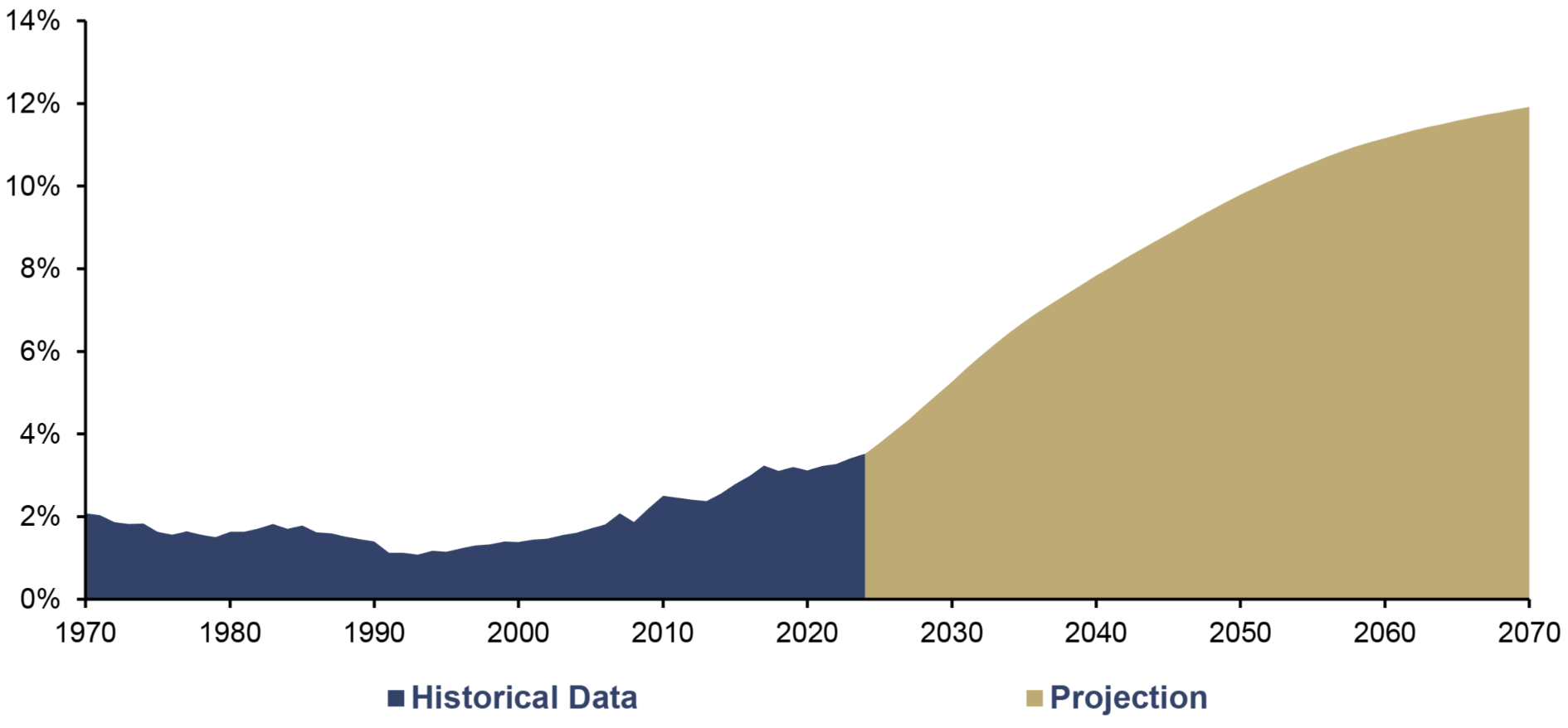
India’s importance to the global gold market has intensified over recent years as rising incomes, rapid economic expansion, and sustained population growth have collectively expanded the country’s base of potential gold buyers. Looking ahead, India’s growing share of global GDP, combined with one of the world’s youngest and fastes t-expanding populations, is set to further elevate total gold demand – reinforcing its role not only as the world’s largest consumer market but as a structural driver of global bullion dynamics.
Two decades of demand cycles and structural resilience
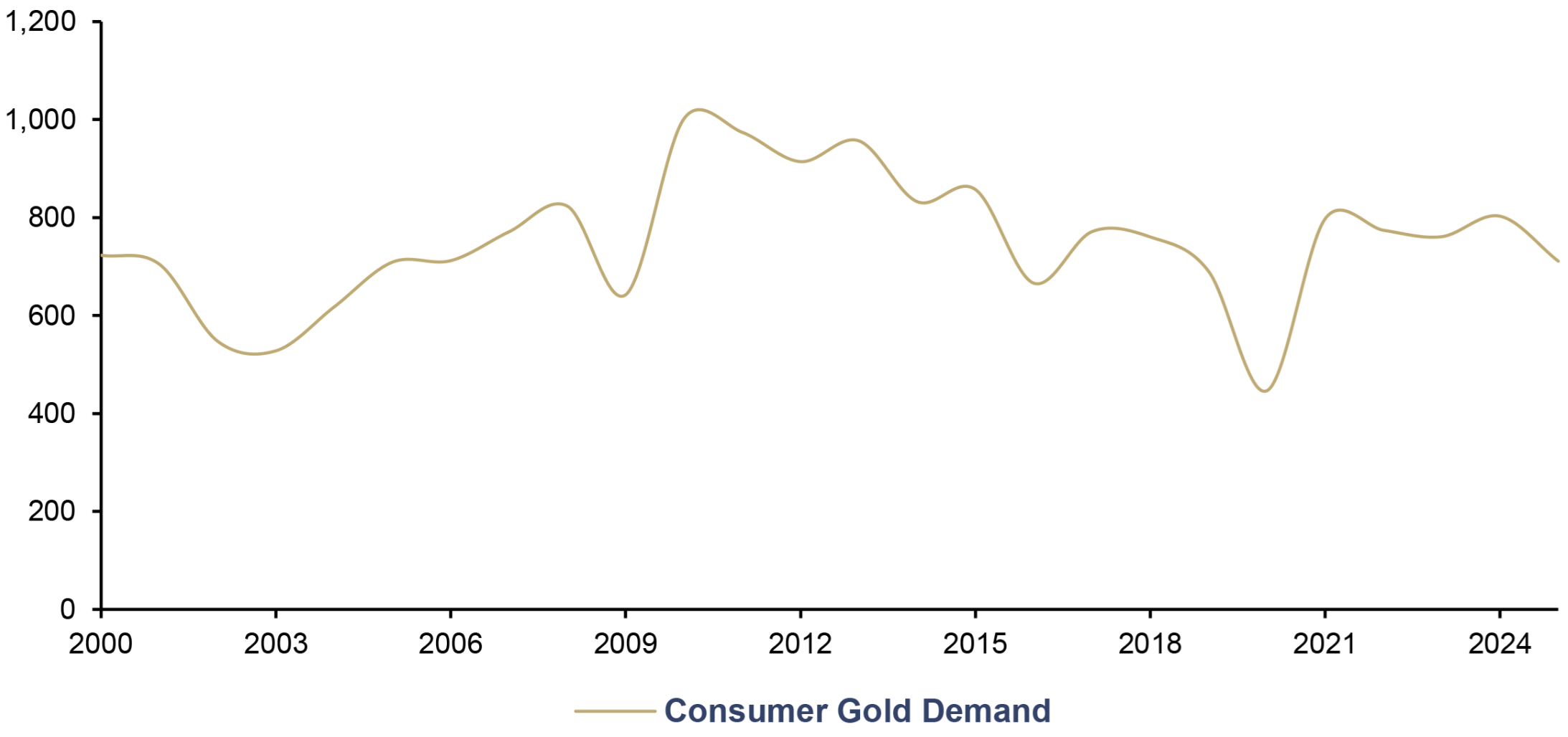
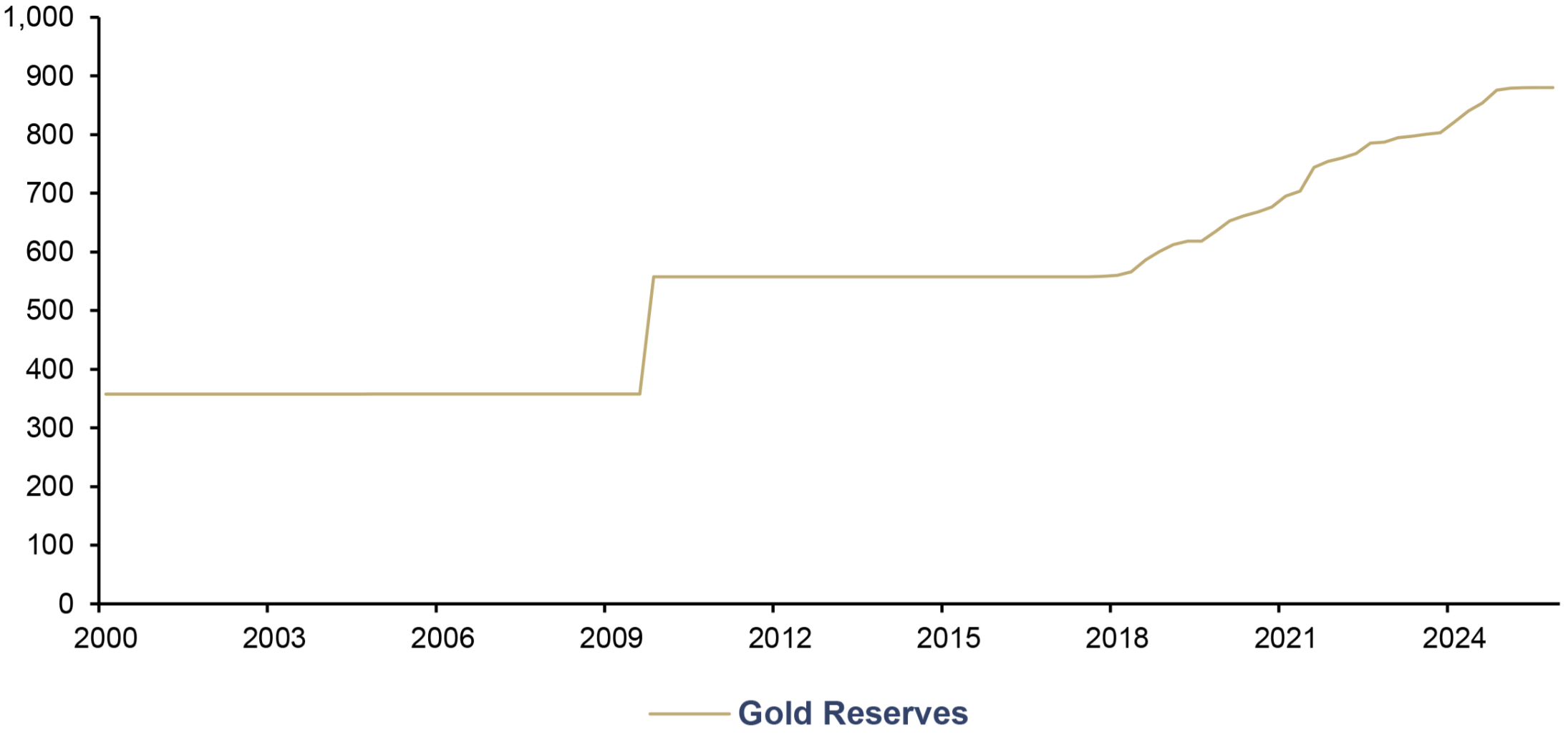
Over the past two decades, India’s consumer gold demand has cycled with macro and policy regimes but has remained structurally high, oscillating roughly between 600– 1,000 t per year, with a pandemic trough of 446 t in 2020 and a recovery to 711 t in 2025 as value terms hit a record on soaring prices. Parallel to this, aggregate domestic gold wealth has compounded dramatically: Recent sell‑side and industry tallies place Indian household holdings near 35,000 t. Official reserves have also been reshaped: The Reserve Bank of India’s (RBI) gold stock rose to 880.2 t at end‑2025 and the share stored domestically to more than 65.5%, reflecting a strategic repatriation and diversification that lifted gold’s share of FX reserves to about 17.2%.
Since the launch of the “Make in India” initiative in 2014, industrial policy has increasingly focused on expanding domestic manufacturing capacity through production-linked incentives, tax reforms, and infrastructure investment designed to attract foreign investment and deepen India’s industrial base. This transformation is visible in the rapid expansion of electronics manufacturing. India’s electronics and IT hardware production rose from roughly INR 221bn in the late 1990s to roughly INR 9.5trn (about USD 115bn) in 2024.
Indian GDP, as a Share of Global GDP, 1970–2070e
Source: OECD, World Bank, Incrementum AG
Household gold wealth
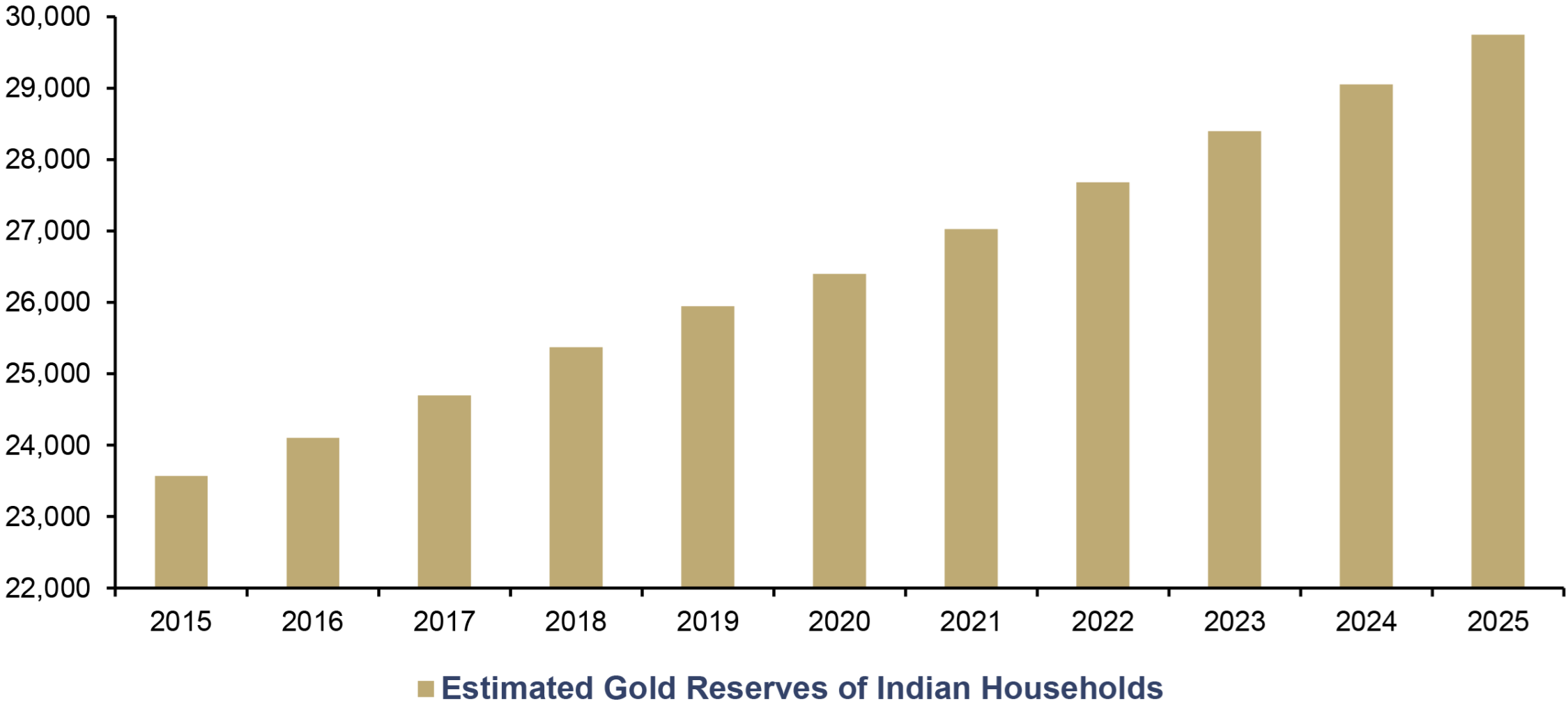
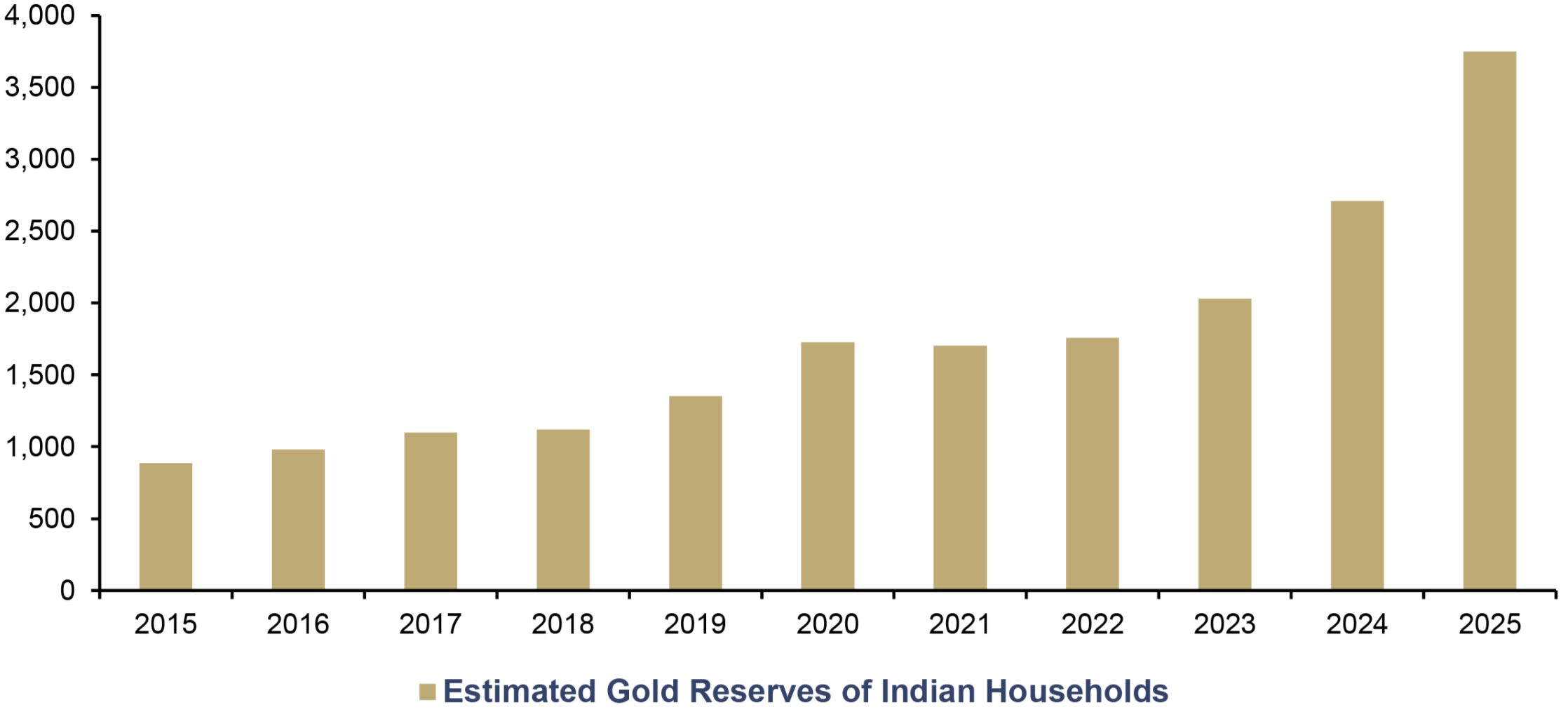
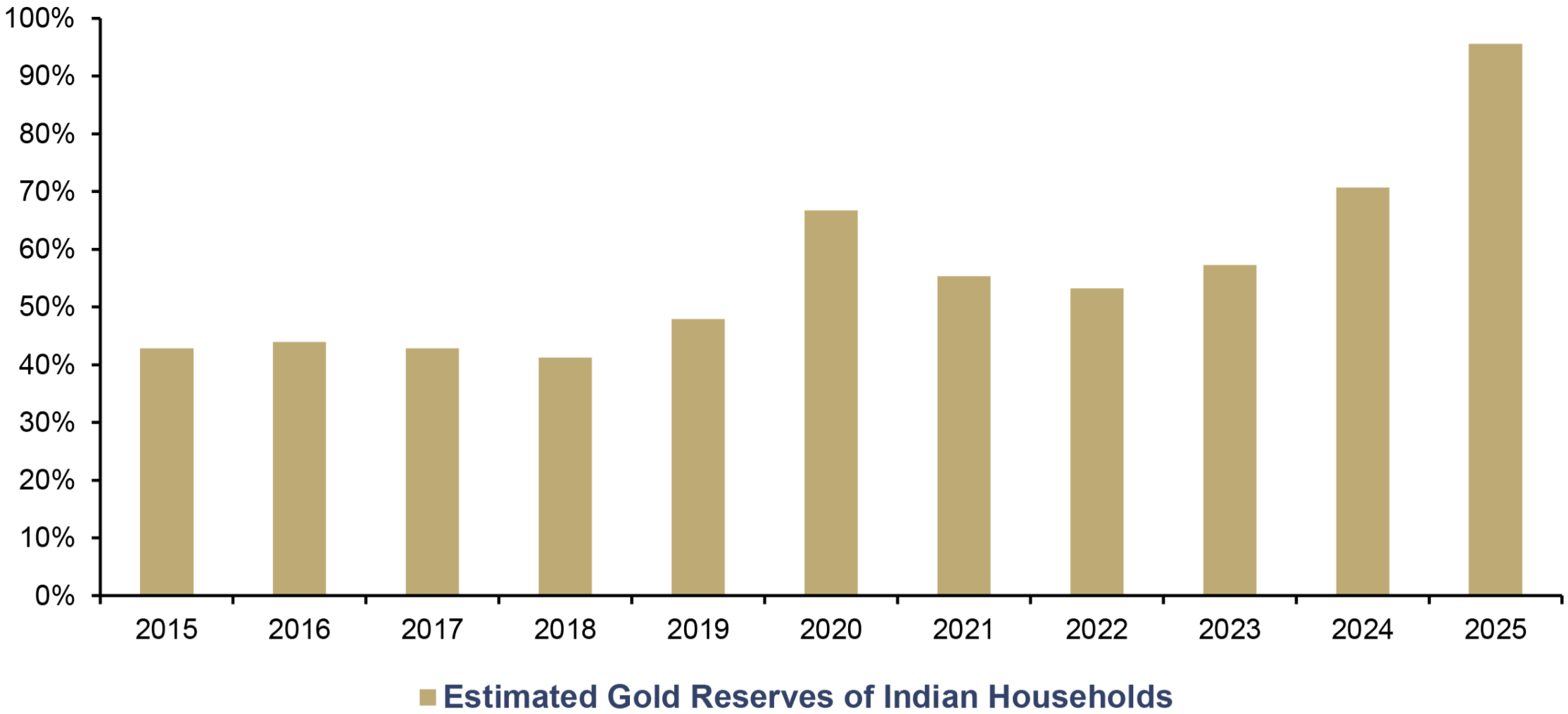
Rising gold prices have substantially increased household balance‑sheet wealth. Updated estimates indicate that India’s household gold holdings expanded from roughly 23,000–24,000 t in 2015 to around 35,000 t by the end of 2025. At the end of March, this amount totaled more than USD 4.0trn, which is slightly more than India’s GDP.
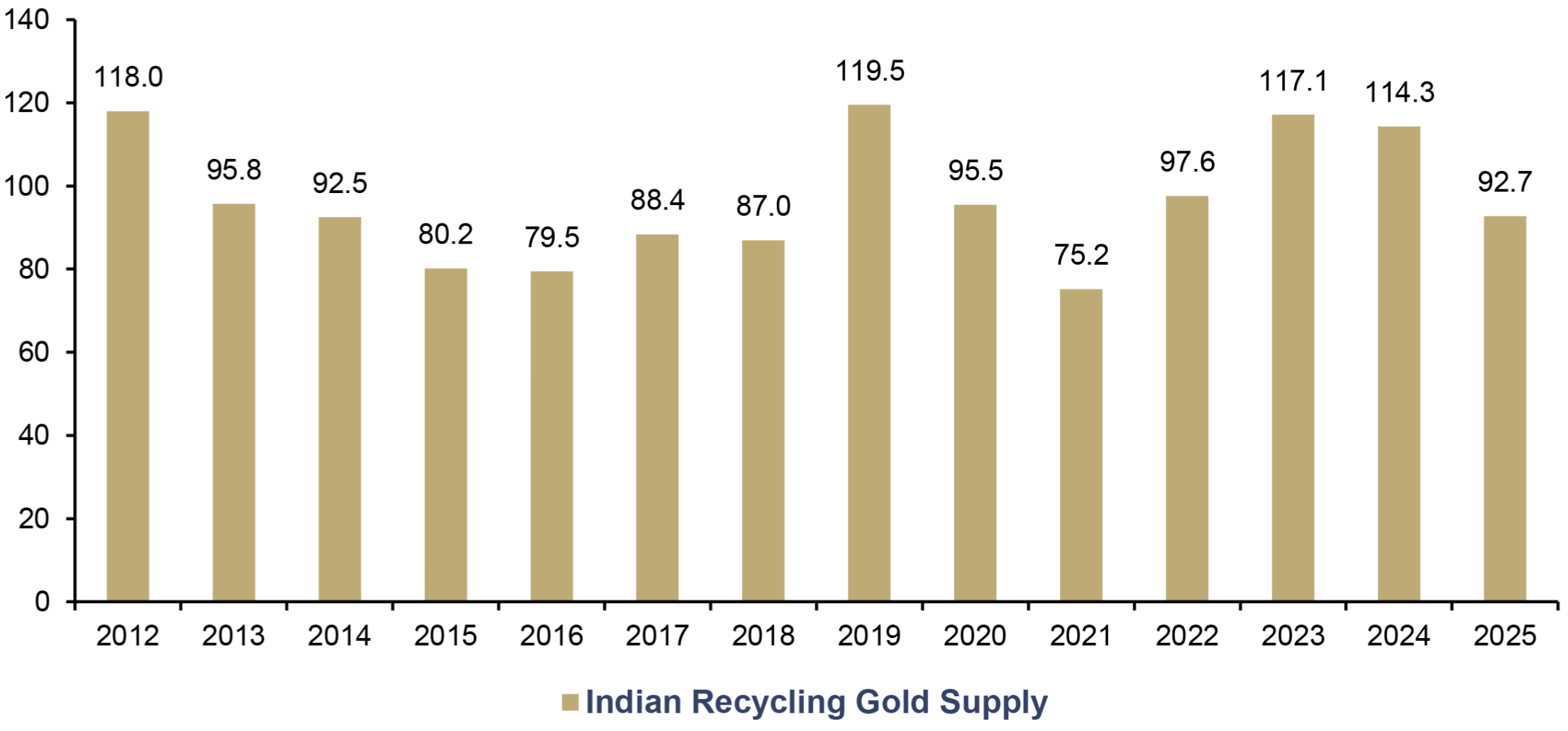
Only a small fraction of household gold enters the secondary market during price spikes, and even then, flows are driven mainly by necessity rather than portfolio rebalancing. Recycling behavior remains very subdued. As the World Gold Council (WGC) highlighted, Indian consumers display a strong preference for retaining gold even during sharp price runups, treating it as intergenerational savings rather than a monetizable asset.
Indian Recycling Gold Supply, in Tonnes, 2012–2025
Source: World Gold Council, Incrementum AG
Gold loans – the most formal mechanism for mobilizing this wealth – have grown rapidly but still represent a very small share of total household assets. As of June 2025, India’s gold loan market is valued at around USD 60bn, equal to just 1.7% of the total gold stock, 1.5% of GDP, and 3.5% of total household debt.
A rising gold price strengthens household balance sheets but has only a modest stimulating effect on consumption or credit channels.
Estimated Gold Reserves of Indian Households, in Tonnes, 2015–2025
Source: CLSA, World Gold Council, Incrementum AG
Estimated Gold Reserves of Indian Households, in USD bn, 2015–2025
Source: Bloomberg, CLSA, World Gold Council, Incrementum AG
Estimated Gold Reserves of Indian Households, as a % of GDP, 2015–2025
Source: CLSA, World Gold Council, Incrementum AG
The next twenty years: income, inflation and format elasticity
WGC’s econometric work finds that a 1% rise in per‑capita income lifts demand 0.9%, while a 1 percentage point increase in inflation raises demand by 2.6%. On structure, the mix will continue to migrate from exclusively jewelry toward financial channels (ETFs/SGBs/EGRs) as formal access deepens – a trend already visible through late-2025 and in Q1/2026, when Indian ETFs posted historic inflows and Electronic Gold Receipts (EGRs) market-building advanced within a regulated perimeter.
Within India, that financialization – alongside duty rationalization and hallmarking enforcement – should stabilize premiums/discounts and narrow informal channels, while demographics, urbanization and rising female financial participation buttress the consumption base. Current macroeconomic projections suggest that India’s GDP growth is likely to remain above 6 percent in the coming fiscal years, supported primarily by domestic demand and policy measures aimed at boosting consumption and investment.
Consumer Gold Demand, in Tonnes (lhs), and Indian Share (rhs), 2000–2025

Source: World Gold Council Incrementum AG
Market Architecture, Formalization and Regulatory Evolution
Import, refining, and distribution reforms since 2000
Over the past two decades, the infrastructure underpinning India’s wholesale and retail gold market has undergone a progressive formalization, moving from a fragmented, opaque system reliant on nominated bank import channels and nonstandardized retail practices toward a more-regulated, exchange-linked, quality-assured architecture. India’s bullion supply chain in the early 2000s rested primarily on a small set of authorized banks and agencies operating under the post-1997 import liberalization regime, with limited transparency in refining, assaying, and wholesale distribution.
Regulatory interventions since the early 2010s – especially during the “intervention phase” of 2012–2013 – introduced tighter controls. Higher tariffs and the 80:20 import rule – introduced in August 2013 and repealed as early as November 2014 – which required that 20% of gold imported into India be re-exported, typically as gold jewelry or other processed products, stabilized the current account in the short term but simultaneously encouraged informal trade. The subsequent “transparency phase” (2014–2018) catalyzed structural upgrading through expanded refining capacity, the standardization of nominated-bank import protocols, and the introduction of more robust risk-management tools such as gold forwards and extended gold-loan tenors – laying the groundwork for deeper market formalization.
Hallmarking, HUID and quality-assurance transformation
The most consequential transformation, however, emerged through quality‑assurance reforms. India’s hallmarking ecosystem, initiated in 2000 under the Bureau of Indian Standards (BIS) and later strengthened through the mandatory rollout of HUID[1]-based hallmarking from June 2021 onward, lifted purity traceability to unprecedented levels: Hallmarked jewelry grew from 3.5 crore (1 crore = 10mn) pieces in 2020 to 12 crore in 2024, supported by the expansion of registered jewelers from 35,000 to 195,000. This quality infrastructure increasingly anchors both wholesale and retail transactions, narrowing purity differentials, curbing adulteration, and strengthening consumer trust.
Indian Consumer Gold Demand, in Tonnes, 2000–2025
Source: Metals Focus, Refinitiv GFMS, World Gold Council Incrementum AG
Exchange‑driven modernization: IIBX, EGRs, and vaulting networks
Parallel developments on the wholesale side have been equally transformative. The launch of the India International Bullion Exchange (IIBX) in GIFT International Financial Services Centre (GIFT IFSC) in Gujarat in 2022 created India’s first unified, regulated bullion-trading venue with direct bullion-depository-receipt settlement, 30-minute clearing cycles, multi-vault logistics, and participation by over 600 qualified jewelers across 20 states.[2] The 2025–2026 IFSCA circulars further expanded eligibility, reduced entry barriers, and integrated bullion imports into a single regulatory framework – democratizing access to imported bullion while enhancing compliance and transparency.
Complementing these exchange-based integrations, amendments in the Finance Act 2025 aligned India’s import policy with the updated ITC (HS) 2022 framework under Chapter 71. Subsequent notifications by the Directorate General of Foreign Trade (DGFT) in May and June 2025 reclassified certain precious metal alloys with high gold content as “restricted” (requiring licensing) and imposed granular restrictions on select unstudded platinum jewelry categories, thereby reducing regulatory discretion at ports, enhancing compliance consistency and strengthening overall trade predictability.
Together with the emergence of Electronic Gold Receipts (EGRs), which address India’s long-standing absence of a regulated spot exchange and improve national price discovery, these reforms signal a decisive shift toward an exchange-centric, custodian-verified, and interoperable market structure. Additionally, gold tariff-rate quotas (TRQs) under the UAE-India Comprehensive Economic Partnership Agreement (CEPA) which was concluded in 2022, were transitioned to a competitive online bidding mechanism in 2025, replacing earlier administrative allocations and further promoting transparent, market-based access to preferential-duty imports.
India as an emerging regional price influencer
Looking ahead, these institutional foundations – traceable hallmarking, integrated bullion exchange infrastructure, digitized ownership records through electronic gold receipts (EGRs), and a more rationalized duty regime following the major 2024–25 reduction of the tax rate from 15% to 6% – position India to evolve from a price-taker with dispersed supply chains into a regional price-influencing hub.
Over the next two decades, the convergence of high-fidelity purity certification, exchange-based wholesale procurement, logistics-linked vaulting networks, and expanded cross-border bullion pathways through IIBX is likely to deepen market efficiency, reduce informal flows, and elevate India’s role in the global bullion architecture. Just as the previous twenty years transformed India from a bank-dominated, semi-informal ecosystem into a partially standardized one, the coming twenty years will consolidate this trajectory, embedding India more fully in international best-practice frameworks while leveraging its domestic demand scale to shape regional liquidity, transparency, and price formation.
Timeline of key reforms (2000–2026)
- January 1, 2000: BIS hallmarking scheme (launch) – BIS designated as the sole hallmarking agency; voluntary purity-assurance scheme introduced.
- January 1, 2005: Market microstructure tweaks – introduction of gold forwards and extended gold-loan tenors to support manufacturing and risk management.
- August 2012: Duty hikes begin – progressive customs-duty increases to curb imports in light of the sharp deterioration in the current account balance.
- August 14, 2013: 80:20 import rule – imports linked to re-exports (20%); squeezed official inflows, widened local premiums, and incentivized informal routes.
- January 1, 2014: Transparency phase (2014–2018)
- June 16, 2021: Mandatory hallmarking & HUID – phased mandatory hallmarking; six-digit HUID on every new piece; rapid jeweller registration & A&H coverage.
- July 29, 2022: IIBX launch (GIFT-IFSC) – India’s first bullion exchange; BDR settlement, vaulting network, qualified-jeweler access.
- July 1, 2024: Tariff reduction – from 15% to 6% to narrow spreads and encourage formal imports; hallmarking footprint expands (maintained through 2025).
- April 29, 2025: IFSCA bullion market regulations – extended IIBX trading hours, broader participation; setup for additional products.
- January 2, 2026: Modified IFSCA circular – comprehensive framework for gold/silver imports via IIBX; clear eligibility routes for qualified jewelers; ongoing compliance reviews.
India’s gold rush suffered a political setback in the first half of May to protect the balance of payment and the rupee. Import duties on gold were more than doubled to 15%. Moreover, Prime Minister Narendra Modi called on the Indian people to refrain from buying gold for a year, describing such a sacrifice as “patriotic.”
Current Market Dynamics: Prices, Behavior and Imports
The 2025–26 price surge and demand response
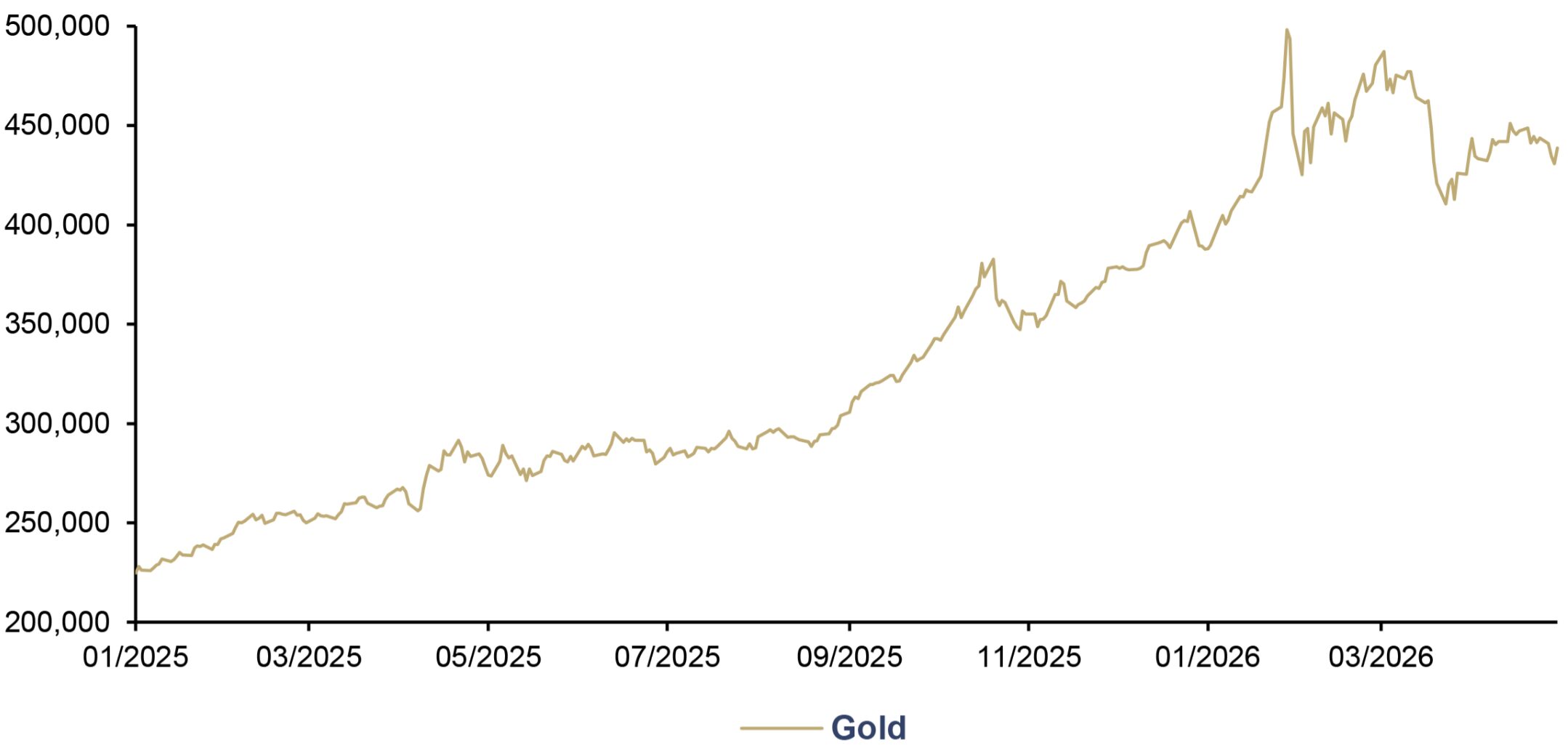
Gold prices in India rose by nearly 75% in 2025 to INR 390,000. An all-time high of just under INR 500,000 was reached at the end of January. By the end of March, the gold price had fallen to just over INR 435,000. This sharp acceleration reflects heightened geopolitical uncertainty, persistent safe-haven demand and strong global ETF inflows, but also the ongoing depreciation of the Indian rupee against the US dollar.
Gold, in INR, 01/2025–04/2026
Source: LSEG, Incrementum AG
Volatility, discounts, and rapid normalization of premiums
Indian demand responded in line with established elasticities. Gold purchasing is highly sensitive to both price level and short‑term volatility: a 1% rise in price reduces demand by 0.4%, while a 1% fall increases demand by 1.2%. As Uday Kotak famously observed, “The Indian housewife is the smartest fund manager.” In a year of 70%+ price surges and wild volatility, many proved him right – quietly rotating from wedding bangles to bars and coins. As prices spiked in Q4/2025, domestic discounts widened to around USD 30, and jewelry purchases softened sharply. Yet the market adapted rather than contracted. Bar and coin demand expanded to nearly 40% of total flows in November–December 2025. This behavior is structurally embedded: over the long run, gold demand is dominated by income effects rather than price effects.
Investment behavior: bars, coins, and ETF leadership
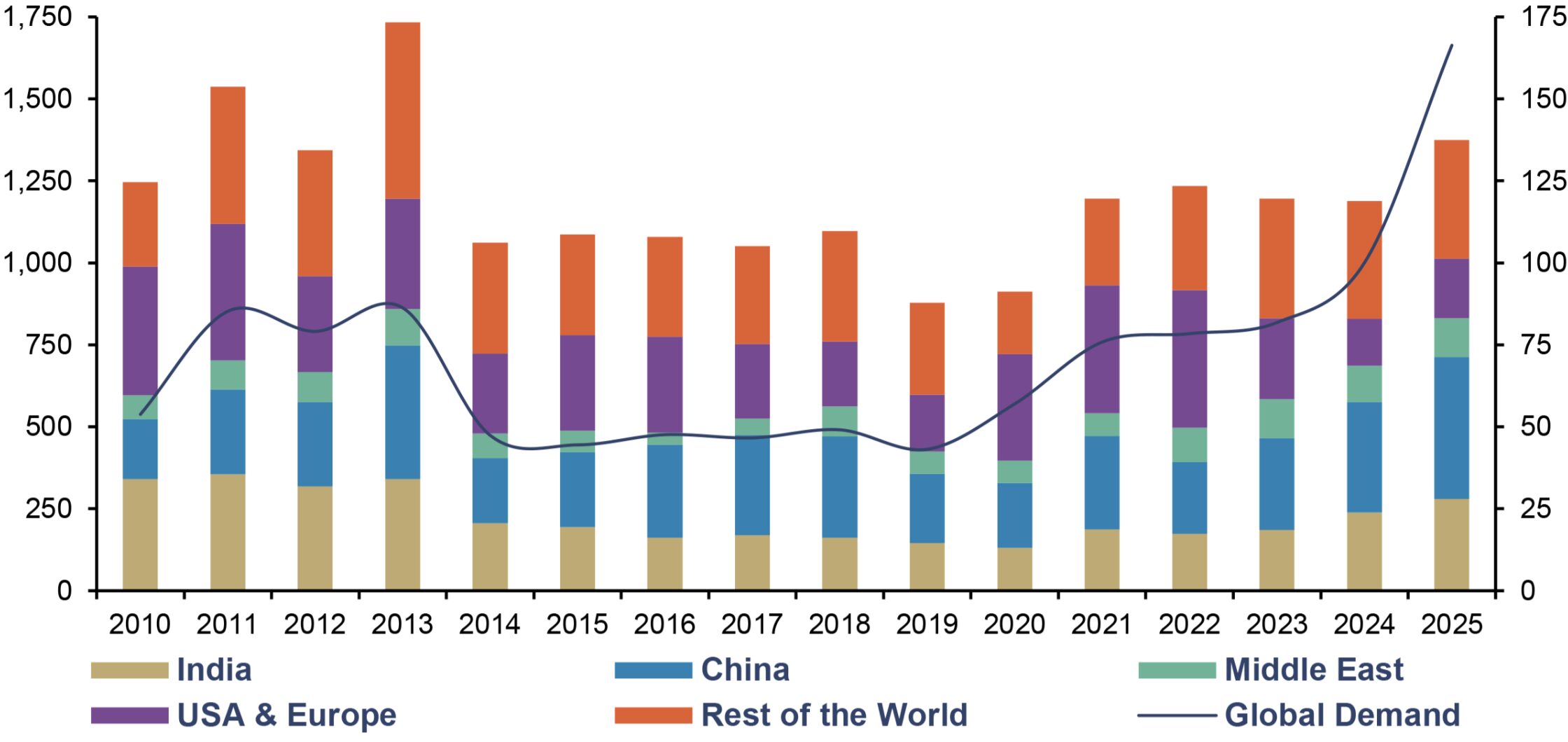
India’s investment segment recorded one of its strongest runs in over a decade, with two back-to-back quarters surpassing 90 t. This lifted annual investment to its highest level in more than ten years and translated into an unprecedented USD 32bn in value. The depth and persistence of these flows point to sustained investor conviction rather than short-term opportunism. These products offer higher purity, lower margins, and better liquidity, making them appealing during periods of rapid price appreciation. This behavioral shift reinforced the robust ba r and coin demand seen in late 2024 and 2025.
Gold Bar & Coin Demand by Region, in Tonnes (lhs), and Global Demand, in USD bn (rhs), 2010–2025
Source: World Gold Council, Incrementum AG
The most striking feature of early 2026 was the speed of demand recovery once volatility subsided. As global prices stabilized in January, India shifted from USD 61/oz discounts to USD 15/oz premiums within days, a pattern mirrored in China, where retail premiums ahead of Lunar New Year normalized into positive territory. Such rapid normalization underscores that Indian consumers respond far more strongly to price stability than absolute price levels. The timing also intersected with India’s peak wedding season (October–February), when 3–4mn weddings typically occur, intensifying the rebound in jewelry fabrication.
Investment activity served as the central stabilizer in 2025. ETFs recorded their highest-ever monthly inflow in December, adding 37 t and taking AUM to INR 1,279bn, while digital-gold purchases surged from INR 8bn to INR 21bn yoy. Gold’s inflation-hedge behavior was especially relevant in a year marked by elevated food and services inflation. Investment gold also provided a stabilizing channel for savings when jewelry budgets were constrained.
Import patterns and arbitrage dynamics
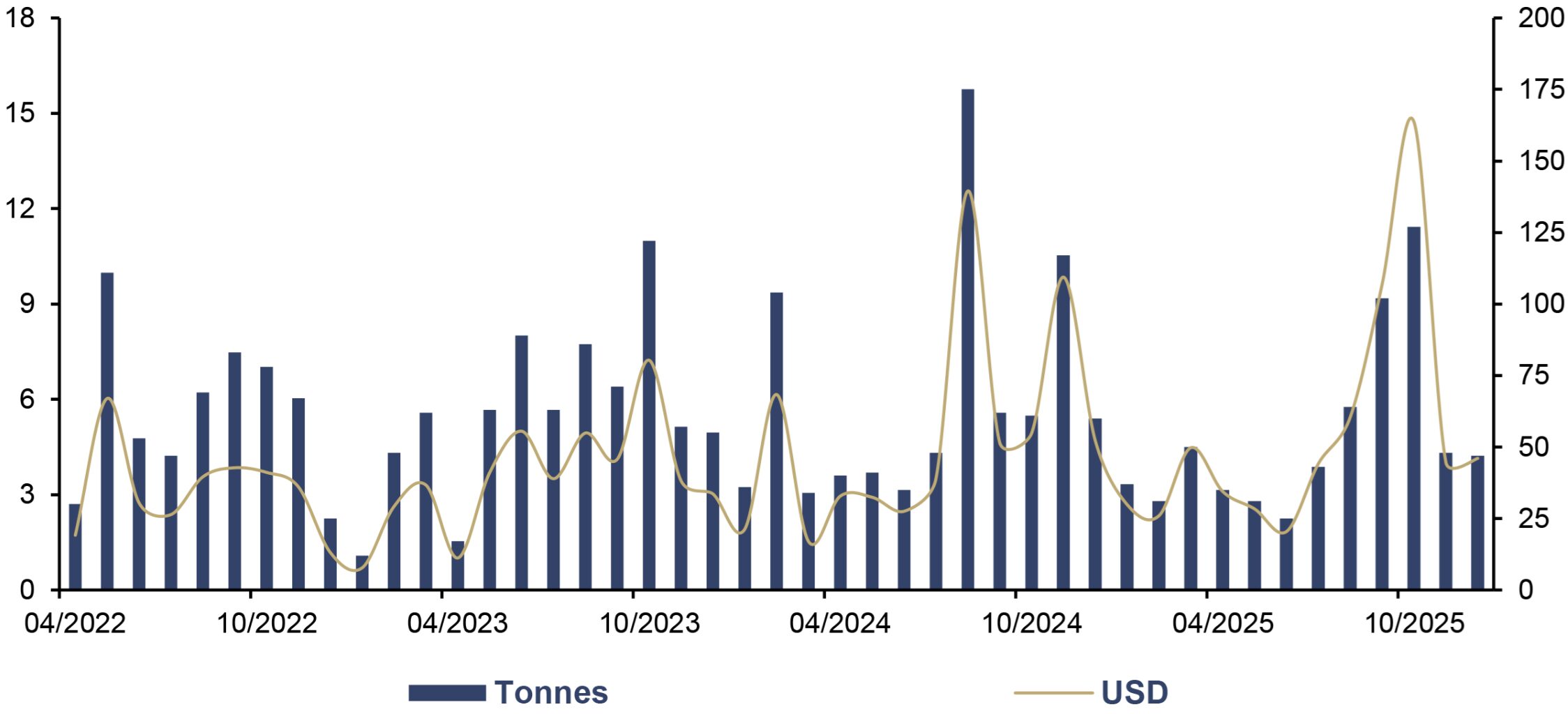
Imports adjusted sharply to market conditions. Official inflows fell to just 35–40 t in December 2025, easing pressure on the current account. This reconfiguration of demand channels, combined with subdued jewelry fabrication and limited recycling, contributed to a marked contraction in total gold supply to 771.2 t in 2025 from 933.8 t in 2024, according to World Gold Council data, with standard bullion inflows dropping to 451.10 t from 572.3, doré to 212.60 t from 229.40, and scrap to 92.74 t from 114.31. On the official side, the Reserve Bank of India added only 4 t during the whole of 2025 – its smallest annual purchase in eight years –, yet continued its multi–year strategy of repatriating and reallocating reserves, raising the proportion of gold stored domestically to around 65% and increasing gold’s share of total reserves to 13.9%. This aligns with the global trend of emerging-market central banks diversifying away from assets with counterparty risk. Private flows, typically sensitive to price spreads and rupee movements, contracted unusually in late 2025 as high volatility temporarily eliminated viable arbitrage windows.[3]
Indian Gold Imports, in Tonnes (lhs), and USD bn (rhs), 04/2022–12/2025
Source: Ministry of Commerce and Industry, Incrementum AG
India entered 2026 with gold up 67% yoy, domestic premiums restored, investment flows signaling deep conviction, and household behavior reaffirming the structural foundations of demand. These near-term dynamics illustrate the broader truth underpinning India’s gold economy: S hort-term volumes may shift between jewelry, investment, and recycled supply, but the long-run trajectory is governed by rising incomes, demographic momentum, cultural attachment, and the increasingly sophisticated financial infrastructure that supports gold ownership across the country. At the same time, geopolitical shifts and supply-chain diversification are increasing India’s role in global trade networks, as multinational firms seek to diversify manufacturing away from concentrated production hubs.
Financialization and the Rise of Investment Gold
ETF expansion and three structural drivers
India’s investment gold market has evolved into a sophisticated, countercyclical pillar of the broader gold ecosystem, complementing and stabilizing jewelry demand during periods of volatility. What was once a largely ornamental or physical-investment market has become a multi-channel financial system, with ETFs, sovereign gold bonds (SGBs), and electronic gold receipts (EGRs) enabling households to hedge risk, manage liquidity and accumulate assets with far greater flexibility than a decade ago. The rapid expansion of financial gold reflects not only shifts in consumer preference but also large-scale improvements in financial inclusion, regulatory infrastructure, and digital penetration in India.
The surge in ETF participation during 2025 illustrates the maturity of this transformation. December 2025 alone saw INR 116bn in net ETF inflows, the highest monthly figure ever recorded in India, leading to an increase in holdings of 8.6 t to a total of 95 t, and a rise in assets under management (AUM) to INR 1,279bn. Full-year 2025 inflows reached INR 430bn, equivalent to a record 37 t net demand. Momentum continued into 2026, with holdings crossing 110 t by end-January 2026 and AUM reaching INR 1,842bn. This surge was propelled by muted equity markets, rising macro uncertainty and the appeal of gold’s price momentum. Who knew that a few quarters of muted equity returns and geopolitical jitters could transform so many urban Indians – previously content with fixed deposits and family gold – into overnight ETF enthusiasts, quietly building positions while sipping chai and scrolling apps?
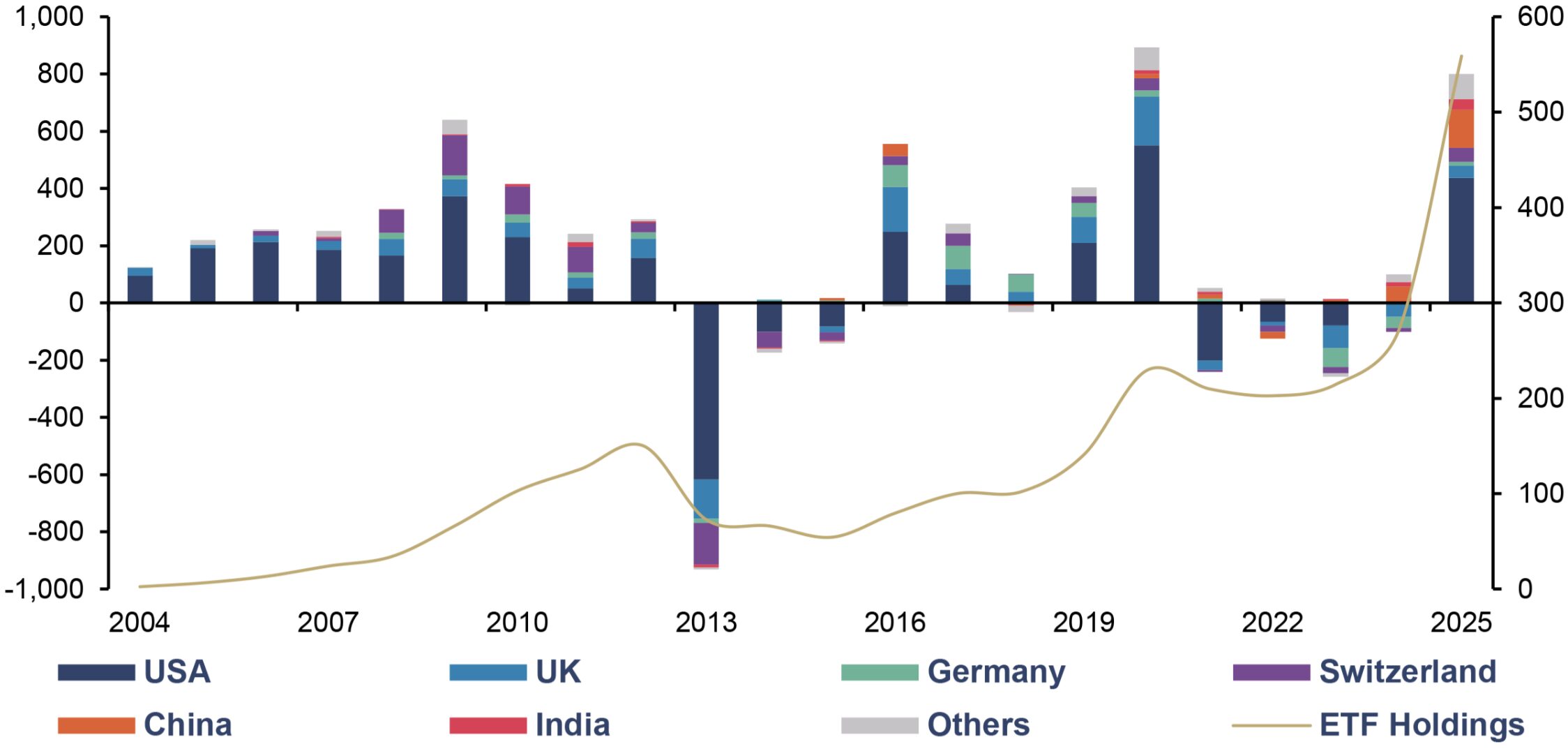
Gold ETF Flows by Country, in Tonnes (lhs), and Global Gold ETF Holdings, in USD bn (rhs), 2004–2025
Source: World Gold Council, Incrementum AG
At the same time that Western ETFs were experiencing persistent outflows, India’s expanding ETF market was absorbing record inflows, effectively increasing the country’s share of global gold ETF AUM and underscoring a clear geographic shift in investment leadership. Part of the ETF surge can also be attributed to a wave of new product launches, which expanded investor choice and widened access to gold-backed funds. These additional vehicles helped absorb strong inflows and cemented ETFs as a mainstream investment route during a year of heightened macro uncertainty.
These flows formed part of a global trend: ETFs in Western markets experienced renewed interest as US real yields softened, recession risks rose, and US dollar strength moderated. Yet India’s trajectory was distinctive. Retail participation expanded not because institutions shifted allocations but because of structural improvements in household access to investment channels. Since 2014, India has opened 482mn Jan Dhan bank accounts, bringing the total to 578mn; demat accounts for equities have increased from 24mn to 216mn; SIP participation surged to 9.4mn; and the number of smartphone users roughly quadrupled to 950mn. Together, these shifts created a pipeline of new investors who could buy investment gold digitally, seamlessly and frequently.
Sovereign gold bonds: design, impact, and limitations
Sovereign gold bonds (SGBs) strengthened this momentum. Offering 2.5% annual interest, exemption from capital‑gains tax at maturity, and the backing of the Government of India, SGBs provided the most cost-efficient long-term gold exposure available to Indian households. Launched in 2015, cumulative issuance reached 98 t, with particularly strong adoption by urban, affluent, and tax-sensitive investors. SGBs also reflected a shift in household mindset: Gold is no longer perceived solely as a family asset or ornament, but increasingly as a financial instrument integrated into broader portfolio planning. SGBs’ eight‑year maturity structure, liquidity via secondary markets, and attractive tax profile recast gold as a strategic portfolio allocation rather than simply a cultural anchor.
India’s sovereign gold bond program was one of the government’s most innovative attempts to reduce the structural macro‑vulnerability created by large physical gold imports. As highlighted by Goldman Sachs Commodities Research, gold remains India’s second-largest import after crude oil, yet unlike oil it produces no recur‑ ring economic return once purchased, instead remaining idle in household vaults, often for decades.[4] By redirecting a portion of household gold demand into a financial instrument rather than imported metal, policymakers hope to lower US dollar outflows, ease current-account pressures, and reduce rupee volatility.
SGBs were designed as a direct financial substitute for physical gold. Issued by the RBI and denominated in grams, they carry an eight-year maturity (with early redemption permitted after year five), an annual interest payment of 2.75% – later revised to 2.5% – and exemption from capital gains tax at maturity. Investors also avoided goods and service tax and jewelry-making charges. At redemption, holders receive the prevailing domestic gold price in rupees, giving them full exposure to price appreciation without the frictional costs associated with coins, bars, or jewelry.
India’s Sovereign Gold Bond (SGB) program is now closed to new issuance, with no fresh tranches since February 2024 – a major shift in India’s financial gold market. Existing series run to maturity through 2032, but subscriptions are over. The halt reflects success in drawing household savings into financial gold, offset by heavy fiscal costs from gold’s sharp rise: Early low-price issuances now redeem at much higher levels after years of interest payments. The scheme has become a legacy portfolio of long-term obligations, shaping the future mix of physical vs. financial gold demand. In retrospect, SGBs were a smart policy step that widened financialized gold access for sophisticated buyers but barely dented mass-market physical demand rooted in tradition.
Digital gold: micro-saving and young investor adoption
Digital gold sits at the opposite end of the spectrum: a mass-market, high-frequency engagement channel, especially popular among younger users aged 18–35. With 5–6mn active accounts, often transacting in denominations below INR 500 (= ca. 5.30 USD), digital gold has democratized ownership, enabling micro-savings behavior that aligns with the explosive adoption of India’s instant payment system UPI and payment-app ecosystems. This segment also introduces millions of first-time savers to gold as an asset, creating a feeder system that naturally matures into ETF and SGB participation over time. UPI-based digital gold purchases grew almost threefold in 2025, rising from INR 8bn in January to INR 21bn in December, with an estimated 13.5 t accumulated over the year. Even after a temporary slowdown following the Securities and Exchange Board of India’s (SEBI) November 2025 advisory, transaction volumes rebounded quickly, underscoring digital gold’s resilience and growing appeal among younger, first-time savers. This rapid growth highlights the increasing integration of gold into India’s digital payments ecosystem. It further indicates that digital gold has become a structural, not cyclical, component of India’s investment landscape. Since late 2025, India’s provident fund regulator has permitted retirement funds to allocate to gold ETFs, and insurance companies are expected to receive similar approval – marking the first time institutional long-term savings pools can invest in gold.
Electronic gold receipts (EGRs): bridging physical and financial markets
Electronic gold receipts (EGRs) institutionalize India’s gold market infrastructure by linking dematerialized receipts to vaulted bullion in a regulated, exchange-traded ecosystem. This bridges physical and financial gold with transparency and standardization, aligning India with global benchmarks in Shanghai, London, and Singapore. SEBI’s 2025 restrictions on unregulated digital gold platforms funneled flows into regulated channels, while IFSCA’s push for interoperability via the India International Bullion Exchange (IIBX) has enhanced liquidity, traceability, and depth. As of early 2026, exchanges like NSE (National Stock Exchange) and BSE (Bombay Stock Exchange) continue preparations and mock trading for EGR segments, advancing this framework.
Precious metals credit expansion: silver as collateral
Beginning April 2026, India took a historic step in its precious‑metals lending framework by allowing silver jewelry, ornaments, and coins to be used as formal loan collateral, under the RBI’s new Lending Against Gold and Silver Collateral Directions. In tandem with these credit expansions, the Bureau of Indian Standards (BIS) introduced voluntary HUID-based hallmarking for silver under the revised IS 2112:2025 standard and extended mandatory gold hallmarking coverage to include 9-carat jewelry, thereby reinforcing digital traceability across a broader range of fineness grades for both gold and silver and further aligning quality assurance with international practices. This policy grants silver the same regulatory status as gold for the first time in modern Indian banking, permitting households to pledge up to 10 kilograms of silver jewelry or 500 grams of coins, valued according to India Bullion and Jewellers Association (IBJA) or SEBI-regulated reference prices. Analysts describe the move as a significant remonetization of silver, noting that formal lenders will now uniformly recognize silver as a collateral asset in a way previously restricted to gold.
Silver-backed lending is expected to unlock substantial household wealth, especially in rural and semi-urban regions where silver ownership is more widespread and affordable than gold – Indian households’ silver holdings are estimated at approximately 34,000 t, mobilizing what was historically considered “dead capital” and bringing millions of firsttime borrowers into the formal credit system. The RBI’s rules introduce tiered loanto-value caps and strict borrower protections, ensuring responsible valuation, secure storage, and transparent auction procedures in case of defaults. Rather than displacing the entrenched gold-loan market, the new framework is expected to complement goldbacked lending, expanding India’s collateral spectrum and deepening the ongoing financialization of household precious-metal savings.
Retail Demand, Fabrication and Consumer Psychology
Wedding cycles, festivals, and nondiscretionary demand
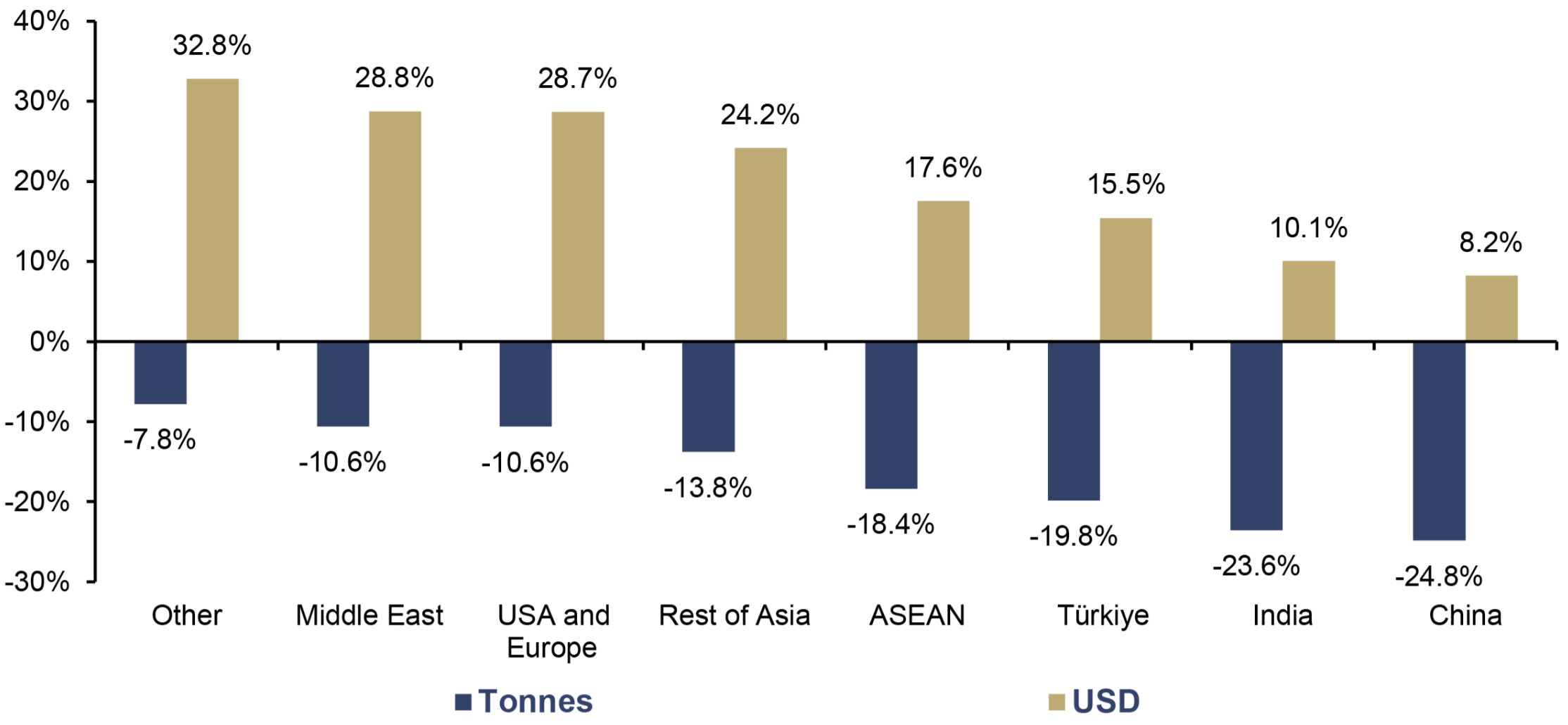
India’s jewelry market remains one of the largest and most structurally resilient in the world, although jewelry demand fell by 24% last year to 430.5 t, the lowest in nearly three decades except for 2020, when the Covid-19 pandemic began. Nevertheless, multi-decade averages are consistently exceeding 500 t annually. Weddings form the single greatest determinant of demand, accounting still for around 50% of jewelry purchasing. Festival periods such as Ak shaya Tritiya and Diwali further inject concentrated demand, often adding 40–60 t within days. These cyclical anchors ensure that, even during periods of elevated prices or macro uncertainty, India maintains a baseline of obligatory, tradition‑driven purchasing.
Rural demand, monsoon cycles, and agricultural incomes
The rural economy continues to play a critical role in shaping jewelry volumes. Despite agriculture’s declining share of GDP, rural households still generate 55–58% of jewelry demand, reflecting the deep connection between farm incomes, harvest cycles, and gold expenditure. Almost 70% of rural households depend on agriculture, and rainfall remains a major driver of disposable income: a 1% monsoon surplus increases gold demand by 0.2%. Conversely, periods of rural real-wage stagnation – such as 2014–2020, when wages contracted by an average of 0.3% – temporarily dampen discretionary jewelry purchasing. Yet even during weaker rural-income cycles, compulsory wedding demand remains intact.
Yet, recent trade feedback suggests that domestic jewelry demand remains resilient, though more measured, as households adapt to elevated price levels by shifting toward lighter designs and lower-purity formats such as 18k and 14k. Retailers report that over 40% of jewelry sales now come from old-gold exchange, highlighting the extent to which consumers are preserving budgets while still fulfilling wedding-season obligations.
Gold Jewelry Demand, yoy, 2025
Source: World Gold Council, Incrementum AG
Formalization of retail and the rise of organized chains
India’s gold jewelry retail sector has undergone one of the most profound structural shifts in recent decades. Organized chains, bolstered by GST, digital payments, mandatory hallmarking, and the HUID system, have gained share – from around 30% in 2015 to estimates of 36–40% by fiscal year 2025 – while improving purity assurance and consumer trust. Historically plagued by 10–15% fraudulent underkarating issues, the sector now aligns closer to global standards, enabling large national players like Tanishq and Malabar Gold & Diamonds to rank among the world’s top jewelers by scale and sales. Fabrication remains artisanal, with 20,000–30,000 workshops and karigars producing about 55% handmade output, providing unmatched flexibility to pivot designs and weights amid price volatility – as seen in the rapid shift to ultra-light pieces during the 2025 spike – though challenges like informal labor persist. Emerging jewelry-park initiatives aim to modernize infrastructure and traceability.
This formalization accelerates further through capital markets: FY 2024–25 saw 17 new listings, with dozens more jewelers and manufacturers filing or advancing IPOs in FY 2025–26 – an unprecedented wave. Public-market discipline imposes audited disclosures, traceability, and governance standards, replacing opaque, cash-heavy practices and setting benchmarks for purity, sourcing, and service. The global ascent of Indian chains combined with this listing surge marks a decisive transition from fragmented, family-run retail to a modern, transparent, investment-grade industry – bolstering trust, consumer protection, and India’s position as a global jewelry powerhouse.
Macro, FX, and Geopolitics: The Strategic Foundations of Demand
Income, urbanization, and demographic momentum
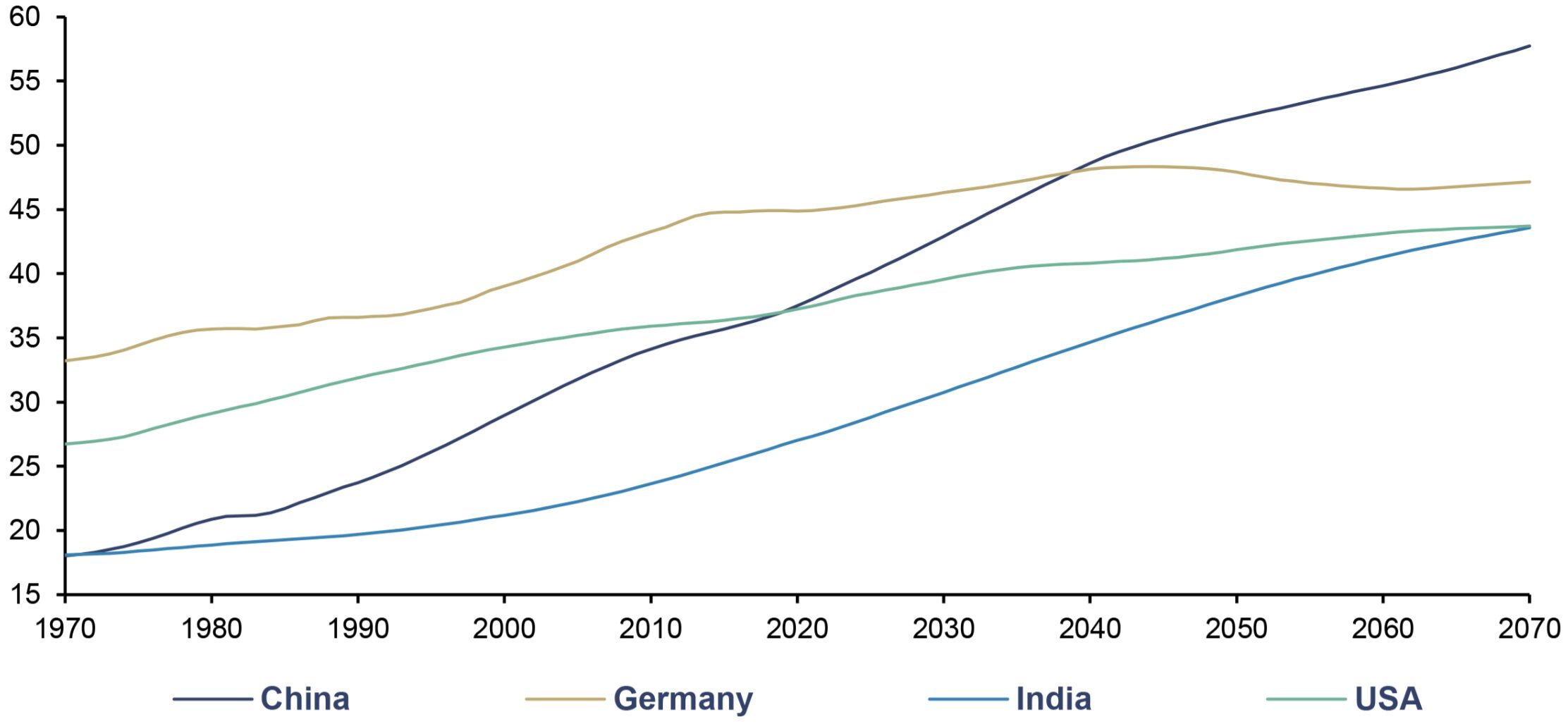
India’s gold demand is anchored in a macroeconomic and demographic landscape that continues to expand the underlying base of household purchasing. With GDP growth consistently in the 6–7% range, a median age of 27, and a working‑age population projected to grow by nearly 7mn people annually until 2041, India is creating millions of new earners and new households each year.
Median Age of the Population, 1970–2070e
Source: United Nations, Incrementum AG
These structural tailwinds reinforce lifecycle-driven jewelry purchases – weddings, births, festivals, and intergenerational transfers – while simultaneously enlarging the pool of savers who can allocate to investment gold. Urbanization, which rose from 18% in 1960 to 38% currently, deepens this effect by improving access to banks, digital payments, and organized retail, thereby expanding distribution channels and formalized consumption. Income elasticity remains a fundamental driver: A 1% increase in per‑capita income raises gold demand by 0.9%, explaining why India’s long‑run demand trajectory has continued to rise even through periods of significant price appreciation.
Inflation, rupee cycles and gold as a hedge
Gold’s interaction with inflation and currency dynamics further reinforces its role in Indian households’ portfolios. A 1% rise in inflation historically increases gold demand by 2.6%, a particularly relevant relationship in 2025 amid persistent food and services inflation. Rupee depreciation magnifies domestic returns on gold, making it attractive both as a consumption asset and as a hedge against purchasing-power erosion. During 2025, the combination of elevated global prices, a strong US dollar and a weak rupee intensified the upward pressure on local gold prices, increasing the appeal of financial gold products such as SGBs and ETFs, while pushing consumers toward old-gold exchange and lighter-weight jewelry. These macrofinancial dynamics explain why investment flows remained robust even as fabrication softened – a behavior consistent with India’s countercyclical gold investment patterns observed over multiple decades.
Geopolitics, reserve strategy and central bank behavior
India’s geopolitical environment adds a further layer of strategic demand. The country remains structurally exposed to maritime chokepoints such as the Strait of Hormuz, whose oil- and gas-supply significance continues to shape India’s external vulnerabilities, as exemplified in the first weeks of the Iran war; to the Indo-Pacific balance of power, where rising US–China competition reshapes regional alignments; to the volatility of the Afghanistan–Pakistan corridor; and to the contested Himalayan frontier with China. For households, gold provides protection against inflation, currency volatility and macro shocks; for the sovereign, it provides diversification against the geopolitical risk embedded in foreign-exchange reserves. In this environment, gold functions as a dual insurance asset – microeconomic for households, macroeconomic for the state.
The Reserve Bank of India’s reserve strategy reflects this logic and aligns closely with global central‑bank behavior. Over the past four years, the RBI repatriated roughly 280 t of gold, added around 64 t in H1/FY2025–26,[5] reduced its US Treasury exposure, and raised gold’s share of reserves to approximately 16%. These moves mirror the broader trend identified in previous In Gold We Trust reports: Central banks – particularly in emerging markets – are expanding their gold holdings as a hedge against counterparty risk, sanctions exposure, and geopoliticalfragmentation.[6] Valuation effects drove gold’s share of FX reserves from 10% to 16% within a single year. This dynamic illustrates how reserve composition is increasingly shaped by price appreciation rather than tonnage growth. It also signals a strategic shift toward consolidation during high-price periods.
Gold Reserves of the Reserve Bank of India, in Tonnes, 2000–2025
Source: World Gold Council, Incrementum AG
Import duties, informal flows, and compliance challenges
India’s import‑duty structure remains one of the most important policy determinants of domestic market dynamics. Duty hikes from 2% to 10% in 2012–2013, combined with the temporary “80:20 rule,” depressed demand by roughly 1.2% annually and created strong incentives for unofficial inflows. As domestic and international price gaps widened, smuggling surged to an estimated 335 t in 2013–14 – nearly one-quarter of India’s total gold demand. While regulatory tightening and increased enforcement subsequently reduced unofficial flows, they remain highly sensitive to premium/ discount cycles, rupee movements, and global arbitrage conditions. Duty rationalization continues to be a critical lever for reducing price distortions, narrowing domestic-international spreads, and enhancing the effectiveness of formal import channels. India currently produces only 1–2 t of gold per year, making it one of the world’s most import-dependent major gold markets; however, ongoing reforms to the mining framework aim to expand domestic production substantially over the next decade, with policymakers and industry groups targeting a long-term goal of meeting a meaningful share of annual demand from domestic mines.
India’s gold ecosystem, however, cannot be fully understood without accounting for the informal market. Smuggling remains the most visible component, but it is far from the only one. Cash-based retail transactions persist in rural and semi-urban markets, where gold is often bought using cash savings accumulated over long cycles. Karigar-to-retail supply chains, largely operating in small workshop clusters, frequently transact outside formal invoicing systems, offering jewelers flexibility but complicating traceability and purity verification.
Old-gold exchange adds a further structural layer. Because 40–50% of India’s jewelry fabrication is met through recycled domestic scrap, households routinely use old jewelry as a liquidity mechanism during periods of high prices. This practice sustains fabrication volumes while reducing official imports, weakening the direct correlation between global prices and recorded domestic consumption. While economically rational, the prevalence of old-gold exchange can distort short-term market signals, obscure true demand conditions, and complicate policymaking around import duties and supply-chain monitoring.
These overlapping informal channels create a series of compliance frictions. High-cash transactions, unregistered workshops, and informal scrap flows complicate AML frameworks, hallmarking enforcement, and the transition to digital-traceability systems like HUID. Policymakers recognize these constraints, which is why duty rationalization, improved refining oversight, mandatory hallmarking, and the expansion of regulated platforms such as IIBX form the core of ongoing reform efforts. These initiatives aim to increase transparency, harmonize price discovery, and strengthen India’s alignment with global bullion‑market standards.
The policy challenge going forward is not simply to formalize the sector, but to formalize it without eroding the adaptive capacities that have historically made India’s gold market both deep and uniquely responsive. This balance – between transparency and flexibility, regulation and tradition – will shape the long-term evolution of India’s gold economy.
Conclusion: India’s Gold Market at an Inflection Point
Twenty years ago, India’s gold market was vast but structurally fragmented – dominated by small family jewelers, limited formal retail, minimal refining capacity, and virtually no financial gold products. Import duties shaped both official and unofficial flows, weddings and inheritance dominated demand, and gold functioned primarily as ornament, family wealth, and cultural obligation. India was the world’s largest consumer but remained largely a passive participant in global bullion dynamics.
Today, India’s gold ecosystem is markedly more sophisticated, transparent, and influential. Organized retail has expanded its footprint, hallmarking and HUID have elevated purity and trust, and refining capacity has grown several-fold, integrating India more deeply into global supply chains. Financialization has transformed gold into a modern investment asset: ETFs, SGBs and EGRs now sit alongside jewelry, coins and bars, while digital platforms have opened access to millions of first-time savers. The market’s behavior during the volatility of 2025–26 demonstrated its adaptability: Jewelry shifted toward lighter pieces and old-gold exchange; investment channels absorbed volatility; and deep-rooted cultural and psychological anchors maintained demand even at record prices.
Informal channels – from cash-based retail and karigar workshop flows to household recycling – still influence transparency, premiums, and import patterns. Yet reforms such as mandatory hallmarking, GST, the expansion of digital payments, improved refinery oversight and the emergence of the IIBX are steadily aligning India with global standards and narrowing the space for distortions.
Looking ahead, India’s trajectory is unambiguous. The country’s industrial base is expanding alongside this trajectory. Rising incomes, demographic momentum, rapid urbanization, and deeper digital-financial integration will continue to broaden and formalize demand. Cultural continuity ensures that gold will remain indispensable to weddings, savings, identity, and intergenerational wealth transfer. Combined with greater integration into global bullion networks and a developing exchange‑based trading ecosystem, India is now moving from being the world’s pivotal consumer market to an increasingly influential participant in regional price discovery, global trade flows, and the long‑term architecture of the international gold system.
„Gold Is the New Gold“
A Conversation with Sachin Jain, Regional CEO India, World Gold Council
This interview was conducted in February 2026.
IGWT: India has one of the world‘s deepest traditions of physical gold ownership. How do you explain its enduring strength today?
Sachin Jain: Physical ownership is still the emotional core of India‘s gold ecosystem. Gold is not treated as a luxury good; it is a way of life. In most families, you have a family doctor and a family jeweler. These jewelers are often century-old businesses, embedded across 350,000 locations in India. Trust, lineage, and cultural continuity keep households attached to physical gold, especially in rural areas where gold still equals „saving“, not „investment“.
Even today, brides in southern India commonly wear multiple kilograms of gold during wedding ceremonies. That physicality creates an emotional anchor no financial product can fully replace – but what‘s changing is that digital and financial forms are supplementing, not replacing, this core behavior.
IGWT: Your data show remarkable growth in financial gold products like ETFs. Does this come at the cost of jewelry demand?
Jain: Not at all – we see complementarity, not cannibalization. India‘s gold ETFs grew from 40 t AUM in January 2024 to nearly 100 t by January 2026, a 2.5x rise. That is extraordinary growth, but still small compared to India‘s ~800 t annual gold demand.
Financialization is rising because urban investors are looking for diversification, liquidity, and transparency. But the cultural functions of jewelry – wedding gifting, status, inheritance – remain untouched. Jewelry fulfills social obligations; ETFs and digital gold fulfill portfolio needs. Both segments grow for different reasons, driven by different consumers.
IGWT: Rural and urban gold behavior seems to diverge sharply. What does this mean for future demand?
Jain: Urban India is becoming more “investment-first”: Gold competes with equities, mutual funds, SIPs, and alternatives. Rural India remains “savings-first”: Gold is the most trusted store of value in regions with limited banking access. About 40% of India‘s gold demand still comes from rural households, and for them, gold is simpler than financial products. What you save in is what you hold in your hand.
This duality is actually India‘s strength. The income pyramid is rising – more Indians are entering the middle-income group, and historically a 1% rise in disposable income leads to a 1% increase in gold demand in value terms. India is not a saturated gold market like some others in Asia; it is expanding into new segments every year.
IGWT: India has seen major regulatory changes – hallmarking, a duty cut, and changes in import rules. What is the government‘s evolving view on gold?
Jain: For decades, gold was seen as a macroeconomic “problem” because it was the second-largest import after oil. Policymakers associated gold with current account pressure. That has changed fundamentally. India now has strong FX reserves, and the government recognizes that gold:
- employs 5mn people across the value chain,
- supports a vast artisanal ecosystem,
- is moving steadily into transparent, formal channels,
- can become a source of export value addition.
The hallmarking revolution – the HUID system – is one of the world‘s most advanced purity-traceability frameworks. And the 2024 duty cut from 15% to 6% essentially broke the back of the grey market overnight. Retail transparency is improving, and India is positioning itself as a future global jewelry hub, not just a consumer.
IGWT: Looking ahead, what is the most important shift you expect in India‘s gold market over the next decade?
Sachin Jain: India is becoming a digital-first gold nation. With the world‘s cheapest mobile data and more than 800mn internet users, the next generation will not interact with gold the way their parents did. The future is a hybrid:
- physical jewelry for culture, identity, weddings and status;
- digital and financial gold for savings, liquidity and portfolio strategy;
- innovations in gold-backed pensions and provident funds;
- and industry-wide modernization through a planned Global Gold Innovation Centre in India – a first of its kind.
If there is one takeaway, it is this: Gold is no longer a „traditional“ asset. It is becoming a transparent, technological, globally relevant asset class. As I like to say, gold is the new gold – and it will stay the new gold for India‘s future.
[1] Hallmark Unique Identification
[2] See “The Rise of Eastern Gold Markets: An Impending Showdown with the West,” In Gold We Trust report 2023
[3] Reuters: Market Notes, Q4/2025
[4] See Goldman Sachs Commodities Research: “India Gold Market: Household Holdings, Financialisation Trends, and Import Dynamics”, August 17, 2025
[5] See “Bringing it Home: Central Bank Gold Repatriation,” In Gold We Trust report 2025
[6] See i.a. “BRICS and the Battle for a New Global Order – Geopolitical Shifts in 2025,” In Gold We Trust report 2025; “Enter the Dragon: De-dollarization and the Eastern Push for Gold,” In Gold We Trust report 2024; “De-Dollarization: The Final Showdown?,” In Gold We Trust report 2023