

Gold Goes Digital: Tokenization, Financial Infrastructure & Trust
“History repeats itself, but in such cunning disguise that we never detect the resemblance until the damage is done.”
Sydney J. Harris
- Tokenization changes how claims on gold move, not what gold is. Settlement accelerates from T+2 to T+0, the entry barrier drops from a USD 2mn Good Delivery bar to a single gram, cross-border transfer becomes frictionless. The infrastructure evolves; the metal endures.
- The tokenized gold market is in fact three markets: retail (PAXG, XAUT) solving for access, institutional (PGIs, Wholesale Digital Gold) solving for collateral efficiency, and a speculative frontier monetizing geological uncertainty. Only the first two rest on gold that actually exists.
- Tokenizing vaulted gold digitizes certainty. Tokenizing in-ground gold financializes uncertainty. The speculative frontier repackages the oldest risk in mining – the gap between what’s estimated and what’s extractable – in a new digital wrapper.
- The growth of digital gold is real; the revolution is gradual. Physical bars in vaults remain the ultimate settlement layer – no token has changed that.
The Digitization of Gold
Gold is the oldest financial asset still in active use – and the most paradoxical. For over 4,000 years, it has served as money, medium of exchange, collateral, and store of value. Yet the infrastructure around gold remains strikingly archaic. A 400-ounce London Good Delivery bar traded today still moves through the same system of vaults and armored transport used in the mid-20th century. Settlement takes days. Fractional ownership is impractical. Cross-border transfer remains a logistical exercise rather than a financial one.
The question is not whether gold needs better infrastructure. The question is whether better infrastructure can be built without destroying what makes gold unique: the absence of counterparty risk.
Gold has been progressively abstracted – and each layer of abstraction has introduced new dependencies. The move from physical coins to gold-backed banknotes was an early step; the goldsmith who issued more receipts than he held metal invented fractional reserve banking centuries before the term existed. Unallocated gold accounts added another layer, allowing multiple clients to hold fractional claims on pooled metal. The creation of gold exchange-traded funds (ETFs) in the early 2000s extended this further, enabling investors to gain exposure without taking delivery. Each development improved accessibility and efficiency but also increased reliance on intermediaries. ETF holders own claims on a fund, not specific gold bars. Unallocated account holders have exposure to a bank rather than proprietary ownership of metal. The pattern is as old as monetary history itself: Every attempt to make gold more convenient has simultaneously made it less gold-like.
There is significant discussion about “digital gold,”[1] but gold has already been digitized in multiple forms. ETFs, unallocated accounts, and online gold platforms allow investors to hold gold through digital records rather than physical possession. These systems are typically account-based, with ownership recorded on centralized ledgers and transfers occurring within platform infrastructure. The innovation was access. But digital gold remained fragmented across separate systems that do not interoperate.
The World Gold Council’s recent paper “Digital Gold: The Case for a Shared Infrastructure” makes this distinction explicit. The issue is not that gold is insufficiently digitized, but that digital gold does not yet operate as a unified asset. The WGC’s concept of “Gold as a Service” reflects attempts to connect these systems, but largely within account-based models. Tokenization goes further, enabling gold exposure to be transferred, split, and used as collateral through programmable tokens rather than bilateral contractual claims. It does not eliminate intermediaries, but rearranges them. Nor does it change the metal itself. A gold bar in a vault remains a gold bar in a vault. What changes is how claims on that gold move: settlement speed, transferability, and collateral mobility.
This progressive abstraction reflects a recurring historical pattern: Gold remains the monetary anchor, while the infrastructure around it evolves. In that sense, tokenization represents a movement “back to the monetary future” – a traditional asset re-embedded into next-generation financial rails. Over a 20-year horizon, the key question is not whether gold becomes digital, as it already is, but whether fragmented digital representations converge into interoperable infrastructure – and whether that infrastructure preserves or undermines gold’s fundamental properties.
Three Layers of Tokenization
The tokenized gold market is not one market; it is three – each with different risk profiles, regulatory treatment, and institutional dynamics.
The retail layer is dominated by products such as PAX Gold (PAXG) and Tether Gold (XAUT): digital wrappers around vaulted gold, designed to bring gold into crypto-native environments – 24/7 trading, fractional ownership, and integration with decentralized finance protocols. They solve a distribution problem. The trade-off is that they add a new intermediary (the issuer) between the token holder and the vault.
The institutional layer addresses something different: efficiency. Initiatives such as the World Gold Council’s Pooled Gold Interests (PGIs) and Wholesale Digital Gold aim at collateral efficiency and T+0 s ettlement within the existing LBMA infrastructure. Here, tokenization is not a consumer product but a process. The participants are banks, custodians, and institutional investors.
The speculative frontier is where tokenization stretches furthest from physical reality: tokens linked to in-ground resources, undeveloped deposits, mining royalties, or future production. Here, the underlying asset is not gold but a projection of gold. Unlike vaulted gold, where the asset already exists, in-ground tokens are bets on future extraction. This layer tests the limits of what tokenization can do – and it is where the gap between promise and reality is widest.
The retail layer: PAXG, XAUT, and the counterparty paradox
PAX Gold (PAXG) and Tether Gold (XAUT) are the dominant retail-facing gold tokens, with combined market capitalizations that have risen sharply alongside gold’s extraordinary price performance.[2] Each token represents one fine troy ounce of physical gold held in professional vaults. Both are ERC-20 tokens, compatible with Ethereum wallets and DeFi protocols.
The tokens trade continuously, can be held in self-custodied digital wallets, and are increasingly used as collateral within crypto lending platforms. Fractional ownership lowers the entry barrier from nearly USD 2mn for a 400 oz London Good Delivery bar to the price of a single gram. Over time, this accessibility could broaden gold’s monetary reach, particularly in emerging markets where digital wallets are becoming a primary access point to financial assets.
Gold’s defining monetary property is the absence of counterparty risk. Tokenization, by its very architecture, reintroduces it – through the issuer, the custodian, the smart contract, and the legal framework. While PAXG and XAUT offer liquidity, auditability, and distribution, the token holder sits one step removed from the vault. What is being traded is not gold itself but a structured claim on gold: a digital form whose price tracks the metal but whose value remains dependent on traditional custody and enforceability.
Does tokenized gold work? The empirical evidence
A 2026 study by Harvey, Lin, Rabetti, and Zhang titled “Tokenized Gold” provides the most rigorous academic analysis of tokenized gold markets to date. The researchers examined PAXG and XAUT across market conditions and found that tokenized gold tracks spot gold very closely, with correlations above 0.98 and minimal short-lived deviations. Even under stress conditions, the peg holds. Arbitrage mechanisms function as intended. In that narrow sense, tokenized gold works extremely well.
But the same study highlights something equally important: Despite 24/7 trading capability, liquidity patterns remain anchored to traditional gold market hours. The entire system remains dependent on off-chain structures – custody, legal enforceability, and issuer credibility. The technology may be novel, but the trust architecture remains traditional. The implication is clear: Tokenized gold does not create a new form of trust. It redistributes existing trust across a different set of intermediaries.
The Institutional Layer: Plumbing for the 21st Century
If the retail layer is about access, the institutional layer is about plumbing – and in institutional markets, plumbing is everything.
The World Gold Council’s Pooled Gold Interests (PGIs) represent the most significant institutional initiative in gold tokenization. Unlike retail-facing tokens, PGIs are designed for wholesale market participants – banks, brokers, and clearing houses operating within the LBMA system. The goal is not to create a new market but to modernize an existing one.
Gold is one of the largest collateral assets in global markets, yet moving it is remarkably inefficient. Account transfers, settlement delays, and operational friction contrast sharply with modern financial assets. PGIs aim to change this by tokenizing pooled gold holdings: Multiple participants contribute gold to a pool; and tokenized interests can be transferred instantly, used as collateral, and settled on a T+0 b asis. The technical infrastructure is permissioned – bank-grade blockchains – and the legal structure is designed to be compatible with existing commodities and securities regulation.
Alongside PGIs, the WGC’s paper “Digital Gold: The Case for a Shared Infrastructure” broadens the focus to the structure of the market itself. Rather than promoting a single product, the emphasis is on building a shared infrastructure layer that standardizes how gold is issued, recorded, transferred, and reconciled across participants. In this model, digital gold is defined not by whether it takes the form of an account balance or a token, but by the ability of different representations to function seamlessly within a common framework.
Institutional tokenization is itself fragmented: Multiple bank-grade blockchains, proprietary platforms, and competing technical standards are emerging simultaneously. This fragmentation may slow interoperability, even as it encourages innovation. And while institutional tokenization may improve efficiency, it also introduces new risks – including the possibility that faster collateral movement could amplify stress during market disruptions. Speed is a feature in calm markets and a vulnerability in crises.
The Speculative Frontier: In-Ground Gold and the Monetization of Uncertainty
The tokenization model becomes far less stable when applied to in-ground gold. Here, the underlying asset is no longer physical metal but geological estimates of gold still in the ground – undeveloped reserves, future production, or mining royalties. These estimates are based on sampling, modelling, and assumptions. And assumptions, by definition, are uncertain.
In-ground tokenization is the fractional reserve banking of the crypto era: an elegant packaging for an old problem – the monetization of promises that nobody can guarantee.
The entire premise rests on geological surveys that assert the existence, quantity, grade, and extractability of a deposit. If the survey is wrong, the token has no underlying value. But geological surveys are estimates, not facts. They rely on limited drilling data extrapolated across wide areas. Reporting standards vary – NI 43-101 in Canada, JORC in Australia – with different levels of rigor. Crucially, NI 43-101 is a disclosure standard for public companies, not a certification of gold. Using NI 43-101 disclosure to market a token creates regulatory exposure because it invokes securities law without complying with its requirements.
Failed in-ground projects follow a depressingly familiar pattern: An optimistic survey markets the token; capital is raised; the company fails to disclose downgrading data; permits are not secured; token holders discover the resource was never developable. The collapse of Bre-X in the 1990s, where reported reserves were later found to be entirely fraudulent, wiped out billions in market value and remains the cautionary archetype. The experience of Gabriel Resources at Rosia Montana illustrates a different risk: Although a large gold resource was identified, environmental and political opposition halted development, demonstrating how permitting constraints can destroy the assumed value of in-ground assets.
Tokenization does not resolve any of these uncertainties; it repackages them. A tradable token is created on top of an illiquid, long-duration, high-risk project. The result is a mismatch between liquidity and reality. In many cases, these structures resemble traditional mining finance – equity, royalties, streaming arrangements – presented in digital form.
Tokenizing gold in vaults is digitizing certainty. Tokenizing gold in the ground is financializing uncertainty – liquidity layered onto geological probability.
What Tokenization Changes – and What It Cannot
Tokenization delivers real gains in three areas: faster settlement, i.e. T+0 versus T+2; divisible ownership, i.e. grams instead of 400-ounce bars; and frictionless cross-border transfer. The shift to 24/7 settlement on programmable rails strengthens gold’s potential role as collateral. These features are not merely theoretical: Streamex’s GLDY, a yield-bearing gold-backed tokenized security launched in February 2026, provides 1:1 exposure to physical gold while generating an annualized yield of up to 4% through gold leasing with Monetary Metals. Listed on NASDAQ and integrated with Chainlink Proof of Reserves, GLDY demonstrates how tokenization can transform gold from a passive store of value into an asset that earns a return.
But let us be precise about what tokenization cannot do. It does not remove intermediaries; it repositions them. The full chain from token holder to platform to issuer to custodian to vault remains intact. The token adds a layer rather than removing underlying dependencies. Tokenization does not eliminate trust; it redistributes it – across issuers, custodians, smart contracts, and legal frameworks – with backing verified through off-chain audits rather than on-chain mechanisms.
Obstacles to convertibility remain. While tokenized gold is marketed as redeemable, minimum sizes, onboarding requirements, and logistics mean that for most holders it functions as exposure to the gold price rather than a path to physical ownership. As the OMFIF’s April 2026 report “Tokenisation frameworks: Design for a new era” notes, the legal structure of a token – whether it represents direct ownership, a beneficial interest, or an unsecured claim – determines investor protection and insolvency treatment. Most gold tokens fall into the indirect category: The holder has a claim on the issuer, not on the metal itself.
The UAE Case Study: Tokenization as Market Infrastructure
Dubai has positioned itself as the most integrated jurisdiction for commodity tokenization. The Dubai Multi Commodities Centre (DMCC), home to the region’s largest gold corridor, has made tokenization a strategic priority.[3] Dubai’s Virtual Assets Regulatory Authority (VARA) has developed one of the world’s first dedicated frameworks for asset-referenced virtual assets (ARVAs) – a regulatory category that encompasses goldbacked tokens.
What distinguishes Dubai is the integration of a regulatory framework with a physical commodities hub. DMCC has licensed a growing number of entities authorized to tokenize commodities under VARA supervision. Tokinvest, a DMCC-based platform, holds VARA’s first multi-asset issuance and broker-dealer license. Ctrl Alt, another DMCC-based infrastructure provider, recently tokenized USD 280mn in certified polished diamonds on the XRP Ledger with Ripple custody – one of the largest commodity tokenization projects to date.
The market remains at an early stage. Liquidity is limited, participation is selective, and the real test will be whether these licensed platforms translate into sustained institutional use and active secondary markets. But the architecture is significant: What is being built is not a new asset class but a new way of moving existing assets. Over the next 20 years, jurisdictions that combine physical commodity hubs with digital regulatory frameworks may shape the global infrastructure layer for tokenized gold.
The RWA Market: Scale, Securitize, and the BlackRock Signal
In early 2026, the tokenized real-world asset (RWA) market had surged to approximately USD 25bn, more than quadrupling from a year earlier. US Treasuries and commodities account for 58% of this growth, with BlackRock’s BUIDL fund exceeding USD 2.2bn. Ethereum hosts over 65% of all tokenized RWAs, with more than 663,000 unique token holders across major chains.
Projections for the end of the decade range from USD 11trn (ARK Invest) to USD 16trn (BCG/ADDX). But even at these levels, tokenized assets would account for less than 2% of global financial assets. The growth is real; the revolution is gradual.
The most closely watched company in this space is Securitize – the tokenization partner for BlackRock’s BUIDL fund and the platform behind over USD 4bn in tokenized assets for KKR, Hamilton Lane, and Apollo. Securitize holds a unique regulatory position: the only vertically integrated tokenization provider with SEC-registered transfer agent, broker-dealer, ATS, investment advisor, and fund administrator. In October 2025, Securitize announced a planned public listing via SPAC merger, valued at USD 1.25bn, with investors including BlackRock, Morgan Stanley, and Coinbase. When BlackRock invests in tokenization infrastructure, the signal is institutional, not speculative.
Regulation, Jurisdiction, and the Competition for Infrastructure
Tokenization is functionally global but legally local. Sovereign competition is accelerating as jurisdictions race to host the infrastructure layer:
Global Regulatory Landscape Regarding Tokenization
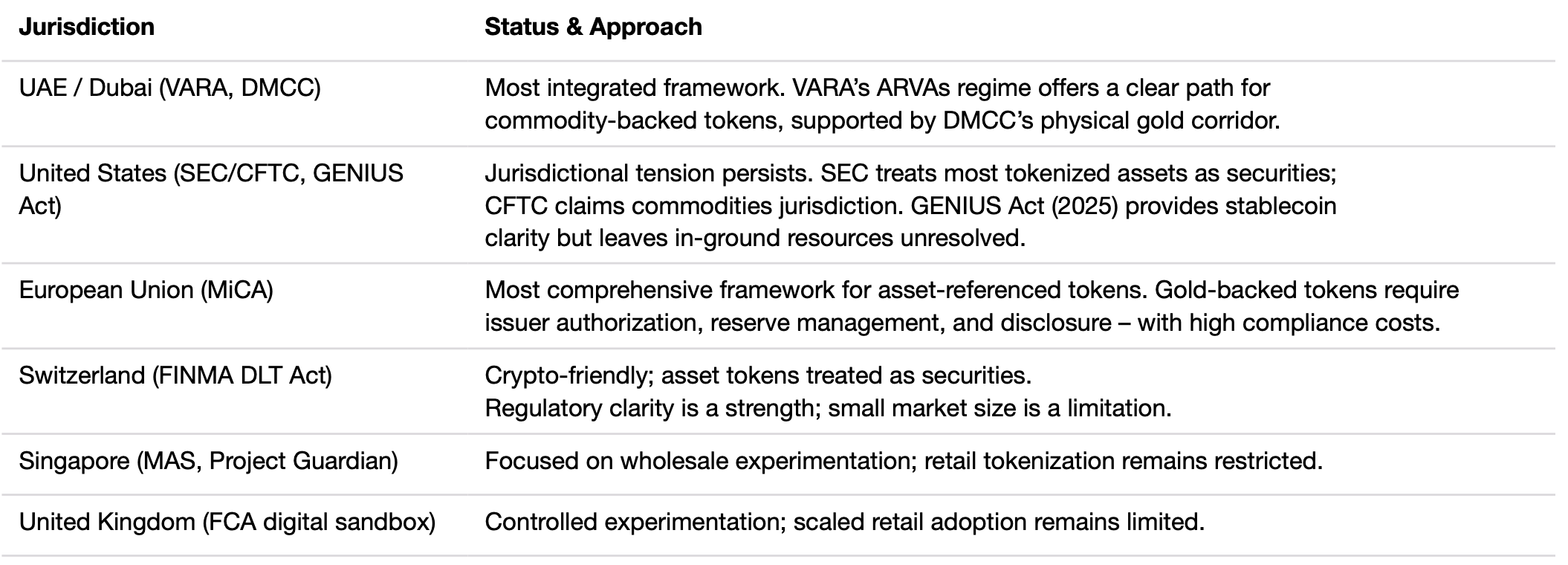
Source: In Gold We Trust report
Over a 20-year horizon, regulatory clarity may prove as important as technology in determining where tokenized gold markets scale. The pattern across jurisdictions is clear: Frameworks are emerging, but operational markets remain immature. The winners will be those jurisdictions that convert pilots into credible, scalable markets – not those that issue the most licenses.
Conclusion: Back to the Monetary Future
Tokenization represents the latest chapter in a story as old as gold itself: the recurring tension between the metal’s physical properties and humanity’s desire to make it more convenient. From coins to banknotes, from banknotes to unallocated accounts, from unallocated accounts to ETFs, from ETFs to tokens – the abstraction deepens, the infrastructure evolves, but the fundamental question remains unchanged: At what point does the claim on gold become so removed from the metal that it is no longer gold?
Over the next two decades, tokenization is likely to develop as an additional infrastructure layer rather than a replacement. Retail adoption may expand access – particularly in emerging markets, where digital wallets are increasingly the primary interface with financial assets. Institutional adoption may improve efficiency – T+0 settlement, collateral mobility, and interoperability across the LBMA system. Speculative models will remain constrained by valuation risk, regulatory scrutiny, and the irreducible geological uncertainties of in-ground assets.
Physical bars in vaults will continue to serve as the ultimate settlement asset. What changes is not the metal but how it moves. The jurisdictions, institutions, and platforms that succeed will be those that manage trust effectively: combining transparent technology with regulated custody, verifiable reserves, and clear legal frameworks.
Perhaps on the road back to the monetary future, we don’t need roads, either. But we do need gold – and we need to ensure that the digital infrastructure built around it honors the properties that made it valuable in the first place. Tokenization changes the plumbing, not the metal. The plumbing matters – but only because the metal endures.
[1] We have already discussed the digitization and tokenization of gold on several occasions; see “Gold-Backed Tokens in 2020 – A Glimpse into The Future?,” In Gold We Trust report 2020; “Gold vs. Bitcoin vs. Stablecoins,” In Gold We Trust report 2019; “Crypto: Friend or Foe?,” In Gold We Trust report 2018
[2] See also chapter “A Golden “Stabilization” Op in Plain Sight” in this In Gold We Trust report
[3] See “Dubai, the Golden Oasis driving the UAE Gold Market’s Growth,” In Gold We Trust report 2024