

Gold and the Monetary Analogue of Mackinder’s Foundational “Heartland Theory”
“Man and not nature initiates, but nature in large measure controls.”
Halford John Mackinder
- The foundation of modern geopolitics is Mackinder’s Heartland Theory and the strategic imperative of controlling the Eurasian landmass.
- The conflict plays out between the major land powers of Eurasia, like Russia and China, and the external maritime powers, such as the US and formerly Britain.
- In the monetary analogue of Mackinder’s theory, the strategic imperative is control of the world’s reserve currency and its monetary architecture.
- The US dollar system has represented the projection of “maritime power” that has contained Eurasia for decades. Gold is the impregnable monetary Heartland – the ultimate expression of “land power” – and the gold price is a real-time indicator of the balance in this conflict.
A geopolitical struggle is unfolding in which gold is inexorably returning to a central role in the global monetary system.[1] This struggle can be viewed through the lens of classical geopolitics – namely Sir Halford J. Mackinder’s seminal paper, “The Geographical Pivot of History”, which advanced his “Heartland” theory.
The underlying principle of Mackinder’s theory and its adaptations has endured. The distribution of foundational resources and strategic assets determines the architecture of global order. This chapter argues that this principle now applies as much to the international monetary system as it once did to the geopolitical map. In our analysis, we outline Mackinder’s geopolitical theory and how it applies to the current situation involving the US, China, OPEC, NATO, BRICS, the Middle East, Ukraine, the South China Sea, etc.
Translating the theory to the monetary sphere, we show how gold is akin to Mackinder’s “Heartland” as the anchor to the financial system as the dollar’s role declines. The result is a global struggle for monetary hegemony that mirrors the geographic dynamics Mackinder explored over a century ago. The monetary architecture is in the early stages of a transformation that is greater in magnitude than we saw with the breakdown of Bretton Woods in 1971.
Mackinder’s Heartland Theory – the Geopolitical Perspective
The “Great Game” of modern geopolitics dates back to the rivalry between Great Britain and Russia for supremacy in the Central Asian region during the 19th and early 20th centuries. According to Wikipedia, the paper Mackinder presented to the Royal Geographical Society in 1904 is “…often considered as a, if not the, founding moment of geopolitics as a field of study”.
Mackinder argued that global power is ultimately anchored in geography and the major geopolitical prize for the world’s great powers is control of the Eurasian landmass – the connected continents of Europe and Asia – which he called the “World Island”. The rationale was straightforward: Eurasia contains the bulk of the world’s population, economic activity, and natural resources. Control of Eurasia, and where and how to exert control, are key to Mackinder’s theory.
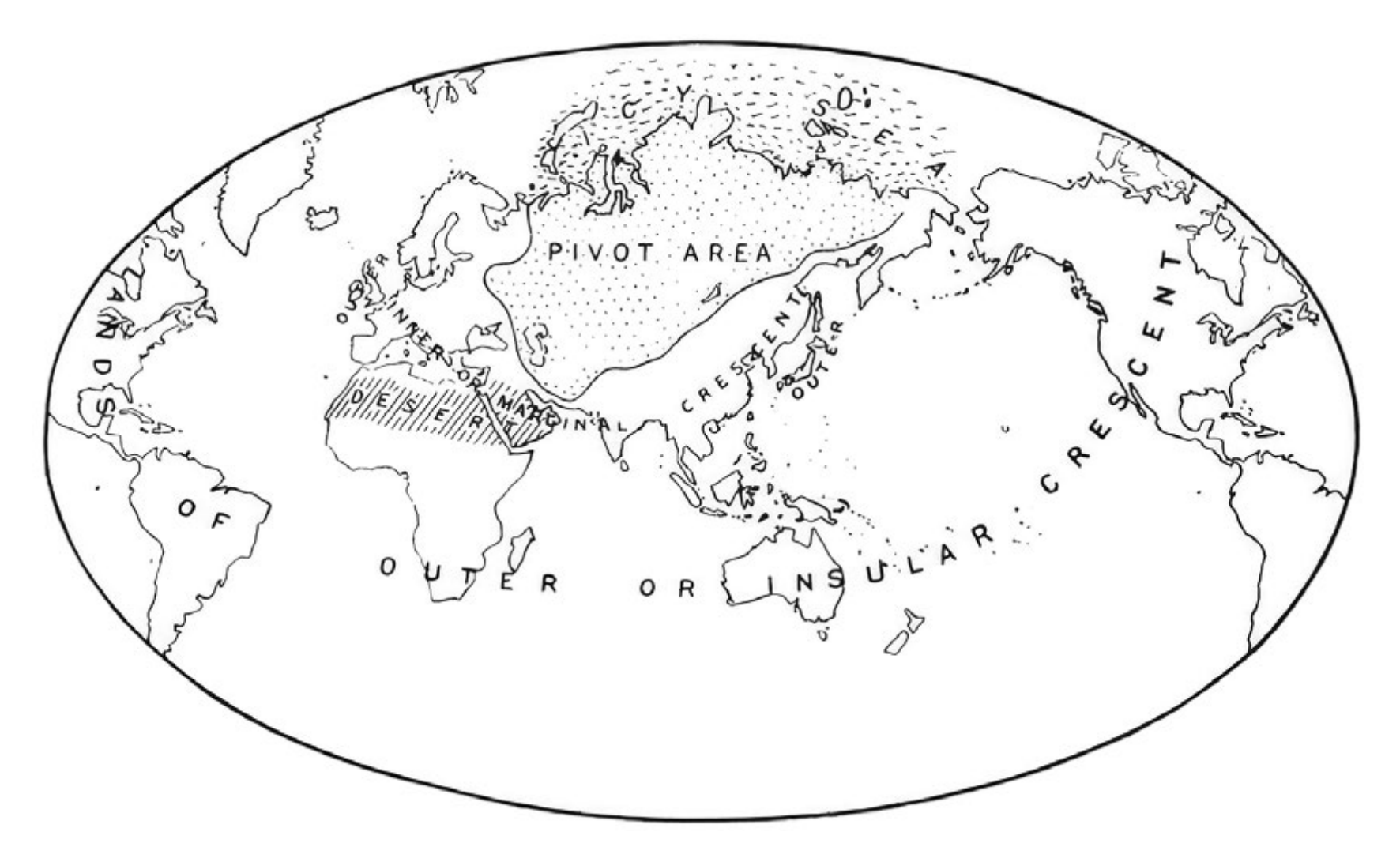
Having identified Eurasia as the geopolitical prize, Mackinder divided the world into three regions:
The Heartland or Pivot area, which Mackinder identified as Eurasia’s vast interior. Initially, he identified it as the area east of the Volga, south of the Arctic, west of the Yangtze, and north of the Himalayas – although he subsequently extended it;
The Inner or Marginal Crescent (Rimland), which included the coastal fringe regions of Eurasia: Western Europe, Türkiye, the Middle East, India, East and Southeast Asia, Taiwan and Korea, etc. We prefer to use Nicholas Spykman’s term “Rimland” for this area; and
- The Outer or Insular Crescent (Offshore Islands), which included the maritime nations largely separated from the Eurasian continent, such as Britain, Japan, North America, South America and Australia. We prefer Spykman’s term “Offshore Islands” for this area.
The following quote is from the Reagan Administration’s “National Security Strategy of the United States”, published in January 1988. It is “pure Mackinder”:
The first historical dimension of our strategy is relatively simple, clear-cut, and immensely sensible. It is the conviction that the United States’ most basic national security interests would be endangered if a hostile state or group of states were to dominate the Eurasian land mass – that area of the globe often referred to as the world’s heartland.
Writing almost a decade later, the influential globalist and former US National Security Advisor, Zbigniew Brzezinski, argued in his famous 1997 book The Grand Chessboard:
Ever since the continents started interacting politically some 500 years ago, Eurasia has been the centre of world power… For America, the chief geopolitical prize is Eurasia – and America’s global primacy is directly dependent on how long and how effectively its preponderance on the Eurasian continent is sustained.
Another key element in Mackinder’s theory was the competition between the major land powers and major sea powers. Through the lens of Mackinder’s theory, large landmasses bestow strategic depth, raw materials and efficiencies in transportation. Consequently, the control of large, contiguous interior territory creates strategic options which sea powers lack and cannot penetrate. The Heartland’s size, central location and invulnerability to sea power made it key to controlling the World Island – hence the “Geographical Pivot” – according to Mackinder.
Mackinder’s theory contradicted the idea that maritime supremacy was sufficient for Britain, the greatest sea power at the time, to safeguard its hegemony. Since Mackinder’s era, the US has obviously surpassed Britain as the leading sea power, with its 11 carrier strike groups and extensive network of ports and military bases in and around the periphery of Eurasia. Mackinder theorized that with new transportation routes, e.g. the Trans-Siberian railway, and technology, a land power controlling the center and resources of Eurasia could eventually repel the sea power’s colonies everywhere across the continent.
Mackinder argued in 1919 that World War I extended his original definition of the Heartland as far as the Baltic Sea to the northwest and the Black Sea in the southwest. This brought additional nations into the Heartland, including Poland, later to be the catalyst for World War II, and Ukraine. He argued the case for preventing a convergence of interests between Russia and what he saw as the new “pivot” states of Eastern Europe, i.e. Austria, Hungary, Czechoslovakia and Poland. He summarized this in his famous dictum:
Who rules East Europe commands the Heartland;
who rules the Heartland commands the World Island;
who rules the World Island commands the world.
Gold as the Monetary “Heartland”
A gap exists in classical geopolitical literature, since money and finance were never integrated as strategic elements of geography. Mackinder acknowledged resources, industrial bases, and transport networks, but not:
- the dominant currency in pricing international trade;
- cross-border payment systems;
- reserve currencies;
- neutral collateral assets;
- the geography of gold production and storage; and
- systemic consequences of weaponized finance.
This absence was less problematic in Mackinder’s era, when gold anchored the monetary system and financial globalization was limited. But in the contemporary age, where financial flows exceed physical trade by orders of magnitude, geopolitics cannot be disentangled from the architecture of international money.
Mackinder viewed his geopolitical Heartland as land power possessing natural barriers and immunity from sea power, which made it a unique “fortress”.
If we asked the question, what asset is the monetary equivalent of the Heartland and has acted as the monetary pivot of history, we would argue that there is only one answer and that is gold – even if it has temporarily been confined to a lesser role since Nixon took the world off the gold exchange standard in 1971.
Why is gold the monetary Heartland?
The Heartland’s power derived from its centrality and difficulty of encroachment. Gold has been used as money in coin form for at least 2,500 years and is believed to have been used in trade and as a store of value in Ancient Egypt as long ago as 3,000 BC. It possesses unique attributes with which to function as money and a store of wealth:
- It is geopolitically unaligned and therefore neutral;
- Its supply is geologically constrained and it cannot be printed, created by fiat, or devalued;
- Its value is universally recognized;
- It is the only financial asset with no counterparty risk, i.e. it is nobody’s liability; and
- It has a high stock-to-flow ratio which gives stability – all the gold ever mined exists as above-ground supply, so annual changes in gold production are almost immaterial.[2]
In a Mackinder monetary analogue, we see gold as metaphorically representing land power:
- Once gold is mined it tends to be stationary and remains stored in vaults;
- The movement of physical gold tends to be relatively small in the context of the total amount of gold stored in vaults and traded on the world’s exchanges; and
- Gold is the ultimate reserve asset and avoids the need to settle every trade in gold – net positions can be settled periodically between countries or banks.
We should remind ourselves that historically, currency in the form of coins that are not “specie”, i.e. not made out of gold or silver, and until recently also banknotes, were viewed as nothing more than derivative instruments corresponding to gold or silver in vaults. British banknotes still say, “I promise to pay the bearer on demand the sum of…” which historically was understood to mean that they could be converted into the equivalent amount of gold at the Bank of England.
The Geopolitical Importance of the Rimland
Mackinder believed that a land power like Russia could use its base in the Heartland to control the World Island by taking over the coasts and warm water ports that made global commerce possible, i.e. the Inner or Marginal Crescent on the periphery of Eurasia. In 1919, Mackinder’s focus was on Eastern Europe as a gateway to the major coastal nations of Western Europe.
We believe that Mackinder’s theory benefits from integration with another geopolitical theory, namely Spykman’s “Rimland theory”. Nicholas J. Spykman was Professor of International Relations at Yale University, and the book establishing his theory, The Geography of the Peace, was published in 1944. Spykman also focused on controlling Eurasia as the geopolitical prize and adopted Mackinder’s divisions of the world, although he renamed two of them:
- Heartland – the same as Mackinder;
- Rimland – equivalent to Mackinder’s “Inner or Marginal Crescent”; and
- Offshore Islands & Continents – equivalent to Mackinder’s “Outer or Insular Crescent”.
Spykman agreed with Mackinder that the Heartland offers a uniquely defensive position – something which was self-evident at the time from Germany’s unsuccessful invasion of Russia in 1941. However, Spykman argued that exerting control on the maritime edges of Eurasia to the west, south and east, i.e. what he called the Rimland, was more important than the Heartland. This was due to the Rimland being:
- more densely populated;
- more industrialised; and
- containing more resources.
The key regions and countries in Spykman’s Rimland were:
- Western European coastal nations, from Scandinavia to Southern Europe;
- Middle East/Near East, including Saudi Arabia, Türkiye, Iran, Iraq and Afghanistan;
- Southern Asia – India and the Indian Ocean littoral; and
- East Asia and South Asia – China and the coastal nations along the Pacific Rim.
The countries in the Rimland are in a kind of “amphibian belt”, or “buffer zone”, between the Heartland and the oceans. They can be influenced by both the major land powers and the major sea powers. The Heartland has the potential to act as an impregnable base for a land power to take control of the Rimland. From the standpoint of a major sea power, like the US, the Rimland was the area where sea power could pressure the land-locked Heartland and where it was crucial for land power to be contained. In contrast to Mackinder, Spykman’s dictum was: “Who controls the Rimland rules Eurasia; who rules Eurasia controls the destinies of the world.”
This idea of containing the land powers of Eurasia has been a long-term strategy of Britain, the US and NATO. While most people remain unfamiliar with Mackinder’s and Spykman’s theories, they explain much of the geopolitical tension during the 20th century:
- Britain’s containment of Russia in the early part of the century;
- the Cold War from 1945–89; and
- NATO’s eastward expansion following the fall of the Iron Curtain in 1989.
The strategy was highlighted by the US Naval War College in 2023 in the context of Ukraine. The paper “Confining the Enemy – Halford Mackinder’s Theory of Containment and the Conflict in Ukraine” stated:
Mackinderite analysis rests on an imperative of checking the territorial power — either alone or in alliance — occupying the heartland. The elements of Mackinderite maritime geostrategic perspective endure, and they are as follows: onshore bridgeheads, offshore (island) aerodromes and military bases, maritime denial of threatened seas, and the United States reestablished as a thalassocracy (i.e. deriving power and wealth from maritime supremacy).
While the validity of much of Mackinder’s theory has stood the test of time – including the central tenet about controlling Eurasia and the balance between land power and sea power – some aspects have evolved since his era.
While Mackinder identified nations in East Europe as being the “pivot” states in the struggle for geopolitical dominance of Eurasia, as we discussed, we believe that the pivot areas evolve over time. This is due to multiple factors including:
- economic growth;
- military strength;
- industrial development and technology;
- access to key resources;
- monetary architecture; and
- geopolitical alignments.
In our opinion, three pivot areas have come to the fore in recent decades:
- Middle East;
- Central Asia and the Trans-Caucasus; and
- South China Sea.
The oil-producing nations of the Middle East, notably Saudi Arabia, Iran, Iraq and Kuwait, took on greater importance as the world became increasingly dependent on crude oil and, latterly, natural gas.
More recently, several nations in Central Asia and the Trans-Caucasus, including Ukraine, Azerbaijan, Turkmenistan, Uzbekistan, have risen in geopolitical significance. In part, this is due to their substantial energy resources and/or pipelines.
The next quote is another from B rzezinski’s book The Grand Chessboard regarding the Central Asian Republics, or “Eurasian Balkans”, as he describes them. Interestingly, he also mentions gold:
They are of importance from the standpoint of security and historical ambitions to at least three of their most important and more powerful neighbours, namely Russia, Türkiye and Iran, with China also signalling an increasing political interest in the region. But the Eurasian Balkans are infinitely more important as a potential economic prize; an enormous concentration of natural gas and oil reserves is located in the region, in addition to important minerals including gold.
Arguably, Brzezinski’s thinking provides insight into the US-supported “color revolutions” in the region, including Ukraine (Orange, 2004), Georgia (Rose, 2003) and Kyrgyzstan (Tulip, 2005), and its support in overthrowing the pro-Russian government in Ukraine in 2014’s Maidan Revolution. Ukraine is clearly a critical bridge between Western Europe and the Heartland – losing Ukraine constrains Russia’s Heartland power while gaining Ukraine expands it.
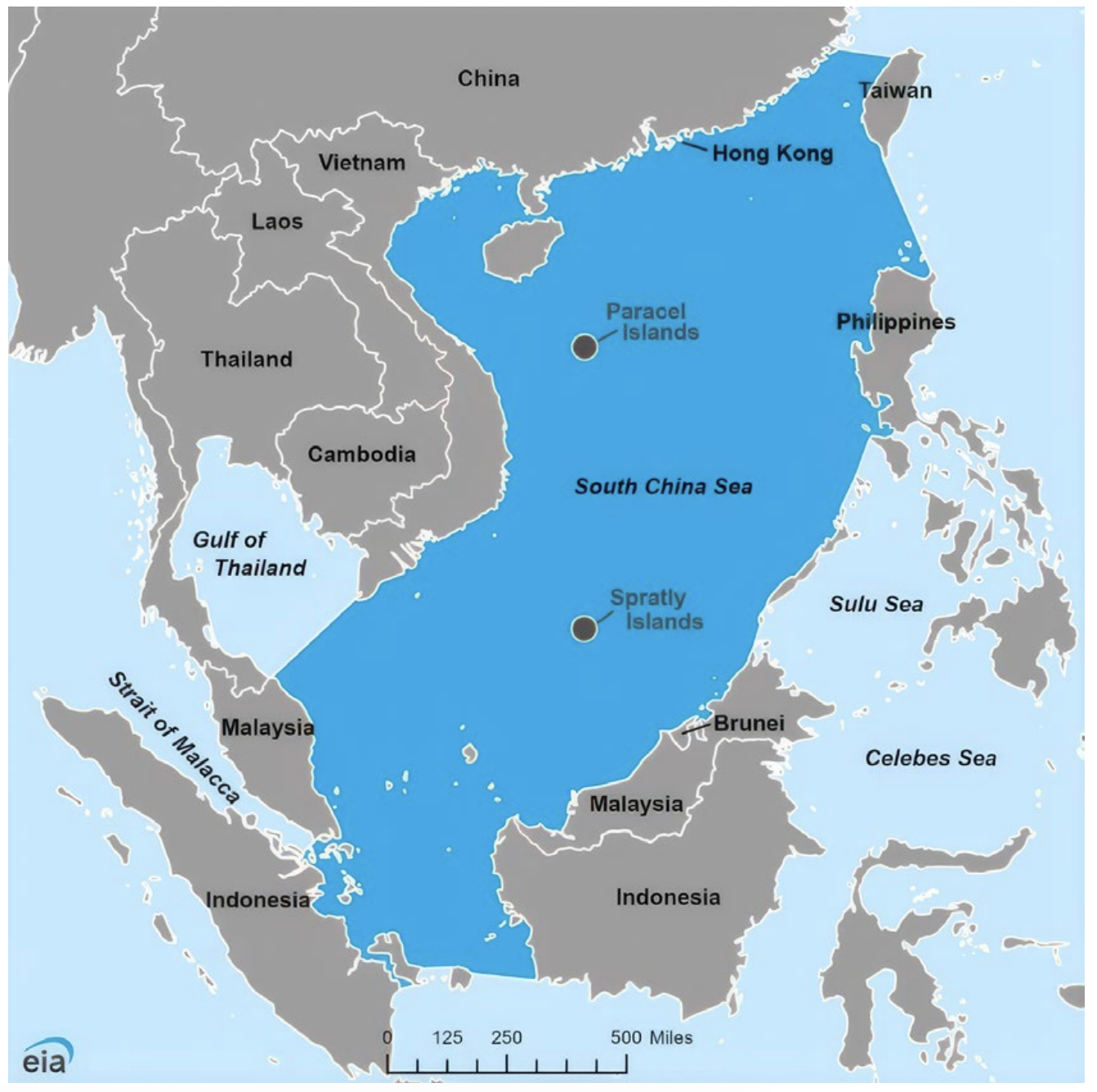
In our opinion, the East China Sea and the South China Sea in particular are becoming important “pivot areas”. The South China Sea stretches from Singapore and the Strait of Malacca at its southern end to the Strait of Taiwan in the northeast. It is the world’s second busiest sea lane.
The Atlas Institute for International Affairs commented on its importance in July 2025:
The South China Sea has become a critical pressure point for global commerce. With 24% of global maritime trade passing through these contested waters in 2023… the South China Sea’s strategic importance extends beyond simple transit volumes. The region handles 4% of global crude oil shipments, 42% of propane (and LNG), and 26% of automotive trade.
In an October 2011 article, “America’s Pacific Century”, then Secretary of State Hillary Clinton signaled a re-engagement with the Asia Pacific region:
As the war in Iraq winds down and America begins to withdraw its forces from Afghanistan, the United States stands at a pivot point… One of the most important tasks of American statecraft over the next decade will therefore be to lock in a substantially increased investment – diplomatic, economic, strategic, and otherwise – in the Asia-Pacific region.
This marked the beginning of the US “pivot to Asia” or “rebalance to Asia” in foreign policy since the Obama administration. Clinton highlighted US interest in the freedom of navigation of the South China Sea, human rights issues in China, the need for the US to strengthen alliances in the region, and the desire for peaceful settlement of territorial disputes. Clinton argued, diplomatically, that it wasn’t about containing the rising influence of China. Nevertheless, she is believed to have angered the Chinese leadership.
Comments from the retiring commander of the US Pacific Fleet, Admiral Patrick Walsh, in January 2012 directly identified the geopolitical threat from Chinese dominance of the South China Sea. Walsh, a proponent of Mackinder’s theory, recommended that it should be the regional focus for the US:
In the Pacific Century, sea power resumes its traditional role in the sea-lines of communication… You can identify where [the South China Sea] the critical node is… It forces an assessment of whether we are prepared for where this economic juggernaut [China] is going.
The US “pivot to Asia” was clearly rooted in classical Mackinder geopolitics, even in its adoption of the word pivot. It represented the leading sea power striving to contain a potentially dominant Eurasia-based power that could exert control on the Heartland and the Rimland. We should note that we see China as having both land power and sea power characteristics, based on Mackinder and Spykman’s theories.
Fast forwarding to today, geopolitical rivalry sees the US, on one side, looking increasingly isolated as Trump threatens sanctions on NATO allies, launches military operations in Venezuela and Iran, and signals his intention to take Greenland. The continuation of the longstanding alliance of Western nations via NATO is no longer certain.
On the other side of the geopolitical divide are China and Russia, which are the primary nations in two broader alliances:
- Shanghai Cooperation Organization (SCO) – which includes India, Iran, five of the “Stans” including Pakistan, and Belarus. The SCO accounts for about 65% of the Eurasian land mass, 42% of the world population and nearly 25% of global GDP; and
- BRIC – which was formed in 2009 with Brazil, Russia, India and China; South Africa joined in 2010, making it BRICS. A further five countries have since joined: Iran, Indonesia, Egypt, Ethiopia, and the UAE. A further 10 nations are designated partner countries and participate in summits. The BRICS nations account for nearly 50% of the world population and 25% of global GDP.
Mackinder feared a single power, like Russia, or an alliance of powers, such as Germany and Russia in his day, controlling Eurasia, which would enable them to challenge the British Empire and, by extension, the US.
China and Russia are the two great powers of the Eurasian landmass along with Germany. From Mackinder’s framework, it’s clear that the rise of China in economic and military strength, its closer cooperation with Russia, and their closer cooperation with other Eurasian nations, is a potential existential threat to the global hegemony of the US. This situation is almost perfectly mirrored in the monetary sphere.
The Monetary “Rimland” – US Dollar System and “Paper Gold”
In the same way that Mackinder and others identified control of Eurasia (the World Island) as the major prize in the struggle for geopolitical hegemony, there is a monetary parallel. There is a developing struggle for monetary hegemony that mirrors the spatial dynamics Mackinder explored over a century ago.
The analogue in the monetary sphere is control over the monetary and financial infrastructure that underpins global commerce and reserve currencies and assets. The US dollar system has effectively occupied that position since the end of World War II, but is increasingly under threat.
In the Mackinder and Spykman models, the US is classed as a maritime nation included in the Offshore Islands, along with UK, Japan, South America and Australia. The Offshore Islands encircle Eurasia and can project power against it. While the US is an Offshore Island in a geopolitical sense, a large portion of dollar liquidity exists outside of the US in what are known as eurodollars and the eurodollar market.[3]
Eurodollars are US dollar liabilities against US banks that are held overseas but operate outside the direct control of the Eurasian land powers. The “oceans” of US dollar liquidity act as an external offshore system, flowing in and out of the Eurasian economy and encircling it at the same time.
The US dollar system is similar in concept to a maritime power projecting its power far from its home shores. It has taken a range of forms:
- The flows of US dollar liquidity underpinning world trade;
- Control of the international banking system and payment systems such as SWIFT;
- US Treasury bonds acting as the premier “risk-free” financial asset;
- The recycling of US deficits into US financial assets by overseas nations; and
- Fed swap lines adding dollar liquidity during times of crisis – effectively the lender of last resort.
By the US requiring critical commodities to be traded in US dollars, the Eurasian powers have been forced to engage with the US dollar-based monetary system. The US dollar has acted as a containment tool in a Mackinder sense:
- The US dominates these monetary flows, which allows it to bridge or block trade, just as a navy controls the seas, and shape the economic landscape of Eurasia;
- It has provided the US with the “exorbitant privilege” of exporting its inflation in the form of trade/budget deficits and lowering its interest rates; and
- It has also restricted the ability of the Eurasian powers to build an autonomous, self-sufficient continental economic zone.
If we think of the Rimland as the meeting point of land power and maritime power, there is another monetary analogue besides the external dollar (eurodollar) system. These are the “paper gold” markets. Most readers of In Gold We Trust reports will be familiar with this, and we won’t go into a detailed description. Nevertheless, for decades, gold price discovery has been determined by two locations:
- London Bullion Market Association (LBMA), based in London and trading unallocated and allocated gold. It is a trade association dominated by the world’s major bullion banks; and
- COMEX – trades gold futures and is based in New York. It is part of the CME Group, the world’s largest derivatives market.
While it’s acknowledged that only a tiny fraction of COMEX futures trades are settled in physical bullion transfers, it’s widely believed that gold trading on the LBMA is settled in bullion transfers. In reality, that is rarely the case, either. In fact, it is estimated that more than 95% of LBMA trades are settled in unallocated gold accounts, which are paper claims to an undisclosed volume of gold bars in a vault – they are effectively gold derivatives. This is a highly leveraged fractional reserve system. Less than 5% of trades are settled in allocated gold accounts, where the ownership of metal is transferred from seller to buyer.
The combination of gold futures and unallocated gold accounts has led to an imbalance in paper gold supply versus physical bullion. The imbalance has counteracted the relative scarcity of physical bullion, leading to the gold price in US dollars and other currencies being suppressed.
Rimland Monetary Conflict – Gold versus the US Dollar
The gold price in US dollars is a real-time expression of Mackinder’s geopolitical conflict in the monetary sphere. Every currency regime, from the classical gold standard to modern, fiat-based systems, is ultimately judged against gold.
A rising gold price represents:
- Debasement of the US dollar via excessive deficits and credit creation;
- A structural challenge – currently led by the BRICS nations – to the US dollar system and the erosion of its dominance; and
- The breakdown in the ability of paper gold settlement systems to contain a rising gold price, as they are overwhelmed by physical accumulation.
From the perspective of the BRICS and other nations, the US dollar system has been weaponized by:
- sanctioning international payment systems and a growing narrative that it is a tool of US power; and
- structural and rising budget and trade deficits.
The US, along with the EU, United Kingdom and Canada, agreed to remove seven Russian banks from the SWIFT international payments system in March 2022, following the Russian invasion of Ukraine. This was expanded to 50 Russian banks and remains in place. The US and other nations also froze approximately USD 300bn in Russian central bank assets held overseas. The treatment of Russia in terms of access to SWIFT and the freezing of its reserves had a profound knock-on effect on the gold market.
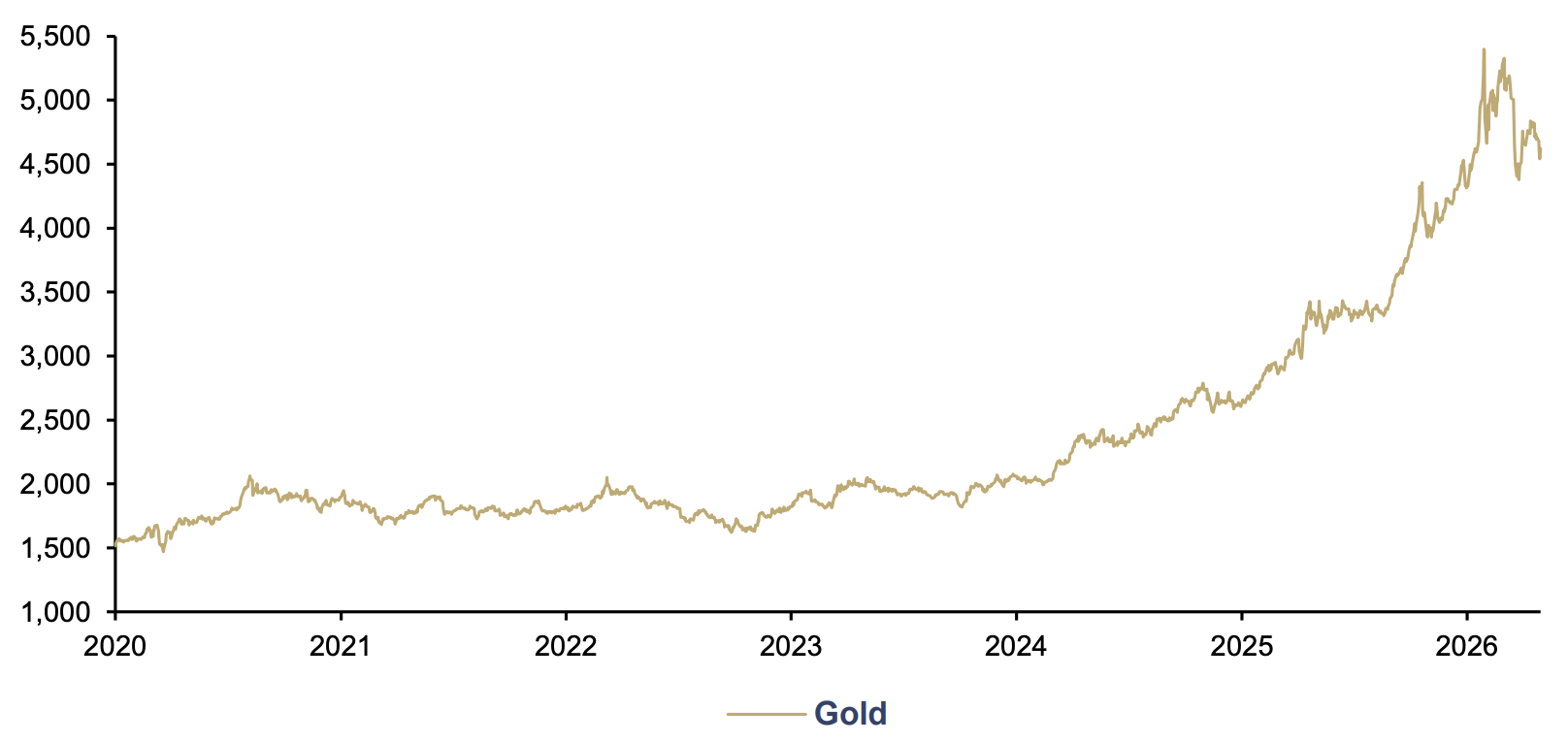
Gold, in USD, 01/2020–04/2026
Source: LSEG, Incrementum AG
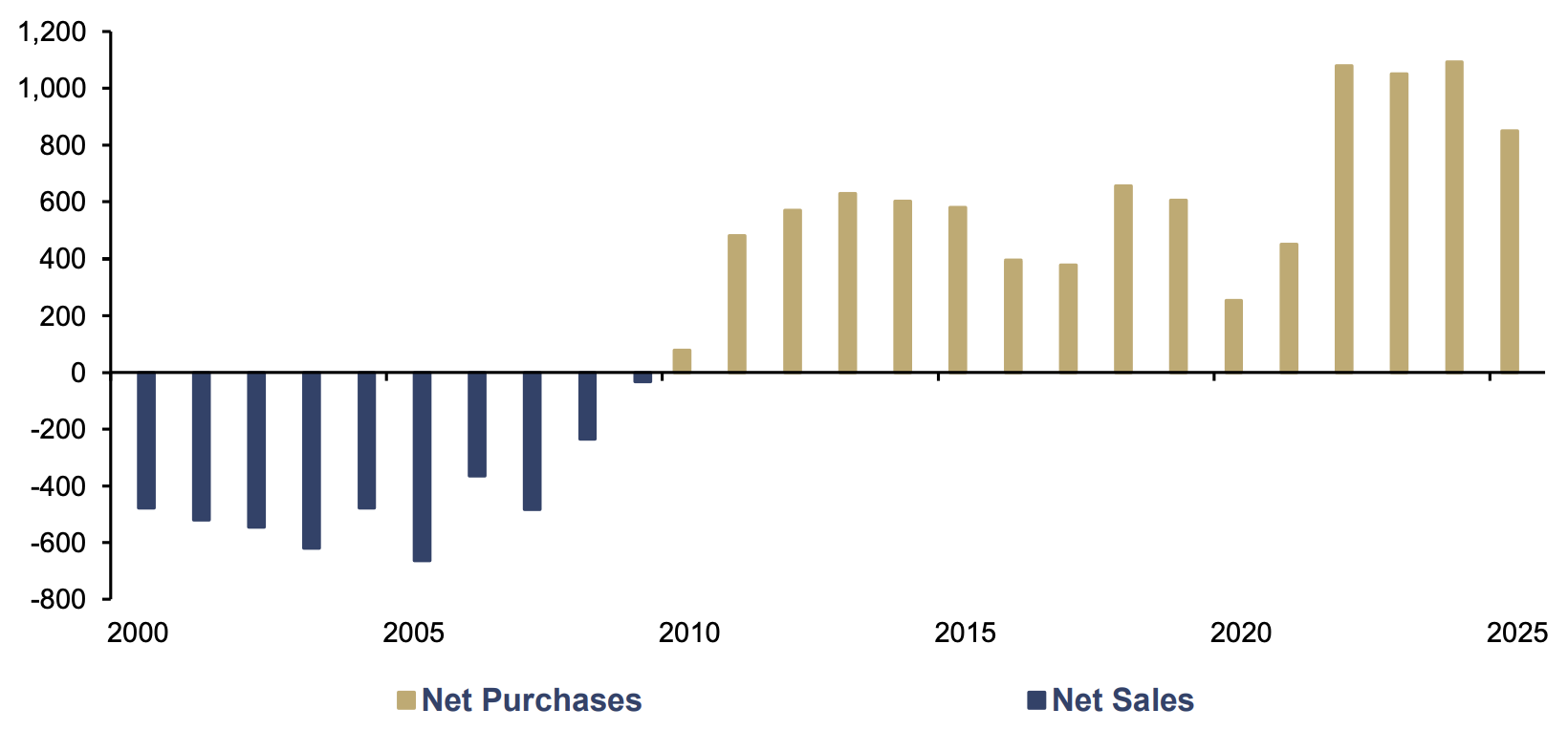
When trust in fiat currencies fades, central banks return to gold as the ultimate and neutral form of money and reserve asset.
Global Central Bank Gold Purchases, in Tonnes, 2000–2025
Source: ICE Benchmark Administration, Metals Focus, Refinitiv GFMS, World Gold Council, Incrementum AG
In 2024, the value of gold exceeded the value of US Treasuries as a proportion of international reserves for the first time since the mid-1990s. Several BRICS nations and those linked to the BRICS group have been increasing gold reserves in recent years. Russia and China have done this most aggressively, but also India, Türkiye, and Middle Eastern states. This accumulation can be interpreted as:
- A hedge against fiat currencies;
- A hedge against financial sanctions;
- Preparation for non-dollar commodity settlement and collateral; and
- A foundation for credibility in new monetary arrangements.
In 2024, China and Russia led global gold production with 380.2 t and 330.0 t respectively, while the United States produced approximately 160 t. Initial estimates indicate that 2025 set a new annual record of 3,672 t. Combined production from BRICS+ and aligned nations, including Kazakhstan and Uzbekistan, accounts for approximately 50% of global gold output – a concentration that gives the bloc unprecedented influence over the physical gold market.
The US ability to cut off Russia’s access to the SWIFT dollar payment system acted as a blockade and, effectively, as an attempt to confine its economic activities within the Heartland. Gold and the dollar are in an intensifying conflict that marks the first serious systemic challenge to the US dollar-centric global order since the collapse of the Bretton Woods system in 1971.
In parallel to the accumulation of gold reserves, the BRICS nations have been cooperating with regard to a new monetary architecture. This includes commitments to:
- endorse alternatives to dollar-centric and SWIFT settlement in principle;
- undertake further intergovernmental and central bank work on shared infrastructure; and
- developing a common unit of account partly backed by gold.
From a gold perspective, the most interesting aspects of the discussions relate to the possibility of a gold-linked “unit”:
- It would be used in the settlement of cross-border trade;
- It would not be a “BRICS currency” in the same way as, for example, the euro; and
- The unit would be partly backed by gold, with media reports suggesting roughly 40% gold and 60% based on a basket of BRICS currencies.
If a gold-linked unit is developed, it is expected to be based on multilateral gold netting between nations rather than bilateral settlement, which would significantly reduce the amount of gold required.
At the 17th summit in Rio in July 2025, BRICS leaders did not formally endorse a goldlinked settlement mechanism in the official communiqué. In October 2025, however, a pilot project by the Institute of Economic Strategy of the Russian Academy of Sciences (IRIAS) launched a prototype with 100 units, each initially pegged to 1 gram of gold. Some Russian-linked sources have suggested the creation of a gold settlement network with vaults in several BRICS jurisdictions, e.g. in Shanghai. It’s been rumoured that some BRICS officials are targeting 2030 for the rollout of this system.
In the meantime, China announced two further moves in early 2026 which put it in direct conflict with the US dollar system, and that impact the gold price indirectly: In the Communist Party’s journal Qiushi, China’s leader, Xi Jinping, stated that the RMB could attain reserve currency status; and Reports in early February 2026 suggested that Chinese regulators were urging the country’s banks to reduce holdings of US Treasury bonds due to concentration risk and volatility in US debt markets.
The accumulation of gold reserves and efforts by the BRICS nations to construct a separate monetary architecture with a link to gold are akin to a strengthening of the Heartland’s position in a Mackinder sense. As they build a monetary Heartland, they also benefit from Russia having massive quantities of natural resources and China’s manufacturing base and large trade surplus.
In the monetary sphere, we are seeing the Heartland pushing back against the maritime supremacy of the dollar system and its stronghold in the Rimland and beyond. The last time the baton was passed in terms of the world’s reserve currency, it was done in an ostensibly benign fashion from Britain to the US, i.e. from one ally to another. It wasn’t an issue in Mackinder’s day. This is not the case this time and, going forward, we see the gold price as the ultimate expression of Mackinder’s theory in the battle between land power and maritime power in the monetary sphere – between gold and the dollar system.
[1] This article was written under the lead of Paul Mylchreest. Paul has over 30 years analytical experience, having started his career in the Chemicals sector and worked at S.G. Warburg, Schroders and Citibank. After a brief foray into Oil & Gas, he worked for several years as a Global Macro & Cross Asset strategist, firstly setting up on his own, and later working at US commodity trader, Archer Daniels Midland (ADM Inc.). He began his mining coverage at Crédit Agricole Chevreux in 2005 and also covered mining at Redburn Partners and Hardman & Co.
[2] See “Stock-to-Flow Ratio as the Most Important Reason for Gold’s Monetary Importance,” In Gold We Trust report
[3] See “How Bankers Turned Money into ‘∑ 0 ∞ € ¥’,” In Gold We Trust report 2021