


Gold and the End of the US Dollar Standard
“The capital account rules the current account.”
Eugen von Böhm-Bawerk
- The capital account and capital flows determine the trade balance – not the other way around. Large net capital exports from surplus countries force corresponding current account deficits elsewhere.
- Persistent trade surpluses are not the result of natural comparative advantages, but stem from deliberate domestic policies in countries like China, Germany, and Japan that suppress household consumption and generate massive excess savings.
- The US became the residual adjuster of the world’s excess savings and had to run persistent current account deficits as a result. Washington now views the reserve currency status more as an “exorbitant burden” than a privilege.
- The US is no longer willing to act as residual adjuster of global excess savings by accepting ongoing deficits in US-dollar assets. This shift is putting the existing dollar-based system under increasing pressure.
- As US-dollar reserves face growing political risks (sanctions, taxes, fees), gold is increasingly taking on the role of a neutral reserve asset with no counterparty or confiscation risk. Central banks and surplus countries are therefore diversifying heavily into gold.
- Gold is decoupling from the old drivers of real interest rates, volatility, and liquidity and is now primarily driven by structural demand for a neutral reserve currency. As long as global excess savings persist, the long-term upward trend for gold remains intact.
It was August 15, 1940, and Adolf Galland had just watched the Luftwaffe lose 75 aircraft in a single day. German intelligence estimated the RAF was down to its last 300 fighters. The British should have been nearly finished. Instead, RAF squadrons kept showing up in the right place at the right time, in numbers that should not have been possible. Galland, one of Germany’s finest commanders, later noted that the RAF seemed to know just where and when to send their aircraft. He could see the outcomes, but he could not explain them.
Unbeknownst to the Germans, Hugh Dowding had quietly revolutionized air defense. Radar stations along the coast fed data into filter rooms, which fed sector control stations, which scrambled fighters to exactly where they were needed. Air defense had become an integrated information system. The Luftwaffe was fighting the battle with a framework built on Spain, Poland, and France. Yet, Dowding had changed the nature of the battle entirely, and the Germans were reading it with the wrong map.
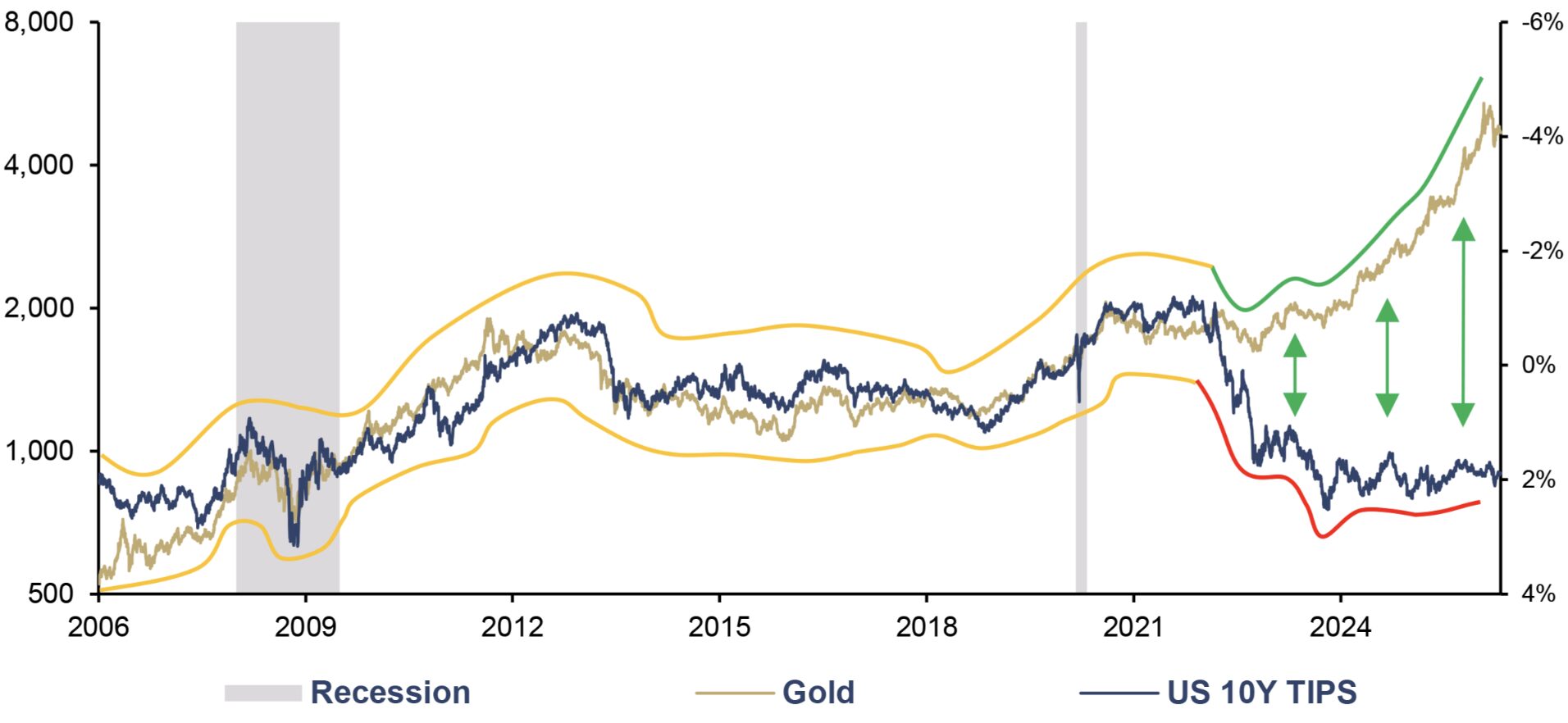
Gold has undergone a similar paradigm shift, and most investors haven’t fully realized it.[1] They can see the price action, but they’re still trying to explain it within the old framework. For years, gold could be understood reasonably well through a three-factor model built on real interest rates, volatility, and liquidity. That map no longer works on its own. Gold is increasingly trading not just as a hedge inside the existing monetary order, but as a reserve asset outside it.
This chapter argues that gold’s role is changing because the international system around it is changing. To explain the shift, we need to walk through the full logic of how we got here. We begin with a simple balance of payments identity. We then show how a set of domestic policies in surplus countries systematically suppresses consumption and generates excess savings. Those excess savings create a growing need for reserve assets and force counterpart deficits somewhere else in the system. That, in turn, explains why reserve currency status has become a burden for the US and why the US is now trying to restructure the global trading and capital flow system. From there, we can understand why gold is once again taking on a reserve function, why that changes the way gold trades, and what a future reserve architecture might eventually look like.
Galland kept being surprised because he was still reading the battle through the old framework. The surprises were the signal that the system itself had changed. Gold investors should not make the same mistake.
The Balance of Payments
Most discussions of international trade focus only on goods and services. But that captures only half the picture. When money crosses borders, it does so in one of two ways. It either buys goods and services, which shows up in the current account; or it buys financial assets, which shows up in the capital account. Every net trade flow has a matching net capital flow on the other side. These two flows are inextricably linked through what economists call the balance of payments, which can be expressed in a simple but powerful equation:
Current Account = Capital Account[2]
A country that imports more than it exports must, by definition, sell claims on itself to foreigners. A country that exports more than it imports must, by definition, accumulate claims on someone else. Put differently, a current account deficit is always matched by a capital account surplus, and a current account surplus is always matched by a capital account deficit.
This may sound abstract, but it has enormous implications. It means that persistent trade imbalances are never just about trade. They are also about where surplus savings are going and which countries are willing, or are forced, to absorb the corresponding net capital inflows.
The balance of payments accounting identity also tells us that any change in one side of the equation must be matched by an equal and opposite change in the other. For example, when a Japanese pension fund or the Bank of Japan uses its trade-earned US dollars to buy USD 1bn in US financial assets, all else equal, US net exports must decrease by USD 1bn and Japanese net exports must increase by USD 1bn, despite this transaction having no direct connection to trade in goods and services.
A century ago, this mattered less because capital flows were much smaller and most international finance was tied directly to trade. Today, capital flows are enormous and global foreign exchange transactions dwarf trade flows by orders of magnitude. When we focus solely on trade flows, we ignore the powerful role that capital flows play in driving trade outcomes. In fact, in today’s global financial system, it’s often capital flows that determine trade flows, rather than the other way around.
Since capital flows can drive trade outcomes, it is essential to understand what generates persistent net capital exports in the first place. Some countries systematically acquire foreign claims year after year, while others are forced to absorb the mirror deficits. This is not a consequence of comparative advantage in the traditional sense. It is the result of domestic policy choices in surplus countries that suppress consumption, subsidize production, and generate excess savings.
The Investment Growth Model and Excess Savings
In the 1960s and 1970s, Japan began running an investment growth model. China adopted a version of it in the 1990s. Germany has run its own variant since the Hartz IV labor reforms of 2003–05. South Korea, Taiwan, and much of emerging Asia have followed similar playbooks.
The investment growth model is a set of policies that transfer income from households to producers. Those policies include currency undervaluation, financial repression, wage suppression, and direct subsidies to producers. Currency undervaluation makes imports expensive and exports cheap. Financial repression keeps interest rates well below growth rates, effectively taxing savers and subsidizing borrowers. Wage suppression holds wages low relative to productivity, reducing household purchasing power while boosting corporate profits. Direct subsidies to strategic industries lower production costs, with the cost ultimately borne by households through taxes or lower transfers.
All of these examples are deliberate policy choices that compress the household share of the economy. High savings rates in countries like China are not primarily the result of cultural thrift or demographic structure. They are the mechanical consequence of policies that suppress the household share of income and raise the producer share.
How Excess Savings Are Created
When household income is suppressed relative to output, consumption falls relative to production. And because savings equals production minus consumption, the gap between the two is excess savings.
Savings = Production – Consumption
Importantly, high savings are not the result of household choice; they are the byproduct of policies that redistribute income away from households and towards producers.
John Hobson identified this underlying dynamic over a century ago. He argued that when income distribution shifts away from consumers and toward producers, demand for consumption goods grows too slowly relative to productive capacity. As a result, the economy generates more savings than consumption can justify.
Countries running investment growth models do not immediately face a savings placement problem because they channel those excess savings into domestic investment, often at extraordinary scale. For a time, that delays the external adjustment. High investment absorbs the excess savings, GDP grows rapidly, and the model appears to validate itself.
But every country that has ever employed an investment growth model runs into the same set of constraints. Investment outpaces profitable opportunities. Capital is misallocated. Bad debt accumulates. And the economy’s ability to productively absorb its own excess savings begins to deteriorate.
At the same time, the model shifts demand away from trading partners. Suppressed consumption and subsidized production make the surplus country’s exports artificially cheap, displacing foreign producers and pulling demand in from the rest of the world. That helps sustain high investment longer than domestic fundamentals alone would allow. But it does not eliminate the underlying imbalance. It only delays the reckoning while spreading the cost.
Eventually, the domestic investment channel saturates. Once that happens, more of the excess savings must spill outward as an external surplus, and the burden of adjustment is pushed onto trading partners.
Why Externalizing the Imbalance Creates a Burden Abroad
If a country systematically suppresses household income and consumption relative to production, the resulting excess output (e.g. savings) must be absorbed somewhere. It can be absorbed domestically through elevated investment, or it can be exported through current account surpluses. When it is exported, the adjustment is shifted onto trading partners.
Not all trade/current account deficits reflect this dynamic. A deficit can reflect healthy intertemporal trade. When capital flows into a savings-constrained economy and finances productive investment, raises future tradable output, and creates a plausible path to reversal, the deficit is the temporary counterpart of development. In that case, the inflow is genuinely beneficial because it expands future productive capacity.
But there is a very different kind of deficit. When a country creates excess savings by redistributing income from households to producers, it can push part of that imbalance onto the rest of the world by exporting those savings. Some other country must then absorb the counterpart deficit and the associated demand shortfall. If those inflows go into an advanced economy where investment is not constrained by scarce domestic saving, they do not automatically generate additional productive investment. In such economies, investment is usually constrained by demand, expected profitability, and risk appetite. The adjustment therefore occurs through lower domestic saving instead – either in the form of weaker output, higher unemployment, higher private debt, larger fiscal deficits, or asset inflation.
The persistent, one-way imbalances of the past four decades are not the result of healthy intertemporal trade with a path to reversal; they are structural surpluses that force the adjustment onto trading partners. In the healthy case, capital inflows finance incremental productive investment and lay the groundwork for future rebalancing. In the burden case, the inflow does not solve a funding problem, but rather creates an adjustment problem.
This was the point John Hobson first identified and Keynes and Joan Robinson extended. Hobson explained how weak consumption in the surplus country creates excess savings that must be absorbed somewhere. Keynes and Robinson added that if the surplus country does not rebalance by raising domestic consumption, the adjustment must occur in the countries forced to absorb the surplus. Robinson called these beggar-thy-neighbor policies because they allow one country to relieve its own demand imbalance by exporting it to others.
The Exorbitant Burden
The US has become the primary absorber of these externalized imbalances because it occupies a unique position in the global system. It combines deep and liquid capital markets, a very large stock of safe financial assets, and an unusually open capital account. Other economies may share some of those features, but not all of them at the same scale. Europe and Japan are surplus economies themselves. China maintains extensive capital controls. Emerging markets are too small, too volatile, or too closed to absorb the world’s excess savings on anything like the required scale. The result is that the US has become the residual destination for the net claims generated by persistent surpluses abroad. That is the real meaning of reserve-currency status.
The US does not run persistent deficits because it is chronically short of savings and needs foreign capital to finance productive investment. It runs them because the rest of the world wants to place excess savings in US dollar assets, and the US has been the country most willing and able to receive them.
In a capital-scarce economy, foreign inflows can finance new productive investment that would not otherwise occur. But the US is not capital scarce. Its investment is generally constrained by demand, profitability, and risk appetite, not by a shortage of domestic saving. As a result, foreign inflows do not automatically create more productive investment. They displace domestic funding and, through the balance of payments, force a corresponding trade deficit that weakens demand for domestic tradable production.
Th is is why the US dollar’s role is better understood as an exorbitant burden than an exorbitant privilege. As Robert Triffin explained in the 1960s, the reserve currency issuer becomes the residual adjuster. When the rest of the world implements domestic policies that systematically generate excess savings and then channels those savings into US dollar assets, the US must run the counterpart external deficit. That means lost domestic demand, pressure on tradable sectors, and adjustment through some combination of higher unemployment, higher household debt, larger fiscal deficits, or asset inflation.
The standard moralizing story gets the causality backwards. Persistent fiscal deficits are a symptom of the adjustment, not the cause of the trade deficit.
Kindleberger made the same argument about the fallacy of blaming the US fiscal deficit for the US current account deficit in the 1980s. In International Capital Movements Kindleberger stated:
Here as in Marshall’s famous general-equilibrium balls in a bowl, the position of each determines the position of all the others, and vice versa…it is a mistake to lay all the blame for the US deficit vis-à-vis Japan on the US government budget deficit.
His point was that the budget can be an outcome of the system’s adjustment when the US accepts large capital inflows.
We can use market prices to help infer the direction of causality. Countries that need to attract foreign capital to fund external deficits experience weak currencies, poor asset returns, and high interest rates needed to entice foreign buyers. That was Latin America in the 1980s, much of Asia in the 1990s, and Tür kiye today.
The US experience could not be more different. US financial assets have been among the world’s best-performing and highest-valued, while the US dollar has remained exceptionally strong despite decades of trade deficits. A currency does not appreciate by 350% over forty years of persistent deficits unless the direction of causality runs from capital flows to trade flows, not the other way around.
End of the US dollar Standard
The US dollar standard could endure only so long as the US believed the benefits of reserve currency status outweighed the costs. For decades, Washington largely treated those benefits as obvious. The US dollar anchored the global financial system, gave the US unmatched geopolitical leverage, and reinforced America’s central position in global finance. In that framework, the domestic burden of absorbing foreign excess savings was either seen as manageable, misunderstood, or treated as the necessary price of supplying the world with a critical public good.
But that bargain was always contingent on the US’s willingness to tolerate the counterpart deficits, the pressure on domestic tradable sectors, and the recurring need to offset foreign demand weakness through some combination of private sector debt expansion or fiscal deficits. Once the burden grew large enough, or became clearly visible enough, the logic of the system changed. What had long been described as an exorbitant privilege began to look more like an exorbitant burden.
That shift is now well underway. It’s not that the costs suddenly appeared. It’s that a growing part of the US policy establishment no longer sees the US dollar system primarily as a source of privilege, but as an underpriced global public good that others have used while pushing the adjustment burden onto the US.
In Stephen Miran’s first major public speech as Chair of the Council of Economic Advisers, he framed the US dollar standard and the US security umbrella as global public goods the US has been providing to the rest of the world. In his telling, the US keeps its markets open and allows other countries to externalize their domestic imbalances by accumulating US financial assets, while surplus countries free-ride on both the security umbrella and the US dollar system. According to Miran, domestic politics in surplus countries make it difficult to shift away from export-led growth toward stronger domestic demand. It is easier to keep running surpluses, accumulating US dollar claims, and letting the US absorb the demand shortfall.
Miran’s conclusion was that if voluntary cooperation does not produce real burden sharing, the country providing those public goods will begin using the instruments it actually controls to enforce it. He points to tariffs, procurement terms, investment conditions, and user fees on official US dollar holdings. In this framework, surplus countries can share the burden by opening their markets wider to US exports; buying more US goods and services; shifting foreign direct investment into US industry; and, in the line most observers glossed over, by “simply writ[ing] checks to Treasury that help us finance global public goods.”
If you have read Miran’s earlier User’s Guide to Restructuring the Global Trading System, it is clear what he has in mind. There he sketches a specific instrument: a user fee on foreign official holders of US Treasury securities, implemented by withholding part of the interest paid on those holdings.
The logic behind a capital flow tax is that every US trade deficit is matched by a capital-account surplus. All US dollars spent abroad must return either to purchase US goods and services or to purchase US financial assets. For decades those US dollars have returned overwhelmingly through the second channel. Foreign central banks and sovereign funds have not been consuming US output; they have been accumulating claims on future US production. A withholding tax or similar capital flow tool would tilt that choice by making US financial assets somewhat less attractive relative to actual purchases of US output and investment in US capacity.
Seen in that context, “write checks to Treasury” is best understood as the diplomatic version of the concrete capital account tool Miran previously discussed. So far the administration has moved in that direction through tariffs, burden-sharing demands, and investment pressure; but it has not yet imposed a user fee on foreign Treasury holdings or directly taxed foreign holdings of US financial assets. Those more explicit capital-flow measures remain unused. But the logic of the strategy points clearly in that direction. The administration’s push on stablecoins, and the passage of the GENIUS Act, tell us that the Trump administration is headed in that direction.
A great deal of confusion in these debates comes from treating the US dollar’s international currency role and its reserve currency role as though they were the same thing. They are not. The international currency role is the plumbing of global trade and finance: invoicing, payments, settlement, and collateral. The reserve currency role is about the asset in which countries accumulate net claims when they run persistent surpluses and export savings on a net basis.
That’s an important distinction because the burden on the US comes from the reserve currency role. Surplus-country policies suppress domestic demand relative to production, forcing those countries to export savings. Those net savings then become net claims on the US, which means the US must run the corresponding current account deficit. The problem is not that trade is invoiced in US dollars. It’s that the system uses US dollar assets to absorb and store persistent global imbalances.
The best analogy is the gold standard. What mattered was not that everyone used gold in ordinary day-to-day transactions. What mattered was that gold settled net positions between countries. Deficit countries lost gold, while surplus countries accumulated it. Gold was the reserve asset because it was the instrument through which persistent imbalances were ultimately settled.
Stablecoins should be understood as an attempt to separate the US dollar’s international currency role from its reserve currency role. The GENIUS Act created a federal framework for payment stablecoins backed one-for-one by specified liquid assets, including US dollars and short-term Treasuries. On its face, that is a push to strengthen the US dollar’s role in the transactional plumbing of the global system. But if Washington intends to increase the friction on foreign reserve hoarding, whether through user fees or other capital-account tools, then it needs some way to preserve the US dollar’s global payments role without continuing to subsidize the unlimited accumulation of net claims on US financial assets. Sta blecoins help unbundle those functions. They allow global users to keep transacting in US dollars even as the US becomes less willing to absorb the world’s excess savings in Treasury form without consequence. Stablecoins are the infrastructure you build before you pull the capital-controls lever.
Why Washington Has Not Yet Moved Directly Against Capital Flows
If the administration ultimately intends to go after foreign reserve hoarding more directly, the obvious question is why it has not done so already.
The first reason is sequencing. Before you can put a tax on foreign US dollar holdings, you need the stablecoin infrastructure to avoid blowing up the US dollar payments system. It is the plumbing that has to be in place before the reserve side of the system can be repriced more aggressively.
The second reason is the Federal Reserve. Capital flow tools are much riskier without the cooperation of the Federal Reserve. Miran says as much in his User’s Guide, writing that this agenda “requires cooperation from the Fed”; and he notes that such cooperation is not unusual, as the Fed has long deferred to Treasury on currency policy, and “the details can be worked out through agreements between the two”. What has likely been missing so far is confidence that Powell would provide that backstop to prevent any disorderly spike in the term premium. That is why the 2026 Fed transition sits in the background of all this. Powell’s chair term ended a few days ago in May 2026, and Kevin Warsh took over.
After Warsh’s nomination, Stanley Druckenmiller gave an interview saying he was “really excited about the partnership between him and Bessent” and that “having an accord between the Treasury secretary and Fed chair is ideal.” Given that both Warsh and Bessent previously worked for Druckenmiller, the comment is hard to dismiss as casual. It may not be a coincidence that, immediately after Warsh’s nomination, Druckenmiller chose to publicly emphasize the importance of a Treasury-Fed accord.
The Supreme Court’s February 2026 tariff ruling also increases the likelihood of the administration implementing capital flow tools. By holding that the International Emergency Economic Powers Act (IEEP A) did not clearly authorize tariffs, the Court narrowed one of the administration’s most flexible trade levers. That makes the capital account tools even more important to reverse the US trade deficit, especially since that represents the source of the underlying imbalance.
Where Will Excess Savings Go?
The US is no longer willing to absorb the world’s excess savings on the old terms. But the excess savings do not disappear. Countries are still running investment growth models that suppress domestic consumption relative to production, so some country must still absorb the counterpart demand shortfall, and some asset must still store the resulting claims.
One possibility is for surplus countries to reduce the excess savings at the source by reversing the growth model itself. That would mean raising household income, increasing consumption relative to production, and giving up part of the industrial competitiveness those policies were designed to create. It is the correct long-run answer, but politically the least likely.
A second possibility is to keep absorbing the excess savings at home through domestic investment. But those economies have already pushed investment beyond what domestic demand can profitably support. More investment would only deepen the debt, overcapacity, and capital misallocation problems already visible in places like China.
A third possibility is to find another country willing to run the counterpart deficits and absorb the rest of the world’s excess savings. But this quickly runs into political reality. No major economy wants to become the new residual adjuster, because doing so would mean tolerating a stronger currency, a weaker tradable sector, and persistent external deficits. Europe won’t do it. European politicians may occasionally speak as if reserve currency status is an opportunity, but a world in which Europe absorbs Asian excess savings would also be a world of a much stronger euro, weaker external competitiveness, and persistent trade deficits. That is the opposite of the strategy Europe, and Germany in particular, has pursued for years. Japan won’t do it, either. Japan has spent decades resisting foreign capital inflows and preserving its position as a net capital exporter. China is even less plausible. China will not accept running the required trade deficits, which would undermine its domestic competitiveness and intensify its overcapacity and debt problems. Emerging markets are too small, too volatile, and too institutionally fragile. In practice, there is no obvious replacement for the US as the global absorber.
That leaves the asset problem. Even if no country is willing to absorb the demand shortfall on the old scale, the excess savings still have to be held in some form. Until recently, the default answer was US dollar assets, above all Treasuries, but also agency debt, corporate bonds, and equities. That option is not disappearing overnight, but it is no longer frictionless. Tariffs, capital-flow threats, withholding-tax proposals, and the broader signaling from the Trump administration all point in the same direction: US assets are no longer just a neutral parking place for surplus savings. They increasingly carry political risk, potential tax risk, and, after the freezing of Russian central bank reserves in 2022, obvious sanctions risk.
If no country wants to absorb the deficits and US assets are becoming politically encumbered, that leaves gold as the obvious reserve asset alternative. Gold does not solve the underlying global demand imbalance. And it doesn’t make surplus countries consume more, nor does it create a new residual absorber, but it solves the reserve-asset problem. Gold has no counterparty risk. There is no foreign government on the other side of the claim that can freeze it, sanction it, tax it, or charge user fees for the privilege of holding it. It can’t be weaponized in the way US dollar reserves were weaponized against Russia, and it doesn’t depend on the policy choices of the country issuing the liabilities.
Central banks already understand this. Since the freezing of Russian reserves, official gold purchases have accelerated sharply. But the reason is bigger than simple sanctions hedging. The world’s major surplus economies are still generating enormous volumes of excess savings. The gold market is tiny relative to the Treasury market. That means even a partial redirection of structural reserve demand away from Treasuries and toward gold can have an outsized effect on the price of gold.
That is why gold has increasingly decoupled from the old macro models that tied it tightly to real rates, liquidity, or the next FOMC meeting. Those factors drove gold when the global trading system revolved around the US freely accepting its role as the residual absorber. That forty-year arrangement is now being renegotiated, and gold is absorbing what the US dollar no longer will.
If the Trump administration moves from indirect signaling to direct capital flow measures, the message that Treasuries are no longer a neutral parking place for excess savings becomes explicit. At that point, the incentive to move into gold should intensify. The more explicitly the US threatens to reprice or restrict foreign reserve hoarding, the stronger the rush into gold will become.
Gold in the New Regime
This structural shift is enormously bullish for gold over the long run. But it also changes how gold trades.
In the previous regime, the main drivers of gold were real interest rates, volatility, and liquidity. Gold would benefit when real yields fell, when macro volatility rose, or when investors began to worry about monetary instability. Those traditional factors still matter today, and they can still be supportive. But they are no longer sufficient to understand gold on their own.
After the freezing of Russian reserves in 2022, gold increasingly began to trade as the neutral reserve asset in a system where the old reserve asset had become politically conditional. Once US dollar reserves could be frozen, or otherwise made contingent on geopolitics, the market had to reprice the one major reserve asset without counterparty risk. That was the moment gold stopped being just a hedge inside the system and started becoming the neutral reserve asset outside it.
Gold (lhs, log), and US 10Y TIPS (rhs, inverted), 01/2006–04/2026
Source: LSEG, Incrementum AG
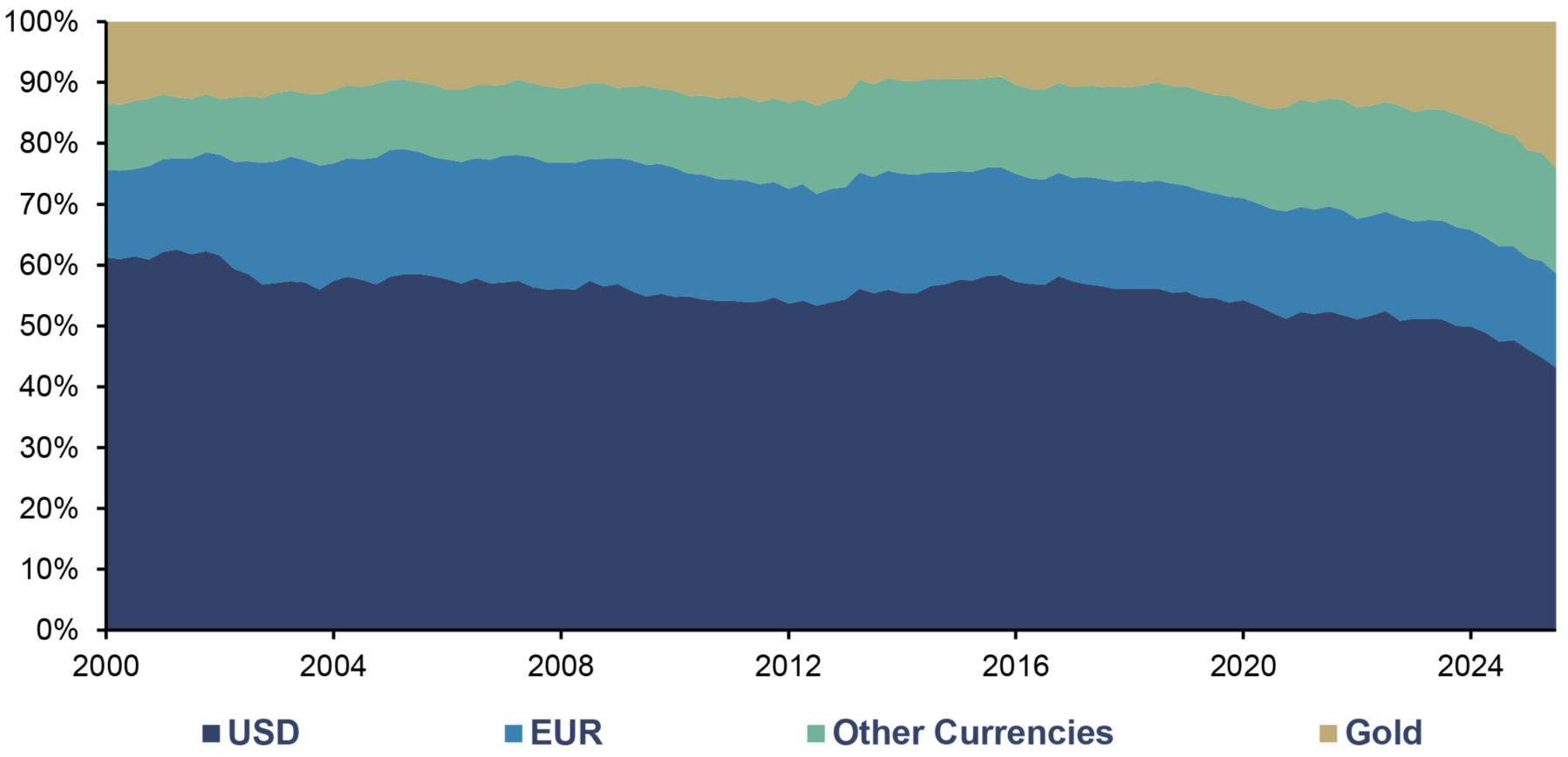
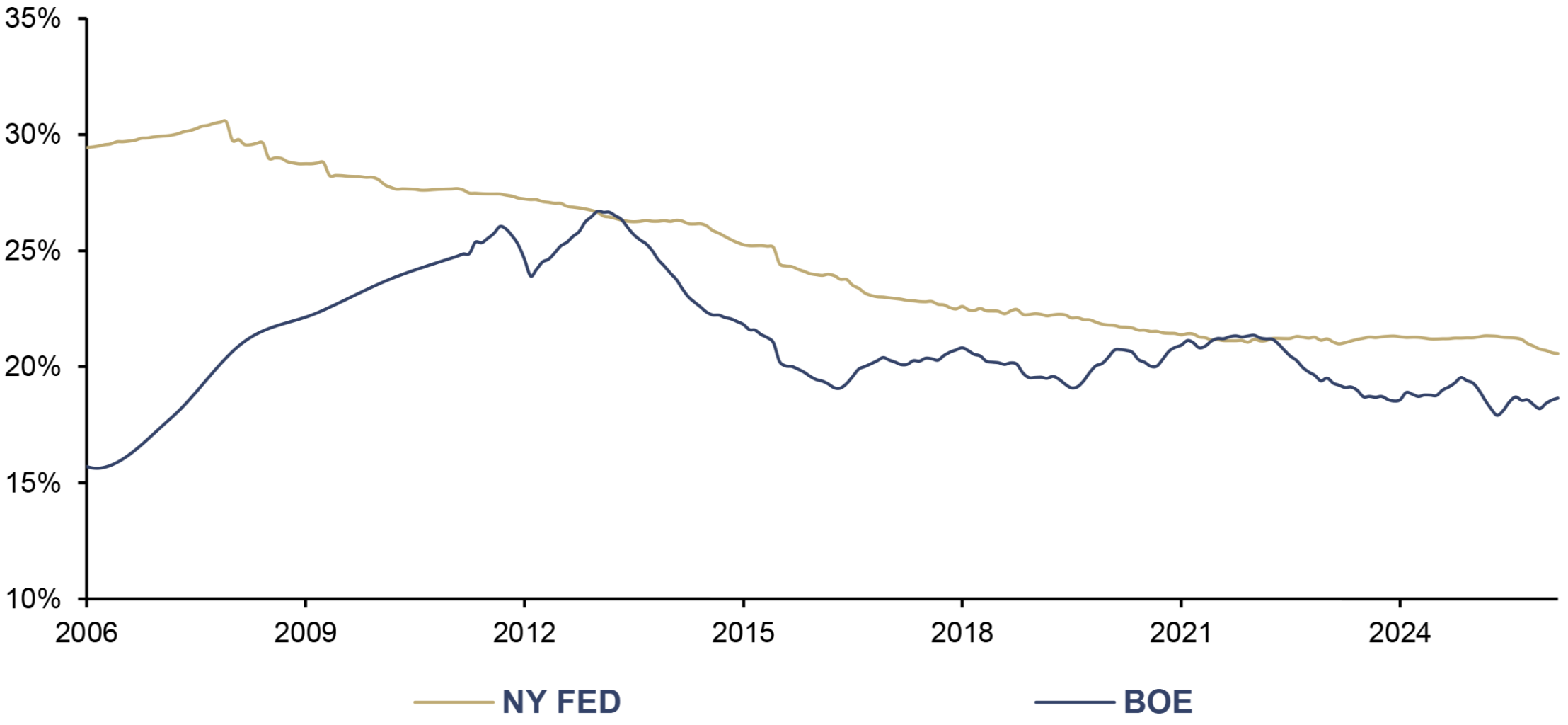
The data confirm that shift. Gold has overtaken the euro as the second most important reserve asset in the world, while the US dollar’s share of allocated foreign exchange reserves has continued to decline. Arslanalp, Eichengreen, and Simpson-Bell show in “Gold as International Reserves: A Barbarous Relic No More?” that gold’s share of reserves, measured at market value, rose from 17% to 25% during 2021–24 for advanced economies, and from 7% to 10% for emerging markets and developing economies. They also show that gold holdings measured in ounces have continued to rise, that the number of central banks buying at least one metric ton has exceeded the number selling in nearly every year since 2008, and that no advanced-economy central bank has sold gold in significant amounts since the Central Bank Gold Agreement ended in 2019. They further document that gold held at the New York Fed and the Bank of England has been declining as more countries repatriate reserves, in part because gold held at home is harder to sanction or freeze.
Composition of Global Total Reserves, 2000–Q3/2025
Source: Eichengreen, IMF, World Gold Council, Incrementum AG
Gold Custody Holdings at the BoE and NY Fed, as a % of Global Gold Reserves (ex UK and US), 01/2006–02/2026
Source: BoE, Federal Reserve Board, IMF, Incrementum AG
Even the broader gold-demand data point in the same direction. According to the World Gold Council, total gold demand hit an all-time high of 5,002 t in 2025. Investment demand reached a record 2,175 t. Central banks added another 863 t, extending what is now several years of extremely strong official-sector buying. It’s not just that demand is high. It’s that the composition of demand lines up with a world in which gold is being accumulated not merely as a tactical hedge but as a strategic store of value in a system where traditional reserve assets have become more politically contingent. Central banks are stepping in, exactly as you would expect if reserve managers were searching for a neutral asset.
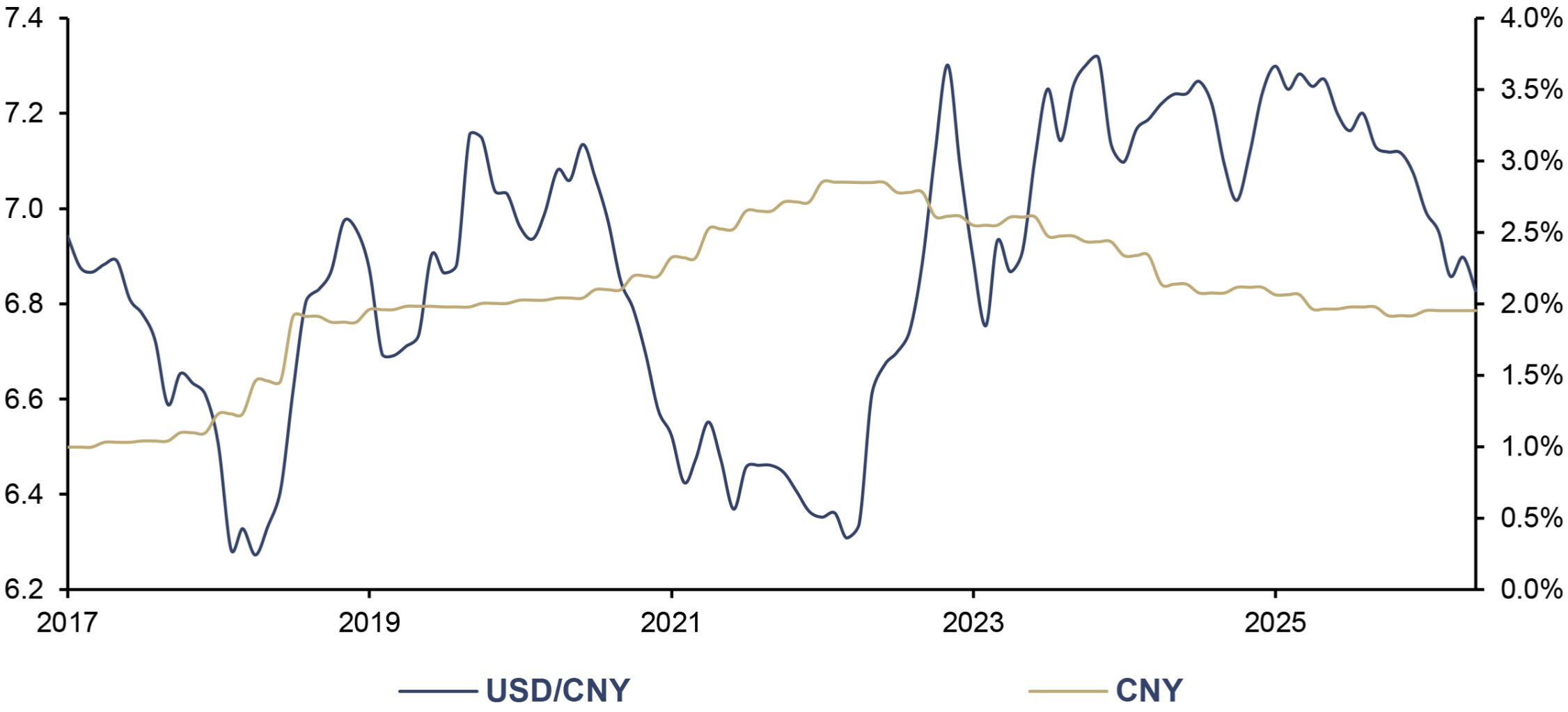
Meanwhile, the most commonly cited sovereign alternative to the US dollar has moved in the wrong direction. The Chinese renminbi’s share of global reserves peaked at 2.84% in Q1/2022 and has since fallen to 2.1%, declining in nearly every quarter. Even after adjusting for exchange-rate effects, the trend is down. Arslanalp and Eichengreen find in the paper “Our Underappreciated International Reserve System” that geopolitical risk and lower relative returns are driving countries away from renminbi holdings. Several European central banks, including those of Belgium, the Czech Republic, Portugal, and Switzerland, actively reduced their renminbi reserves during 2022–24. China maintains extensive capital controls that limit foreign ownership of domestic assets. A reserve currency that cannot be freely acquired or repatriated is not a serious reserve currency. The data now confirm that.
USD/CNY (lhs), and CNY, as a % of Global FX Reserves (rhs), 01/2017–04/2026
Source: IMF, LSEG, Incrementum AG
But official reserve data captures only part of what’s happening. One reason many analysts understate the shift is that they focus too narrowly on central bank reserve holdings. Reserve currency status is not just about what sits in COFER (Currency Composition of Official Foreign Exchange Reserves). It is about what assets the rest of the world chooses to hold as net claims against persistent current account surpluses. Those claims can sit on the balance sheet of a central bank, a sovereign wealth fund, a state-owned bank, a pension fund, a life insurer, or a private corporation. For the US current account deficit, it makes no difference whether those claims are held as official reserves at a central bank or sit on the balance sheet of a Taiwanese life insurer. That is why focusing on official reserve accumulation actually understates the real demand for reserve assets.
Thus, when we say reserve-driven demand has become the dominant marginal driver of gold, we do not mean reserve accumulation only in the narrow central bank sense. We mean the broader pool of foreign savings looking for a store of value outside the US dollar system. Some of that demand is official. Some is quasi-official. Some is private. The point is that more of the world’s excess savings are looking for neutral assets, and gold is increasingly where those flows go when the old reserve asset becomes politically encumbered.
That’s why official reserve growth can slow even while the structural demand for reserve assets remains intact. The capital account is made up of both official and private flows. When US returns are attractive, private capital often flows out of surplus countries and into the US on its own. In those periods, foreign central banks don’t need to accumulate reserves as aggressively because the private sector is already exporting the capital. When private flows weaken or reverse, central banks can step back in and replace them with official flows. We have seen that rotation repeatedly. The mix between private and official channels changes, but the underlying driver is the surplus itself. The demand for reserve assets remains structurally inelastic because the surplus still has to be matched by claims on someone else. Gold is now increasingly one of the assets absorbing those claims.
How Gold Trades in the New Regime
One important consequence of the new regime is that gold is likely to behave more procyclically. When gold demand is increasingly driven by the need to store excess savings outside traditional reserve assets, it becomes more tightly linked to the generation of those savings, which is a function of economic growth, export revenues, and trade surpluses. When the global economy is expanding and surplus countries are running large surpluses, their excess savings grow and gold accumulation accelerates. When that surplus generation is disrupted, the bid can weaken or reverse.
The price action in gold after the Strait of Hormuz closure is a good example. Rising geopolitical risk, rising inflation, and rising volatility would have been close to ideal for gold in the old regime. Yet gold sold off instead. That is exactly the sort of move that confuses investors still reading the market with the old map but makes perfect sense in the new reserve regime.
Gulf Cooperation Council (GCC) countries are among the world’s largest reserve accumulators and gold buyers. When export revenues are severely disrupted, they may need to liquidate reserves to cover fiscal obligations, and gold is one of their most liquid assets. It doesn’t even require wholesale liquidation to weaken gold. All it takes is the removal of the bid. Once the market sees that a major source of reserve accumulation has stalled or reversed, it reprices.
There are also obvious second-order effects. China is the world’s largest oil importer. A large energy shock slows Chinese growth and compresses Chinese surpluses, which in turn slows Chinese reserve accumulation. The same shock ripples through Korea, Taiwan, Japan, Türkiye, and the rest of surplus Asia.
When countries are forced to defend their currencies or cover fiscal needs, they draw down reserves. Türkiye’s gold reserves fell 69.1 t in one week to 702.5 t, bringing the two-week decline to more than 118 t. Reuters ties the move directly to efforts to support the lira and manage the fallout from the Iran war.
At the same time, Fed data shows that Treasuries held in custody at the New York Fed by official institutions dropped by USD 82bn between February and March 2026. Brad Setser at the Council on Foreign Relations documented that this reflected real selling by oil-importing countries, drawing down reserves to prevent their currencies from amplifying the energy shock. If these countries are selling Treasuries to defend their currencies, they are either selling gold outright or at minimum removing the persistent bid they have been putting into gold over the past several years.
In other words, the regime shift makes gold more sensitive to the global surplus cycle than many investors appreciate.
But that does not weaken the long-run structural case. Gold is returning to the role it once played under the gold standard and Bretton Woods, as the reserve asset that helps balance persistent international imbalances. The difference is that in those earlier systems the gold price was fixed. The adjustment happened through money supply, domestic credit conditions, inflation in surplus countries, and deflation in deficit countries. Today gold floats. That means the adjustment happens in the gold price itself. This makes gold more volatile and, at times, more procyclical than it was under a fixed-price reserve regime.
And yet that is also what makes the regime shift so bullish for gold. If gold is increasingly being pushed back into a reserve role, but now under a floating price, the balancing of global savings flows has to happen through valuation. Today’s global imbalances are much larger than they were under Bretton Woods or the classical gold standard, while gold still represents a much smaller share of reserves than it did in earlier eras. At current prices, gold is too small an asset class to fill the role that US Treasuries and agency debt have played. If gold is going to absorb a larger share of global reserve demand, the price has to rise substantially.
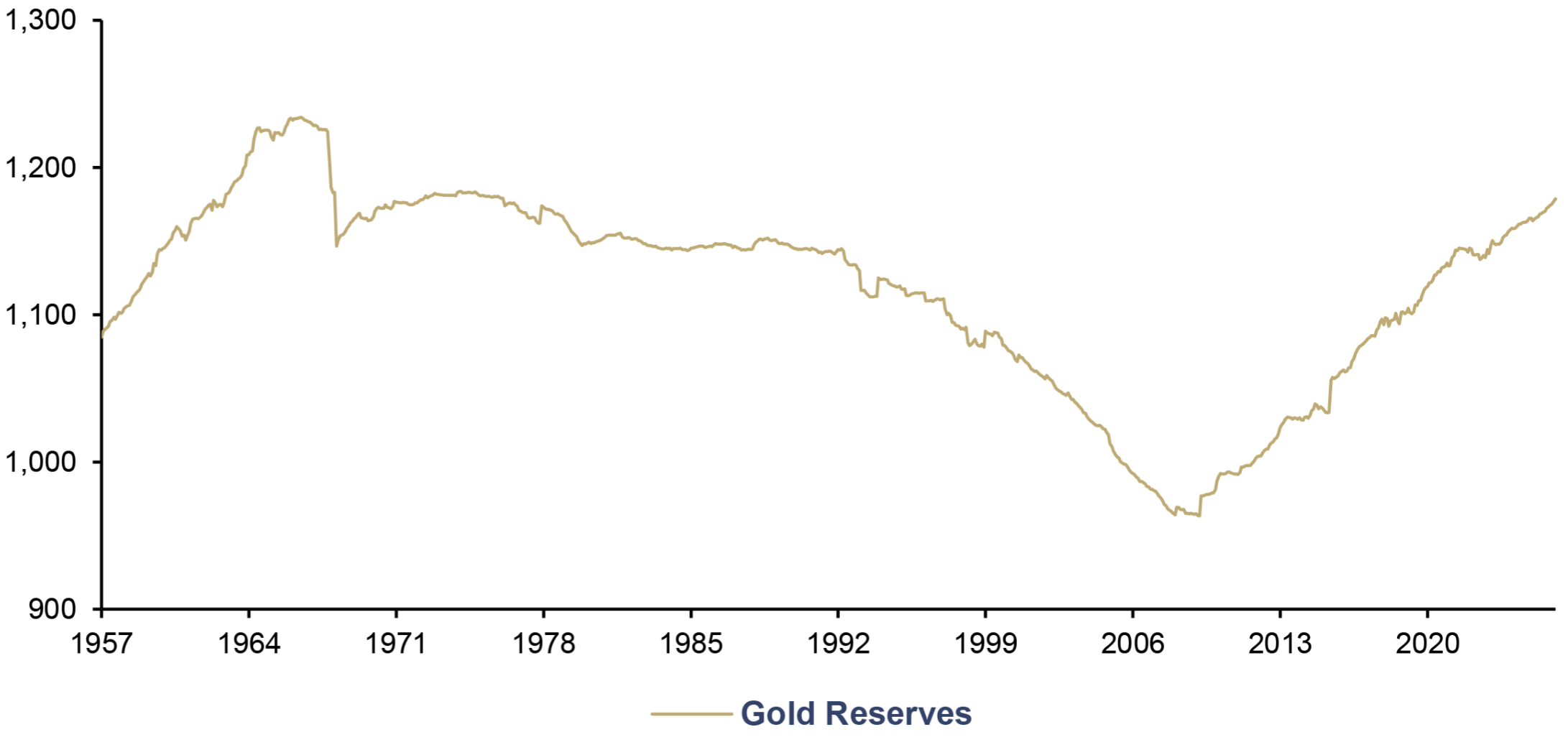
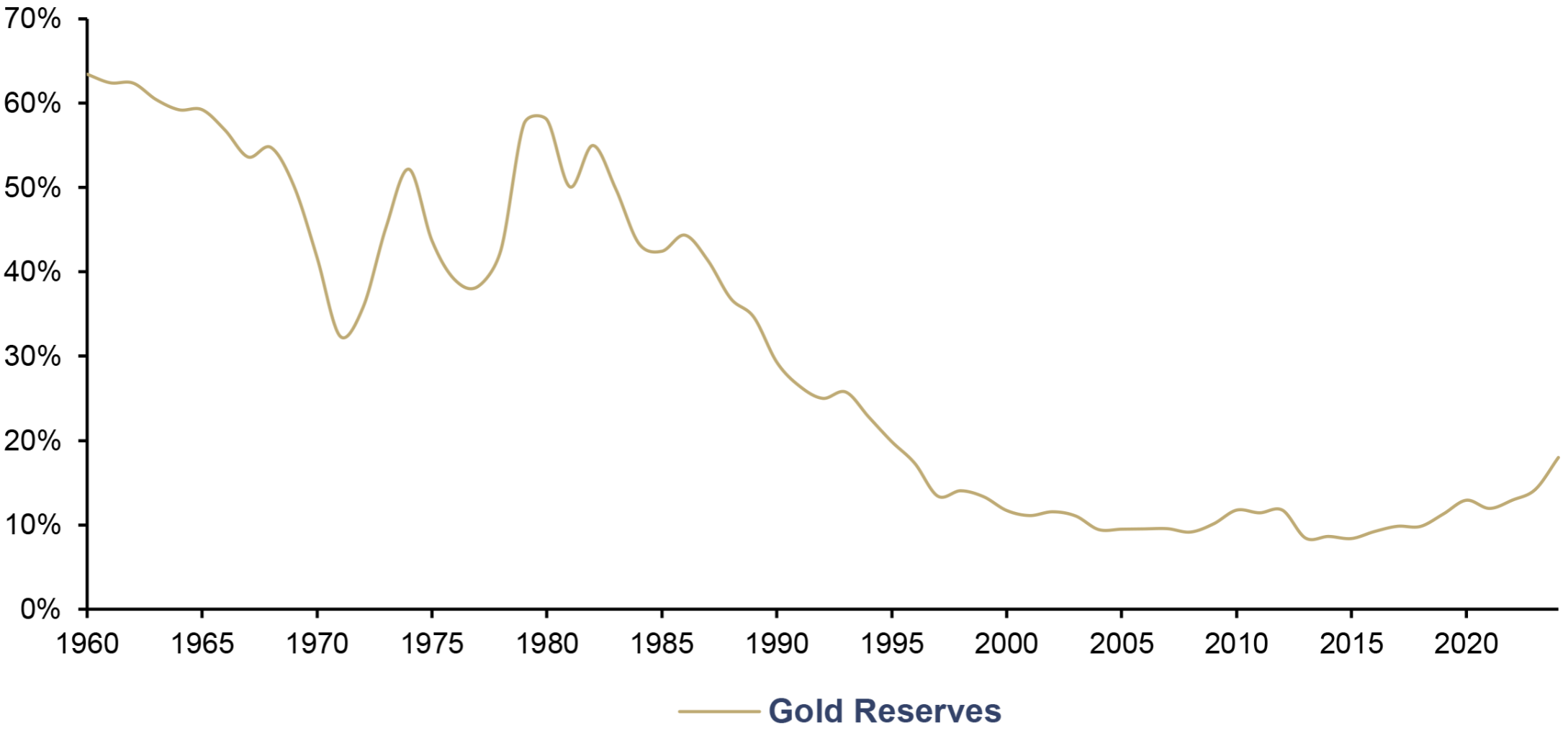
Data from the IMF and from Arslanalp, Eichengreen, and Simpson-Bell show that official gold holdings have climbed back toward prior highs, but gold as a share of total official reserves remains far below the levels common in earlier decades. In other words, there is still substantial room for reallocation.
Global Gold Reserves, in Moz, 01/1957–02/2026
Source: IMF, Incrementum AG
Gold Reserves, as a % of Global Total Reserves, 1960–2024
Source: World Bank, Incrementum AG
And even that understates the shift, because gold’s role isn’t limited to official reserves. Gold is increasingly being used to balance both public and private savings looking for a neutral store of value outside the US dollar system.
The long-run bullish case for gold is much stronger than the older arguments people often used to justify owning it. The old case was mostly cyclical. Buy gold if real yields fall, inflation rises, volatility spikes, or as a hedge to central bank money printing. Those arguments still matter and can be additive. But the reserve thesis is structural. The price of gold in this regime is tied to continued surplus generation and reserve diversification away from the US dollar. That is a much more powerful tailwind. But over shorter periods, gold will move with the global growth cycle in ways that will confuse investors still using the old map.
Toward a New Reserve Architecture
The selloff in gold after the Strait of Hormuz closure highlights the limitation of using commodities as reserve assets. Their prices can fall at exactly the point reserves are most needed. That is obviously true for energy and industrial commodities. But it is now increasingly true for gold as well. Gold used to be thought of as countercyclical, but in the new reserve regime it becomes procyclical too.
Government bonds are structurally better reserve assets in one important sense. Their price is anchored by the expected path of future policy rates, not just by reserve flows. In a growth slowdown, when reserves may actually need to be liquidated, expected policy rates usually fall and bond prices usually rise. That makes sovereign bonds far more stable liquidation assets than commodities. Gold does not have that anchor. Its price is far more exposed to flows and the reserve demand regime itself.
The problem with government bonds as a reserve asset is that they have to be issued by someone. As we have explained, when one country’s sovereign debt becomes the world’s primary reserve asset, that country must run the counterpart current account deficits needed to supply those claims. That is the fundamental flaw of the US dollar standard. It gives the world a highly liquid and relatively stable reserve asset, but only by forcing the issuer to absorb foreign excess savings and sustain chronic external deficits. Government bonds work well for the holder, but they create problems for the reserve issuer.
Gold has the opposite problem. It doesn’t require a deficit country to issue it, which is exactly why it becomes so attractive in periods of geopolitical fragmentation. But unlike sovereign bonds, it lacks a policy rate anchor and is a much less stable liquidation asset when reserves are actually needed.
Gold is not the ideal final architecture. But in the absence of a better neutral reserve asset, it is being pushed into that role anyway.
Gold may be the best available reserve asset for a period of disorder, but it is unlikely to be the permanent foundation of a stable global system. A reserve asset that becomes more volatile and more procyclical precisely when reserves are most needed is unlikely to be the final answer. But neither can a system built on one country’s sovereign debt, because that simply recreates the issuer burden at the center of the US dollar standard. If the world can’t settle on gold and can’t return to a one-country bond standard, then over time the pressure will build for a negotiated multilateral architecture.
Eventually the world is likely to move toward something that resembles Keynes’s Bancor proposal, which he proposed at Bretton Woods but that failed to gain acceptance. Keynes’s idea was an International Clearing Union in which countries would settle net imbalances in a supranational unit, the bancor. Deficit countries would have access to overdraft facilities, but the burden of adjustment wouldn’t fall on them alone. Countries running persistent surpluses would also face charges on excessive credit balances, giving them an incentive to import more, recycle demand, or otherwise reduce their surpluses. Keynes understood that a stable reserve system can’t work if only deficit countries are forced to adjust while surplus countries are free to accumulate claims without limit. The Bancor plan wasn’t just about creating a new reserve asset; it was about creating a system that reduced global imbalances and therefore reduced the need for reserve-asset accumulation in the first place.
But that kind of solution is likely a long way off. History is unambiguous that transitions between global monetary regimes are inherently disorderly. During the interwar period there were repeated efforts to restore international stability, from Brussels and Genoa to Geneva and London, but countries could not even agree on what had gone wrong. Some blamed rigid exchange rates. Others blamed insufficient gold reserves, war debts, or trade barriers. Even the 1936 Tripartite Agreement, often treated as the interwar period’s biggest cooperative success, was really just a limited effort to stop competitive devaluations. When merely agreeing not to actively damage one another counts as a breakthrough, it tells you how low cooperation had fallen.
The same pattern is likely to repeat as the US dollar standard unwinds. Countries don’t agree on the diagnosis of the problem. Some still treat large trade imbalances as the natural outcome of comparative advantage or as a problem for deficit countries to solve on their own. Others see them, correctly, as the product of domestic distortions in surplus countries that the old US dollar system was willing to absorb. As long as countries disagree fundamentally about the source of the problem, coordinated solutions will remain difficult.
The next phase is likely to be messy. Countries built their economic models around exporting to the US while the US dollar standard allowed the US to run persistent deficits. If the US is no longer willing to play that role on the old terms, those countries will increasingly be competing with one another for limited external demand. Cooperation may eventually emerge, and some new architecture may eventually be built. But history suggests that both come only after a painful period of disorder, failed negotiation, and intensifying national responses.
Conclusion
The US dollar standard is ending because the US is no longer willing to play the role of residual adjuster and run persistent deficits so the rest of the world can place its excess savings in US assets.
Yet countries are still implementing policies that tax consumption, subsidize production, and generate excess savings that have to be placed somewhere. As US assets become more politically conditional and less reliable as the default destination, gold is increasingly filling the gap. Not because the world has chosen a new monetary system, and not because gold is a perfect reserve asset, but because there is no better alternative.
As a result, the price of gold will increasingly be driven by reserve demand rather than just by the old mix of real rates, volatility, and liquidity. Gold is no longer trading only as a hedge inside the US dollar standard. It is increasingly trading as the asset that absorbs savings the US dollar system is becoming less willing to absorb.
At some point a new architecture will emerge. But that is likely a long way off. There were twenty years and two world wars between the collapse of the gold standard and Bretton Woods. Until a new system is built, gold is the only major asset that can fill the role.
Regime shifts are only confusing to those still using the old map. Dowding had fundamentally changed the nature of air defense, but the Luftwaffe commanders failed to recognize that change and kept sending pilots into a battle they no longer understood. The price action in gold is sending the same signal now. Investors who keep reading it with the old framework will keep finding the market confusing. It is up to investors to update their model and avoid the mistake of fighting the last war.[3]
[1] For a detailed analysis see “The New Gold Playbook,” In Gold We Trust report 2024.
[2] The technical balance of payments identity is: current account = capital account, but we are using “trade account” in place of the “current account” for simplicity. It should be noted that the current account differs slightly from the trade account – a fact we can ignore for our discussion.
[3] See “The New Gold Playbook,” In Gold We Trust report 2024, in particular the chapter “Mastering the New Gold Playbook;” see also the chapter “The Collapse of Commodity Beta” in this In Gold We Trust report