

A Golden “Stabilization” Op in Plain Sight
“We are very, very, very positive on gold, and equally negative on traditional currencies; this is just the beginning.”
Juan Sartori
- The world’s newest central bank isn’t a central bank. Tether is buying gold at a pace outstripping most sovereign nations. Tether is also building vaults, acquiring mining royalties, and lending against its own token, thereby constructing a shadow bullion bank outside the traditional monetary system.
- The oldest question in money is back: How do you prove the metal is really there? Blockchain changes how you ask it, not whether it needs asking.
- Two visions of the monetary future are in open competition. The BIS wants tokenization with central banks at the core; Tether wants tokenization with gold at the core.
- Gold remonetization won’t require a new Bretton Woods – it’s already underway. When tokenized gold becomes an “opt-in digital gold standard” and a stablecoin issuer is buying up to 2 t of physical gold per week — worth more than USD 1bn per month — the theoretical has become operational.
- Exclusive interview with Juan Sartori, Tether’s head of special projects
Izabella Kaminska is the journalistic force behind The Peg, a new stablecoin-focused publication, as well as The Blind Spot. She was previously senior finance editor at Politico and before that the editor of the FT’s award-winning Alphaville finance blog.
For much of 2025, gold’s unstoppable climb to one record high after another consumed traders and market pundits alike. Everyone had a theory as to why gold was rising: deepening distrust in the US dollar and the return of the debasement trade; the shockwaves of Trumpian tariffs and resurgent Chinese demand; or perhaps a major hedge fund caught brutally short. The speculation was endless.
Then, in November, a far more provocative theory began to circulate. The marginal buyer tipping the market into its newly ascended equilibrium wasn’t a central bank, a sovereign wealth fund, or even China. It wasn’t an institutional heavyweight at all. The unlikely force behind the surge, according to the whispers, was in relative terms a total newcomer to the gold market – Tether, the world’s biggest stablecoin issuer.
The idea first surfaced a few months earlier in a research note by Jefferies equity analyst Fahad Tariq and his team. But it was FT Alphaville’s pick-up on November 24, 2025, in Tether, the gold whale, that catapulted the claim into the spotlight. “Maybe everyone was overthinking it,” wrote Bryce Elder, citing Tariq’s analysis. “Maybe gold went up because Tether has been buying?“
The idea wasn’t as far-fetched as it first sounded. Jefferies analysts had already spotted Tether executives working the floor at the Denver Gold Forum in September 2025. Sources at the conference said the team was holding meetings with gold mining companies – particularly royalty and streaming specialists – signaling ambitions far larger than simple portfolio diversification.
“In recent months, we suspected that there was a new buyer of physical gold, specifically a diversified blockchain-native company called Tether Limited,” the analysts wrote once again on November 20, 2025.
But there had been other clues, too.
- Jefferies had been told by investors that Tether intended to buy ~100t of physical gold in 2025, in addition to investing across gold royalty/streaming companies and the gold supply chain.
- Tether’s CEO, Paolo Ardoino, was making very public comments that the company was looking to add gold to diversify its reserves.
And, most importantly, while correlation doesn’t always imply causation:
- Gold prices had moved ~USD 1,000/oz higher in less than two months over September/October 2025 as if responding to the entrance of a new buyer.
Looking deeper, the analysts noted that Tether’s attestation reports, as well as on-chain data, confirmed that the stablecoin company had indeed been a significant buyer during this time frame and could no longer be ignored. “Given continued growth in USDT supply, strong profitability exceeding USD 10bn annually, and a clear strategic interest in hard assets, Tether appears likely to remain a significant and ongoing buyer of gold going forward,” they predicted.
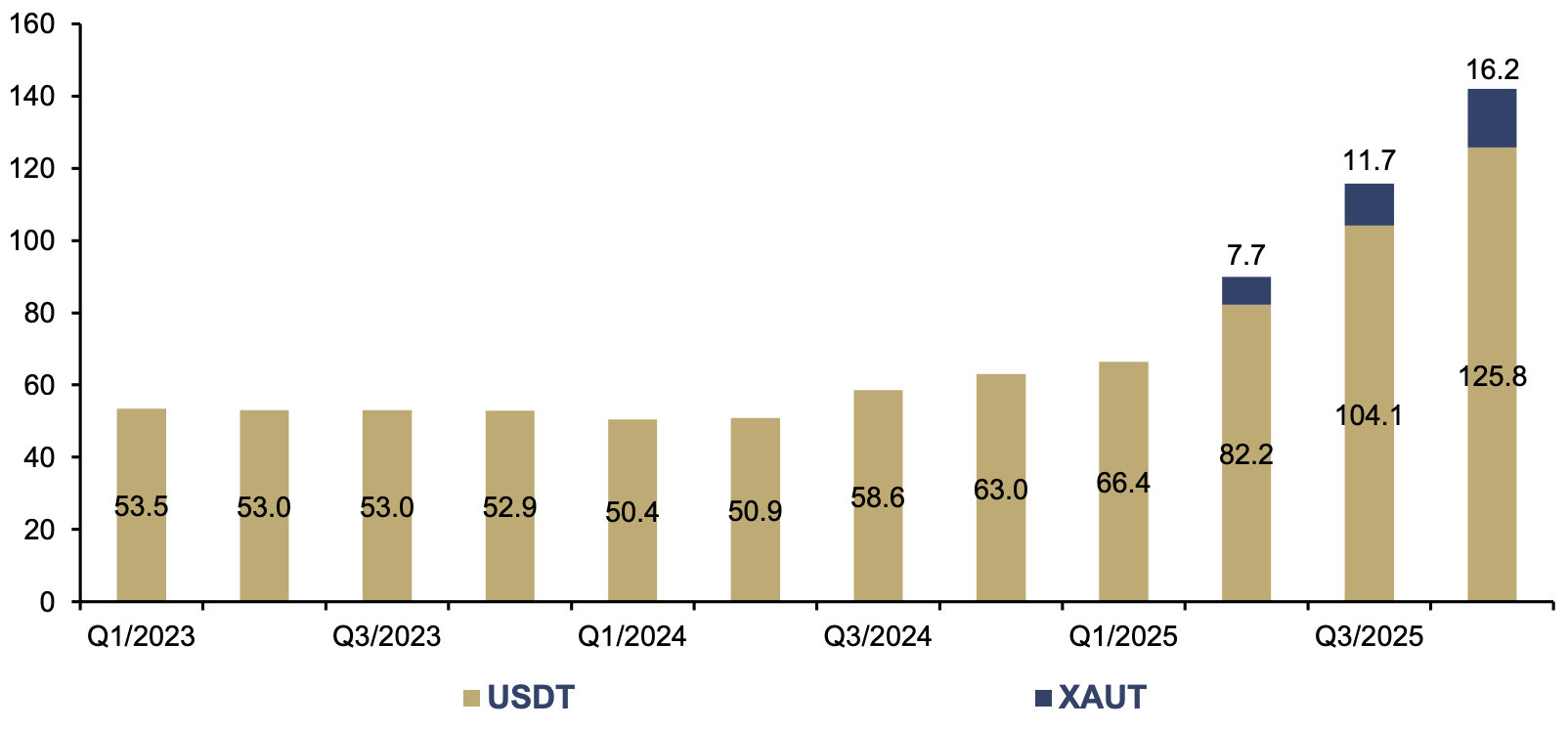
In the months following, Tether would go on to amass even more gold – 26 t in Q4/2025 alone according to Jefferies, with another 6 t added in January 2026, bringing Tether’s total holdings to 148 t worth approximately USD 23bn by the end of January. In a February 2026 update, Jefferies would emphasize that the pace of Tether’s quarterly gold purchases had, in fact, outstripped “most individual central banks, ranking third only behind Poland and Brazil and continuing a trend where Tether’s buying ranks at or above mid‑tier sovereign demand.”
Based on comments from CEO Paolo Ardoino to Bloomberg, the firm was purchasing up to 2 t of gold per week – a pace equivalent to more than USD 1bn per month at prevailing prices – and intended to maintain that rate through the coming months, with purchases sourced through OTC markets and Swiss refiners and delivered to a high-security vault in Switzerland. Assuming this pace held through February and March, Jefferies’ conservative estimate for Q1/2026 purchases was a range of approximately USD 2.6–4.3bn at average quarterly gold prices between USD 4,500 and USD 5,500 per ounce.
Tether’s Gold Reserves, in Tonnes, Q1/2023–Q4/2025

Source: Jefferies, Tether, Incrementum AG
Still, certain mysteries remained. For one, there was a mismatch between the amount of gold Tether said it held to back its two flagship tokens – USDT and XAUT – and the scale of bullion it appeared to be accumulating outright. The company’s corporate gold holdings, in other words, were swelling much more rapidly than the growth of their stablecoins. Tether CEO Paolo Ardoino was also simultaneously signaling – as if taking on the role of a shadow central banker – that the company intended to allocate 10–15% of Tether’s investment portfolio to physical gold.
But why? What exactly was Tether up to in the gold market? And why were they suddenly so interested in gold royalty firms and outright gold purchases for their own account?
The gold market, for the most part, was flummoxed. Many had not even heard of stablecoins until that year, let alone have a familiarity with the modus operandi of such operators.
In an exclusive interview with the In Gold We Trust report, Juan Sartori, Tether’s head of special projects, was candid about the company’s agenda in the market.[1] He stated:
To understand why we launched Tether gold as a company and why we’re making a stronger push into it today — it is important to understand the philosophy and ideology of this company. Its main objective is really to provide a financial solution for most people in collapsing financial systems. … We see ourselves as a company that needs to provide a stable alternative system for these people.
As Sartori went on to explain, the El Salvador-based group suspected from the outset that demand for its gold stablecoin could get significant very quickly. “We didn’t want to push the product until we had created a system that can cope with the demand,” he said.
This, he added, was reflected in the fact that the company didn’t push for wider listings or positioning on more blockchains until very recently.
That caution eventually drove the company’s aggressive behind-the-scenes build-out: securing off-take agreements with the world’s largest refiners and producers and acquiring royalty streams from mines to guarantee decades of physical supply. The goal, in other words, was simple: to have the entire physical and logistical system fully in place before demand for the token potentially exploded.
“We built the product for the world before it was a business, actually,” Sartori said.
In total, based on Tether’s attestation report, Tether – USDT + XAUT – held nearly 150 metric tons of gold as of the end of December 2025.
Tether’s interest in royalty companies, meanwhile, went far beyond locking in supply. Sartori said the company had identified a structural inefficiency in the traditional model where such firms collect gold from mines but pay investors in cash and spotted an opportunity to convert those cash payouts directly into tokenized gold.
Acting on that conviction, over the course of 2025 Tether acquired an approximately one-third stake in Elemental Altus Royalty – its largest and most strategic royalty investment – and promptly influenced the company to become the first publicly listed gold royalty firm to pay dividends in XAUT. According to Sartori, the move is intended to “goldify” the entire royalty chain and solve a long-standing industry inefficiency through tokenization.
2025: Year of the stablecoin
Stablecoins, as they are known, take their name from a core shortcoming of the early cryptocurrency boom. In a market defined by extreme price swings, traders needed a safe place to park profits between trades without constantly cashing out of crypto. That was easier said than done. Banks, wary of crypto’s unregulated status and its association – fairly or not – with ransomware and illicit activity, were often reluctant to service accounts linked to the space. As a result, moving money in and out of crypto was slow, costly, and operationally fragile.
The resulting friction, however, created a perfect arbitrage opportunity for anyone prepared to bridge the two systems.
Tether was the earliest – and ultimately most consequential – attempt to build that bridge. Launched in 2014 in close affiliation with the Bitfinex exchange, Tether was designed as a synthetic crypto dollar (USDT) representing a claim on US dollars held in reserve. The concept was straightforward: large-scale users deposited US dollars, and in return, Tether issued them crypto-compatible Tether tokens. Unlike conventional shares, units, or securities, these could move and be settled instantly across exchanges and wallets via newfangled public blockchains. In theory, each one of these tokens was backed one-for-one with US dollars, pegging its value to the US dollar.
In practice, the model resembled a stripped-down money market fund. The US dollars Tether received were recycled into cash equivalents – over time, increasingly into short-dated US Treasuries. But unlike a traditional fund, there was no yield passed back to holders. That income accrued entirely to Tether. At first, the zero-rate environment of the mid-2010s made the structure a challenging model. But as interest rates rose in the early 2020s, the spread became enormously profitable, helping transform the company into the financial force it is today.
Phil Potter, then a senior figure at Bitfinex, put it to this author in 2017, that Tether’s goal from the outset was to create a “dollar surrogate to bypass traditional channels,” since the main pain point for crypto institutions was “on and off-ramping to traditional banking channels.” He described the concept as “effectively a PayPal model.”
For years, however, Tether remained controversial. Its ownership structure was opaque, and questions persisted about the nature – and even the existence – of its reserves. At various points, critics speculated that reserves included riskier assets such as commercial paper, or that flows were being recycled into crypto markets themselves.
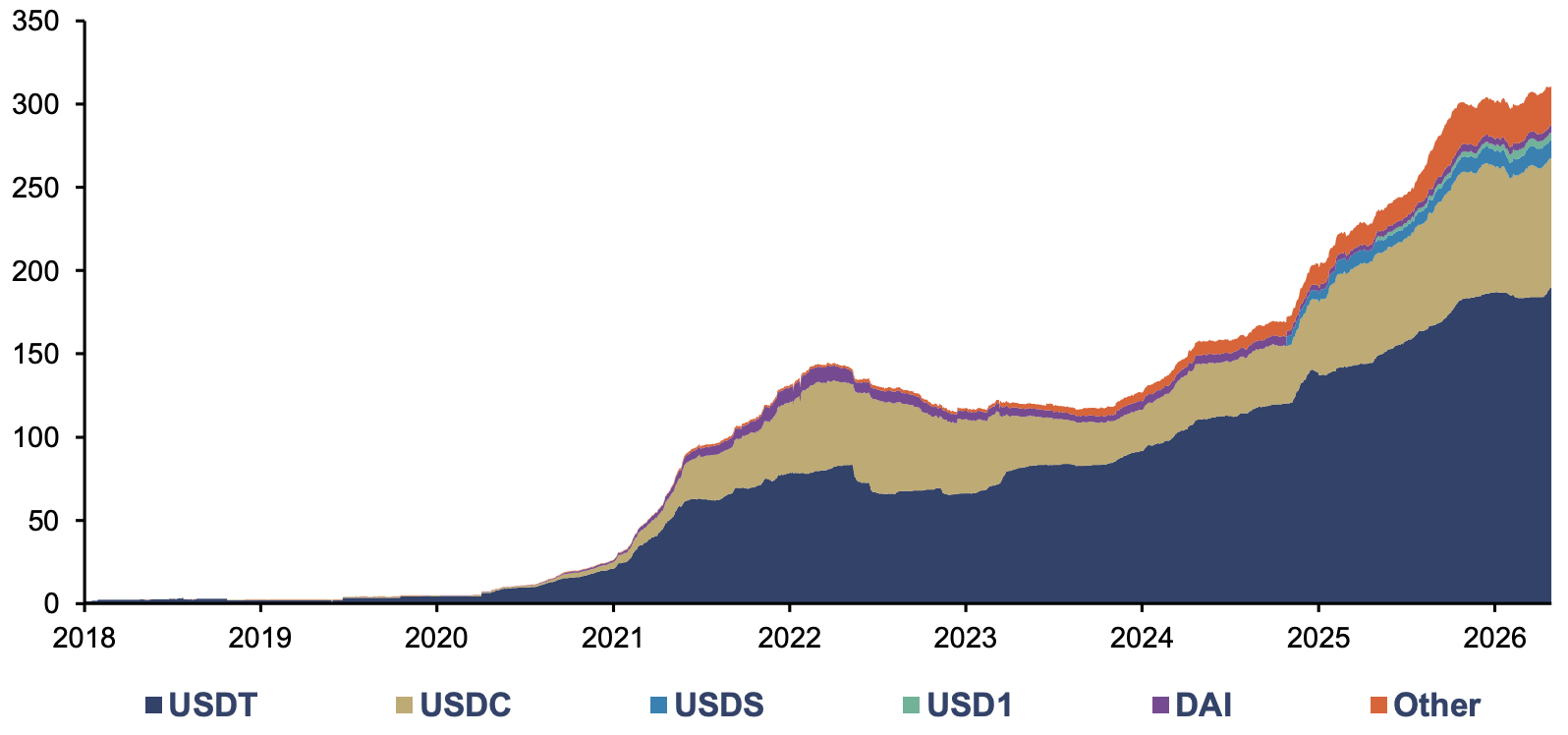
When growth eventually hit, it hit quickly. From 2020 onwards, stablecoins scaled dramatically alongside the broader crypto boom, driven in part by the chaos of the Covid era and a new wave of demand hailing from non-crypto users in emerging markets. Competitors such as Circle (issuer of USDC) and Paxos had by then also entered the market. They hoped to compete with Tether by pitching more transparent, regulated alternatives. But Tether would maintain its dominant position, particularly in offshore and exchange-based trading, something it continues to hold on to today.
Market Capitalization of Top 25 Stablecoins, in USD bn, 01/2018–04/2026

Source: CoinGecko, DeFiLlama, Incrementum AG
From Eurodollar to Eurogold
Over time, as the system expanded, it began to look uncannily familiar to monetary historians. The ability to issue US dollar-linked liabilities outside the US banking system – and to settle them independently via blockchains — invited comparisons with the eurodollar market.[2] For regulators, that was not necessarily a reassuring analogy. Offshore US dollar creation had been central to the global financial crisis, generating layers of opacity and hidden fragility that only became visible once the system came under strain.
Stablecoins, many argued, were simply a blockchain-native extension of offshore US dollar creation. Most notably, in November 2023, a BIS paper from Aldasoro, Mehrling and Neilson titled “On par: A Money View of stablecoins” argued that:
The whole idea, for both Eurodollars and stablecoins, is to enable offshore and onchain settlement without having to make use of onshore and off-chain dollars. Both Eurodollars and stablecoins are intended to function as a means of settlement in their own respective worlds, while economizing on the difficult transaction of crossing back onshore or off-chain.
By the mid-2020s, policymakers could no longer ignore the US dollar-friendly technology that purported to enable offshore US dollar reach without any of the related settlement risk due to the magic of blockchain settlement.
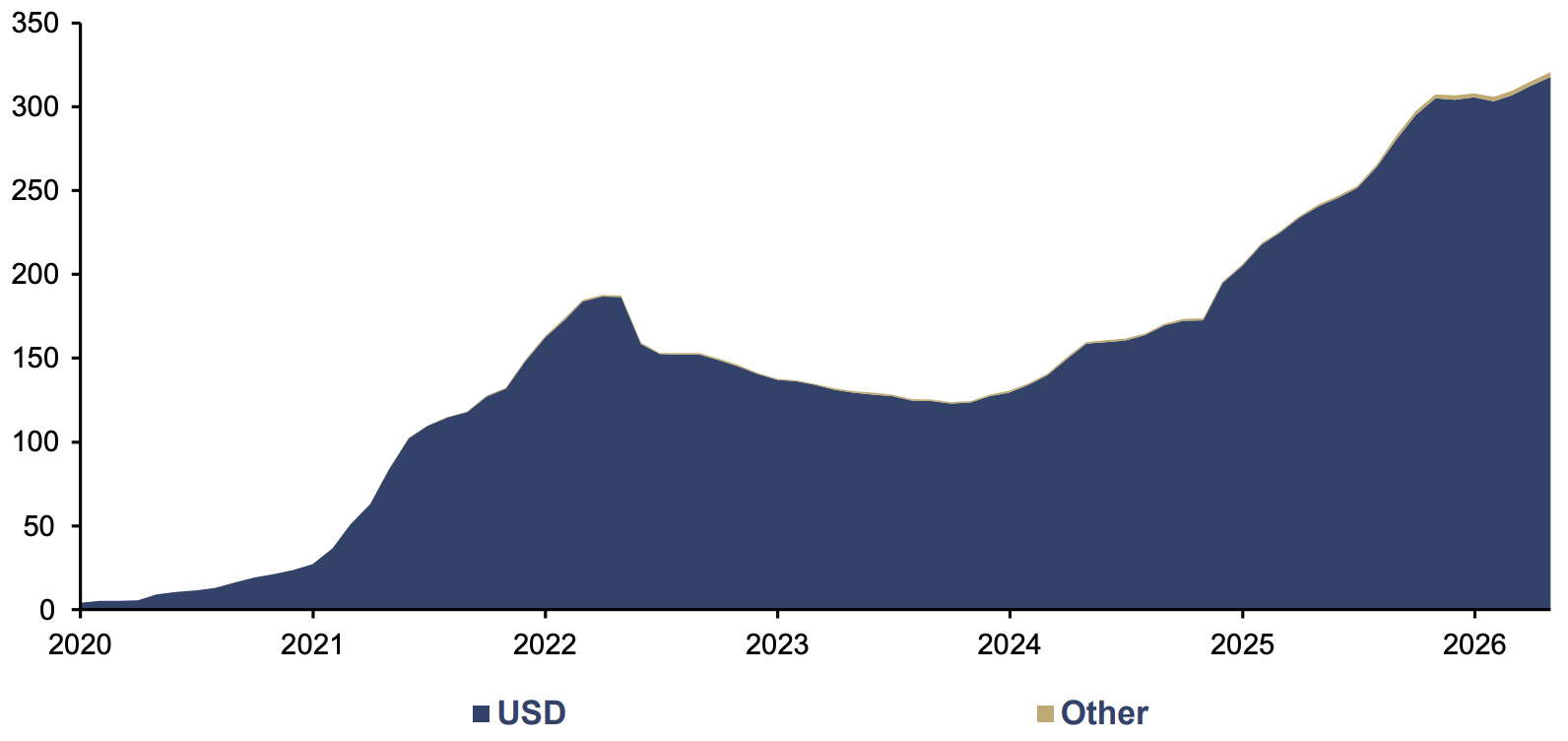
There would be many different regulatory responses, but the most noteworthy would come from the US in 2025. Backed in part by crypto-aligned interests, the Trump administration would lean heavily into the sector as a way of reinforcing US dollar dominance globally. With roughly 99% of stablecoins denominated in US dollars, the logic seemed to be that if crypto needed a base currency, it might as well be the US dollar.
Stablecoin Market Capitalization by Currency, in USD bn, 01/2020–04/2026

Source: DeFiLlama, Dune Analytics, Incrementum AG
The shifting political climate in Washington eventually culminated in the passage of the Guiding and Establishing National Innovation for US Stablecoins Act, or GENIUS Act, in July 2025. While the US was not the first jurisdiction to move on this front – the European Union’s Markets in Crypto-Assets Regulation (MiCA) had already been finalized in 2023 and began phased implementation in 2024–2025 – it was among the first to step decisively towards a stablecoin-specific legal architecture.
Crucially, the legislation has formalized how stablecoin reserves should be defined, managed and disclosed, largely falling in line with pre-existing industry best practices. This includes the rule that systemically important stablecoins should be 100% backed by high-quality liquid assets, primarily short-dated US Treasuries, alongside cash and closely related instruments.
In contrast, MiCA requires issuers to hold a significant share of reserves within the regulated banking system – typically at least 30% in deposits for smaller issuers, rising towards 60% for those deemed more systemic. It also has much stricter limits on exposure to non-cash instruments than the US framework, which allows for a larger share of reserves to be held in government securities and repo markets, provided they meet liquidity and credit quality thresholds. In practice, this reflects an American policy choice to align stablecoin reserves more directly with Treasury market funding, rather than forcing them deeper into the traditional banking system.
Nonetheless, just as in Europe, the US framework draws a clear line on one critical issue. Both GENIUS and MiCA prohibit the direct payment of interest or yield to holders of stablecoins.
But in the US GENIUS stopped short of closing the loop entirely. While issuers themselves are barred from passing through yield, the legislation leaves room for intermediaries – such as exchanges or wallet providers – to share that income with users. That distinction has quickly become the central fault line in ongoing regulatory debates. The still-evolving Clarity Act is expected to determine whether such practices are ultimately permitted or curtailed, with the banking sector in particular pushing for tighter restrictions to prevent stablecoins from functioning as de facto interest-bearing deposits outside the regulated system.
The broader debate around stablecoin proliferation has also revived an older monetary controversy. In a widely discussed op-ed in the NY Times, Berkeley economist Barry Eichengreen warned that the GENIUS Act risked recreating the conditions of America’s pre-Civil War Free Banking Era, when hundreds of private issuers destroyed the “singleness of money” – the principle that a US dollar is a US dollar however it is obtained. Former OCC head Brian Brooks countered that the Act’s standardized reserve requirements made it more analogous to the National Bank Act of 1863, which tamed that very chaos by requiring all banks to hold Treasury securities. For gold-backed stablecoins, the question cuts differently still: backed by physical metal rather than government debt, and paying no yield, they may sidestep the run-risk dynamics that concern Eichengreen altogether – reviving, in effect, the logic of commodity-backed money that predated both the Free Banking Era and the modern fiat system.
According to Brent Johnson – a prominent advocate of the view that stablecoins are becoming an extension of US monetary power – the debate has forced policymakers to reconsider questions long thought settled about the architecture of money itself, not least who captures the seigniorage generated by it. Among the contenders, he points out, are the issuers who manage reserves, the users who hold tokens, and, of course, the governments who enable the system. There is also the share of value extracted through network fees paid to validators and mining infrastructure that facilitate settlement.
Even under GENIUS, “the question of who deserves the yield remains unresolved and politically explosive,” Johnson noted in his Stablecoin Wars report in February.
The stakes in any case are profound. Johnson says at risk is the allocation of trillions of US dollars in potential seigniorage – who gets to intermediate transactions, monitor them, and ultimately permit or deny access to them.
“We are witnessing the re-architecture of money itself, and with it, the re-architecture of power. The opportunity is so immense that the battles will be fought to the death,” Johnson wrote, adding that the outcome amounts to “strategic leverage over nations, corporations, and individuals.”
The pace of growth offers a sense of how quickly that contest is unfolding. Since the shift in US policy direction in 2025, the stablecoin market has expanded from roughly USD 200–250bn to more than USD 300bn by early 2026 – an increase of roughly a quarter to a third in little over a year. Of that, Tether alone accounted for the majority – typically around twothirds of total supply – cementing its position as the dominant issuer of synthetic US dollars in circulation, and relatedly as a crucial price-insensitive buyer of US Treasury bills.
According to Rabobank analysis, since “stablecoins must be backed 100%, increased demand for the former will create forced buyers of the latter. In short, the US is incentivized to encourage the usage of stablecoins to soak up increased T-Bill supply.”
Policymakers across the world – from Japan to the EU – are belatedly catching up to what the model really implies for fiscal policy and statecraft. The consequence is a belated embrace of stablecoins in their own currencies, as well as shifting regulatory attitudes to reserve composition.
Growth of US dollar stablecoins, in any case, is predicted to continue accelerating. Standard Chartered estimates that the entire market could be worth as much as USD 2tn by 2028, driven in large part by regulatory clarity and deeper integration with traditional financial infrastructure. The implication is that what began as a niche workaround for crypto traders is fast becoming something far more consequential: a structurally significant source of demand for US dollar assets.
Against that, it’s no surprise that Tether has worked hard to upgrade its public image to gain institutional trust. Since its 2021 settlement with the New York Attorney General over allegations of reserve misrepresentation, the company has actively published independent attestation reports and progressively improved transparency around its holdings. The most significant milestone undoubtedly came in March 2026, when the group announced it had engaged a Big Four accounting firm to conduct its first full statutory audit — widely seen as the clearest confirmation yet that its reserves are real and fully verifiable.
But it has also forged much closer relationships with law enforcement and regulatory agencies worldwide to combat illicit finance and sanctions evasion. Among its most high-profile actions, Tether has frozen accounts linked to the Maduro regime in Venezuela, as well as Russian and Iranian entities.
Tether’s recent foray into gold markets in that context is not trivial.
Stablecoins no longer represent a kooky corner of what many traditional financiers have long considered a glorified internet gambling market. They are fast-growing, yield-sensitive pools of demand for the very instruments — short-dated Treasuries, and now also gold — with the potential to anchor global liquidity conditions. In that sense, they are part of the evolving plumbing of the US dollar system itself, and a reincarnation of the old eurodollar system, albeit on new cryptographically enforced blockchain rails.
Crucially, what stablecoins have done for US dollars, they now stand poised to do for gold markets. If the gambit succeeds, it won’t just allow for a more convenient way to trade gold, it will pave the way for the emergence of a kind of “euro gold” standard — one capable of loosening the metal’s historic ties to centralized market hubs. Whether through XAUT, PAXG, or other contenders, the trajectory points toward a borderless system: a market for “gold without a passport.” It was against this US dollar-centric regulatory backdrop that gold tokenization found its opening.
The Long March to Gold Tokenization
Tether may have been the first corporate entity to issue a stablecoin, but it certainly wasn’t the first to arrive at the idea of issuing a gold-backed stablecoin.
That honor goes to Paxos, which issued the white paper for its gold stablecoin offering in September 2019. Tether’s gold product followed a few months after in January 2020. But even before either of these crypto-native institutions was considering such things, the gold market had a long track record engaging with the same fundamental model that underpins today’s gold stablecoins. It’s a history that stretches back centuries, at least to the era of goldsmith banks, and most clearly to the 17th century Bank of Amsterdam.
As Adam Smith recounts in The Wealth of Nations, Amsterdam’s bank money derived its credibility from a tightly governed process wherein reserves were physically inspected, ledgers were reconciled, and custody was transferred under oath between successive burgomasters. The system worked not because trust was assumed, but because it was regularly performed and verified.
In November 2020, Frost, Hyun Song Shin and Wierts captured the parallel in a BIS working paper titled “An early stablecoin? The Bank of Amsterdam and the governance of money,” highlighting that the Bank of Amsterdam “resembled what we now know as a ‘stablecoin’ — i.e. a system where account-based money was backed by assets of stable value.”
What distinguishes the present is mainly how that verification is executed. The periodic, human-centered rituals of inspection have given way to cryptographically formulated Proof of Reserves, independent attestations, and – at least in aspiration – continuous on-chain visibility. The purpose of the mechanisms remains the same: to convince holders that each claim corresponds to underlying bullion. Gold stablecoins, therefore, are less a novelty than a step back into the past where the acceptance of asset-backed money hinges on how convincingly its backing can be demonstrated.
This intuition now has rigorous academic support. In a December 2025 SSRN paper “Tokenized Gold”, Duke University finance professor Campbell R. Harvey and co-authors Lin, Rabetti, and Zhang examined the mechanics of tokenized gold and concluded that it enables what they term an “opt-in digital gold standard” – one that requires no central bank mandate and in which consumers and investors choose to adopt it voluntarily. Their research shows that tokenized gold closely tracks traditional gold benchmarks even under extreme market stress, including the ten-standard-deviation drawdown in gold prices on January 30, 2026. Crucially, unlike gold ETFs, tokenized gold can be deployed as a medium of exchange for everyday payments and as a staking or lending asset capable of generating yield – properties that begin to reconstitute gold’s historical monetary functions in ways not seen since Bretton Woods.
The structural implications extend further still. In a companion paper, “Understanding Gold” (2025), Erb and Harvey argue that a second demand shock comparable in scale to the original ETF introduction may be on the horizon – driven by the potential Basel III reclassification of gold as a high-quality liquid asset for commercial banks.
This is important because its current regulatory status makes it operationally costly for banks to hold and impedes its ability to be used as a form of collateral.
Should that reclassification materialize, it would unlock an entirely new class of institutional demand, one that would dwarf the retail-driven flows that tokenized gold has attracted so far.
But there have been plenty of more recent analogs, too. Among the most famous predecessors, and certainly the model that came closest to being deemed a systemic threat, was e-gold – widely considered a key Bitcoin precursor. Launched in November 1996 by Douglas Jackson, the system allowed users to hold and transfer digital units on a central ledger, each fully backed by physical bullion held in reserve. E-gold itself earned revenue through transaction fees and exchange services. In effect, it was an early attempt to turn gold into a native currency of the internet – and the idea proved remarkably successful. By the late 1990s it had achieved what the Financial Times described as critical mass on the web, becoming the first privately issued online currency to gain widespread use in peer-to-peer payments.
But the very qualities that made the system appealing – instant transfers, global accessibility and a metal-backed unit of account — also attracted fraudsters and cybercriminals. Jackson spent much of the early 2000s trying to keep the system honest, cooperating with law enforcement and freezing suspect accounts. It was not enough. In 2007, federal prosecutors indicted e-gold and several executives, including Jackson himself. At the time, the system was backed by roughly 3.6 t of physical gold, had amassed several million user accounts, and was settling roughly USD 3bn in annual transactions. The charges included conspiracy to launder monetary instruments and operating an unlicensed money transmitting business, leading to government orders freezing the precious metals reserves.
Jackson refutes the notion, popular among crypto enthusiasts, that e-gold was shut down because it threatened the US dollar. On the contrary, the presiding judge concluded that the concept behind e-gold was not itself illegal — meaning it was brought down before it ever had a chance to properly threaten the US dollar system. Jackson would later argue that Bitcoin’s origin myth was “spun from misrepresentation of what actually happened to e-gold,” and that the crypto community’s misconstrual of the case led to “a lost decade of unprecedented malinvestment and rampant criminality” – and, worse, set the stage for CBDCs.
By the mid-2000s, a far more institutionally palatable innovation was preparing to enter the market: the gold exchange-traded fund. The timing is difficult to ignore. In late 2004, London’s bullion market was already abuzz with anticipation over a new wave of exchange-traded gold products, most prominently State Street’s SPDR Gold Shares (GLD), which debuted in New York that November.
GLD would eventually become one of the most successful commodity ETFs ever launched. Yet despite — or perhaps because of — that success, ETFs soon ran into a familiar problem. The larger they grew, the more scrutiny they attracted around a single underlying question: was the metal really there?
Despite efforts to engender trust through attestations and transparency, doubts persisted. Investors, particularly those with a preference for physical bullion, worried about the opacity of custodial chains, the use of sub-custodians, and the extent to which holdings were truly allocated.
In the end, GLD and its custodial partners undertook a series of measures to reassure the market. The question facing gold stablecoins today is whether blockchain solutions meaningfully change the calculus of trust, or do they simply rearrange it.
For Gold Token SA, a gold stablecoin offering from Switzerland’s MKS PAMP group – one of the world’s largest precious metals businesses –the answer is, implicitly, no. Unlike Tether, this is not a crypto-native firm attempting to graft credibility onto gold. It is a gold-native institution arguing that credibility in gold cannot be engineered from the outside in. In a market defined by trust in physical collateral, MKS PAMP believes the hierarchy inevitably runs the other way: sourcing, refining, storage and legal title come first, with blockchain as a secondary layer.
According to chief executive Kurt Hemecker, the structure addresses the uncomfortable truth that blockchain may change how claims are recorded and transferred, but it does not eliminate the underlying centralization at the heart of the vaulting system.
“Tokenization doesn’t remove centralization, it changes how assets move,” Hemecker told the In Gold We Trust report. “Even with digital or financial assets, there is always an underlying legal structure, a place where rights are defined, and an entity responsible for them.”
He added: “What matters is the strength of the underlying infrastructure, how the gold is sourced, refined, allocated, and ultimately delivered.”
That is why, from his point of view, it matters that established gold institutions with proven track records are the ones integrating blockchain, rather than crypto-native firms attempting to build credibility after the fact. It is also a reminder that this vulnerability is not new. The Bank of Amsterdam – for all its burgomasters, inspections and sworn assurances – ultimately failed in the late 18th century after it emerged that reserves had been quietly lent out and were no longer fully there.
Nor is the problem confined to history. In 2023, a gold token issued via the Perth Mint became embroiled in controversy, including allegations of diluted bullion and persistent deviations from the gold price. The episode underscored a familiar point: however modern the wrapper, confidence can still fracture when the integrity of the underlying asset is called into question.
Such episodes help explain why blockchain is not a guarantor of anything in and of itself, since it can neither assure the gold was ever there to begin with, nor that it wasn’t tapped or stolen by third parties.
From Pounds to Libras
Even if central banks largely treated cryptocurrencies as a sideshow for much of the 2010s, by 2019 that stance became harder to maintain. Facebook’s Libra — a proposed privately issued, globally circulating digital currency backed by a basket of assets – immediately raised alarm among policymakers who feared a Silicon Valley assault on monetary sovereignty. The choice of name was telling: Libra, Latin for “scale” or “balance,” is also the root of the British pound (originally a pound weight of silver) and of the broader system of weight-based monetary units that once underpinned precious metals markets, including the troy system still used for gold today. Intentionally or not, the project echoed a much older monetary tradition — one in which value was anchored not in fiat credibility but in measurable units of scarce metal.
China’s accelerating development of the e-CNY at the same time also reinforced the sense that digital money was no longer a fringe experiment. Within a few years, dozens of central banks would respond by exploring or piloting their own digital currencies in a bid to fend off such challengers. It was into this increasingly politically charged climate that New York-based Paxos introduced its gold token, PAX Gold (PAXG), in September 2019.
Unlike Tether, which primarily issues its own branded tokens, Paxos — led by former hedge fund manager Charles Cascarilla – had positioned itself more as an infrastructure provider than a product company. Structured as a regulated trust company under US supervision, it offered a “stablecoin-as-a-service” model, enabling other institutions, such as PayPal, to launch tokenized assets on compliant rails. The aim, therefore, was not simply to launch a gold-backed token, but to extend that infrastructure-led model into bullion.
According to Walter Hessert, head of strategy at Paxos, the decision reflected a broader view that financial markets are undergoing a structural replatforming onto tokenized systems.
Gold, in that framework, was a natural place to begin. As Hessert told the In Gold We Trust report, its defining characteristic as a “high stock-to-flow asset” [3]– one that already resides in centralized vaults and trades on top of that infrastructure – made it particularly well suited to what he describes as a technological “database upgrade.”
Tokenization, in this view, turns gold from a relatively static store of value into a more fluid, programmable asset – one that can “move on the blockchain… 24/7 globally, and virtually for free,” as Hessert puts it. And while PAXG isn’t explicitly targeted at retail investors, neither is access restricted: the same infrastructure that enables institutional use also lowers the barriers for broader participation.
At the core of the Paxos model ultimately lies the extension of its regulated, compliance-first infrastructure to third parties — a framework that, by design, errs on the side of caution. In the context of gold, that translates into a strict preference for fully allocated holdings over any form of pooled exposure. Each of its tokens is linked to specific bullion held in LBMA-approved London vaults, with ownership traceable “all the way down to a serial number on the bar.”
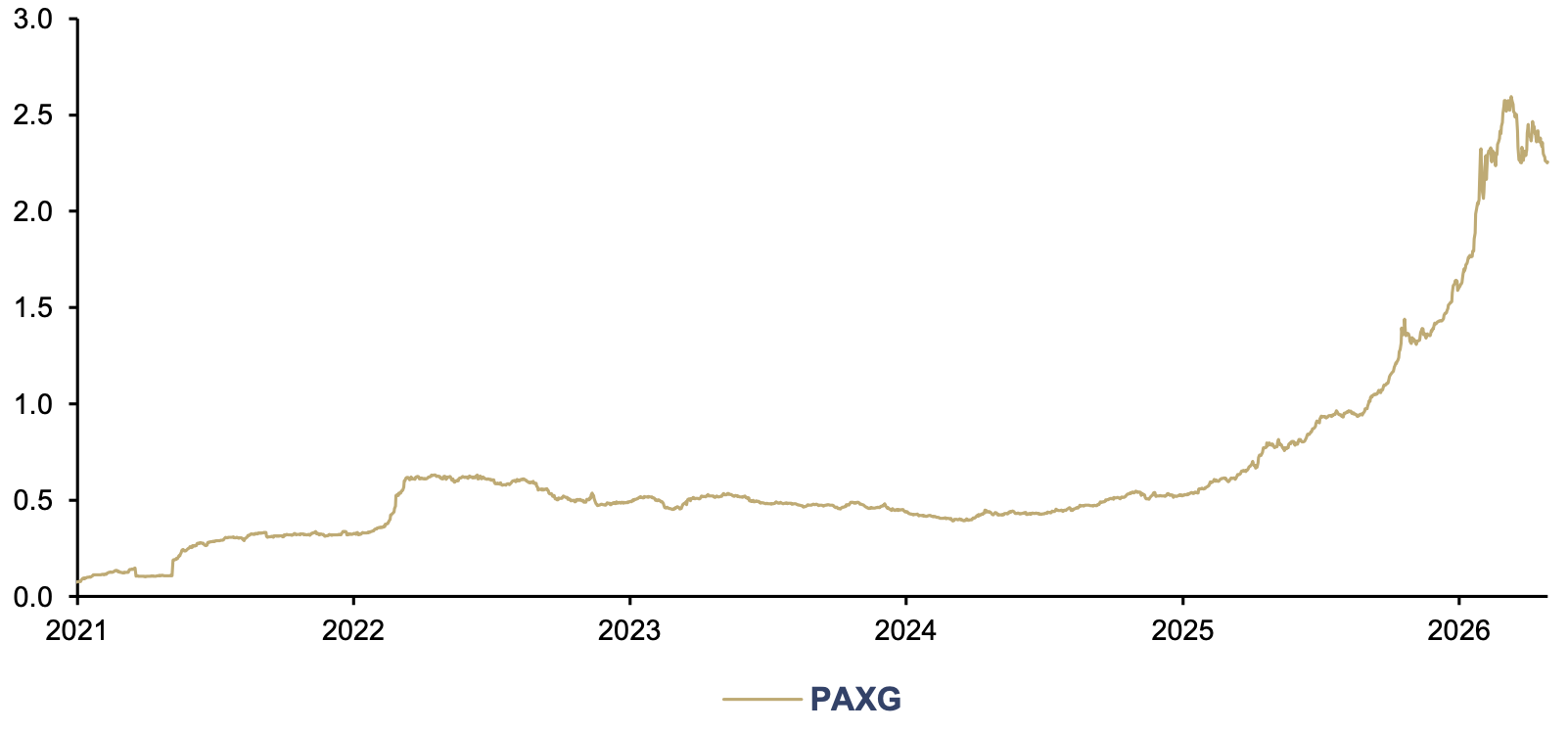
As of early 2026, that model has translated into steady growth, especially over the past couple of years. Internal Paxos figures shared with the In Gold We Trust report show that the number of unique wallet addresses holding PAXG has risen to more than 83,000, up sharply from just a few thousand in its early years.
Overall, PAX Gold today represents a market size of roughly USD 2–2.5bn, with over 500,000 tokens in circulation and daily trading volumes routinely approaching USD 300mn.
PAX Gold (PAXG) Market Capitalization, in USD bn, 01/2021–04/2026

Source: CoinGecko, Incrementum AG
“The past couple of years have been high-growth years for gold in general,” Hessert said, adding that the combination of rising gold demand and increasing interest in tokenization has created “unprecedented demand in both of those dimensions.” Most notably, “large players in the gold ecosystem” – including, in some cases, central banks, according to Hessert, have begun asking how they might “leverage this token” or even use Paxos’s infrastructure to issue tokenized gold themselves.
In Hessert’s opinion, the beauty of Paxos is that unlike other providers, it can cater both to institutions that want to participate within its system, or those who would prefer to issue under their own brand.
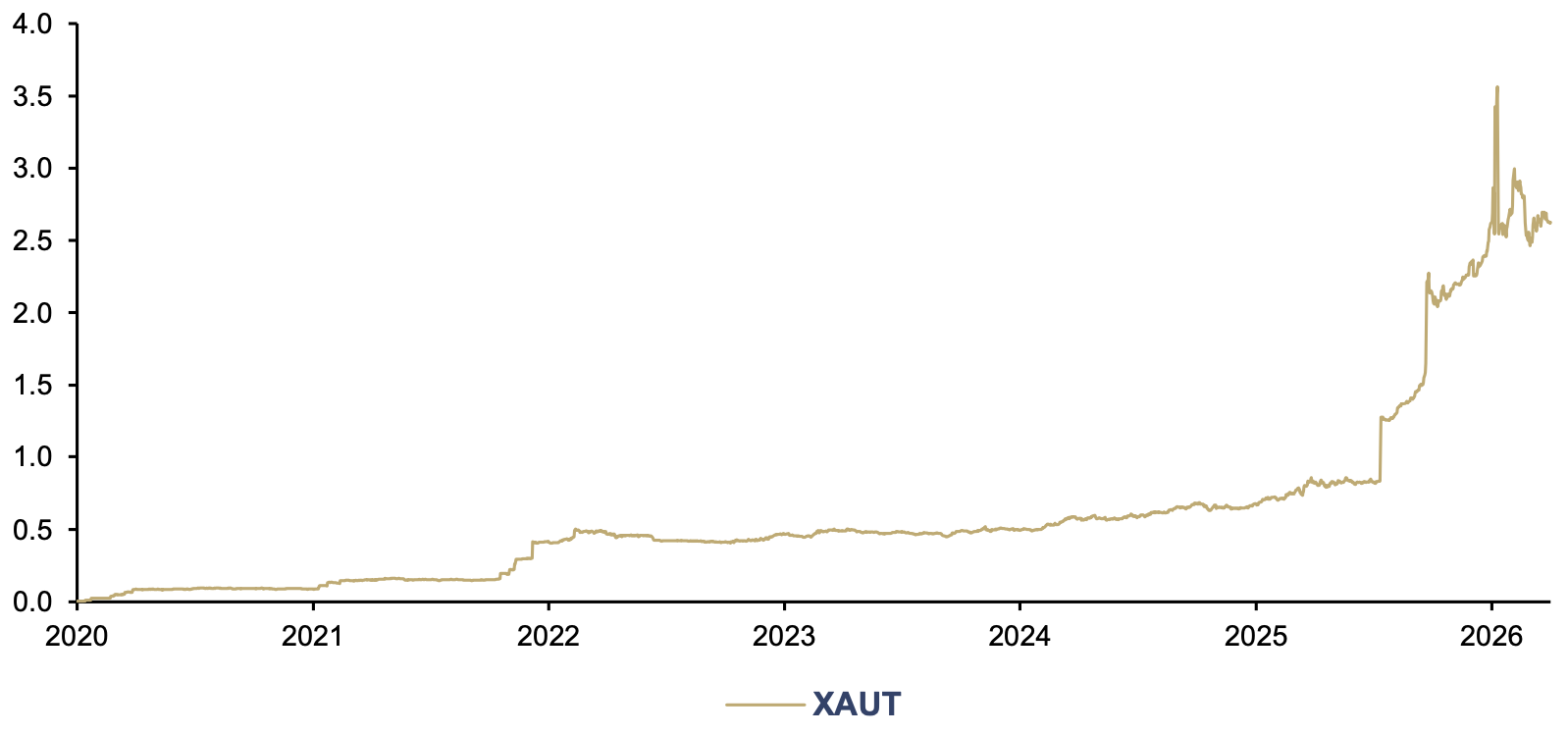
A similar dynamic in terms of adoption and performance has played out at Tether. Despite launching its XAUT gold stablecoin in January 2020, it wasn’t until 2025 that the token’s market capitalization began to accelerate meaningfully.
Tether Gold (XAUT) Market Capitalization, in USD bn, 01/2020–04/2026

Source: CoinGecko, Incrementum AG
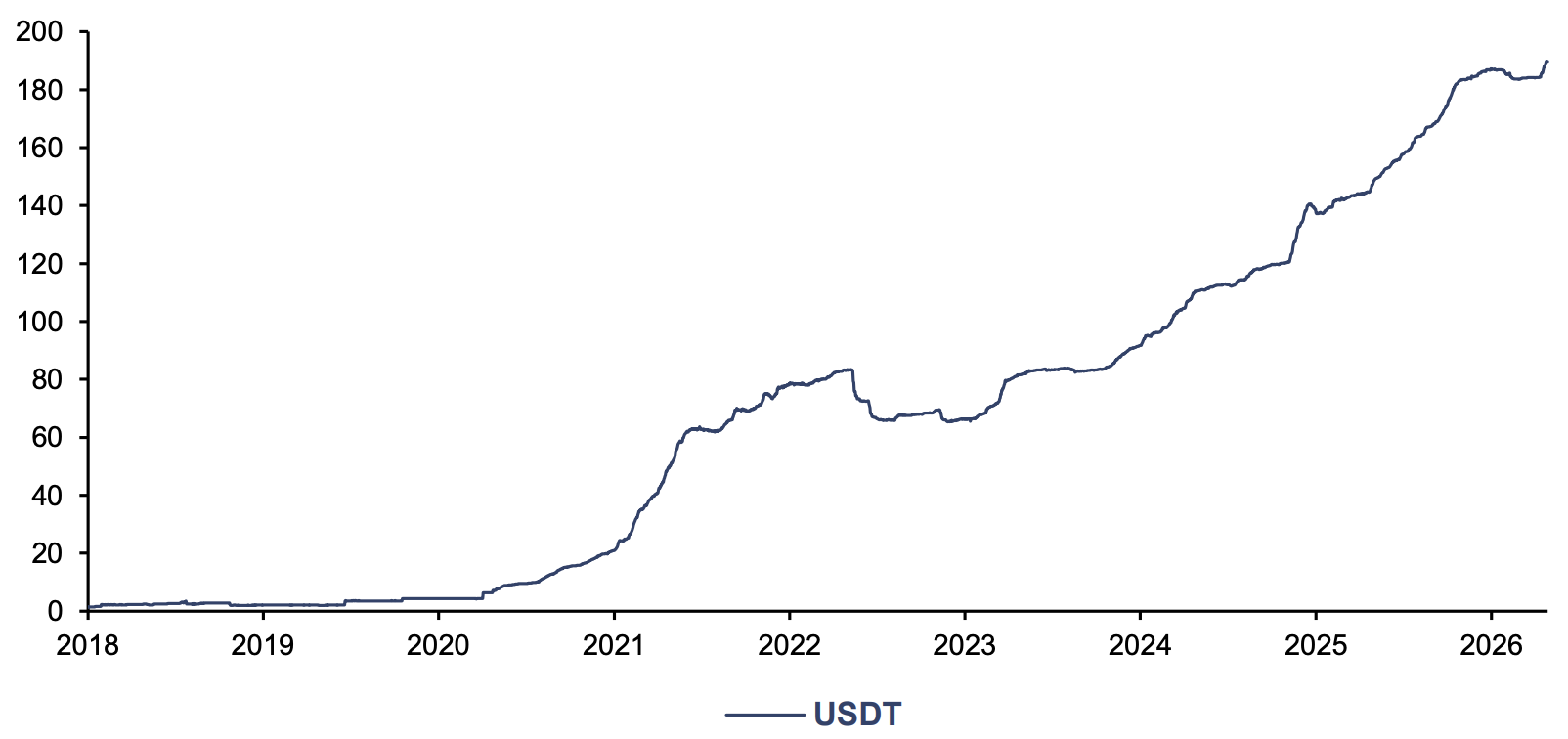
As Jefferies analysts observed, that pattern differs from the more linear expansion of Tether’s flagship US dollar token, USDT, which has grown steadily alongside broader crypto market activity. By contrast, XAUT’s more abrupt phase of adoption coincides with the company’s own deepening involvement in physical bullion markets over the past year.
Tether (USDT) Market Capitalization, in USD bn, 01/2018–04/2026

Source: CoinGecko, Incrementum AG
Taken together, the numbers reveal a market that has moved well beyond niche status. According to data from CEX.io, tokenized gold trading volume reached USD 178bn in 2025 – surpassing every gold ETF except the SPDR Gold Shares (GLD) in global trading activity. CoinGecko data showed the combined market capitalization of tokenized gold surging roughly 177% to over USD 4.4bn by year-end, with Tether’s XAUT alone accounting for approximately 75% of Q4/2025 trading volume.
Much of the mystery behind the uptake divergence between XAUT and USDT, as well as the proportionately larger accumulation of gold reserves for Tether’s own account relative to its stablecoin, lies, as alluded earlier, in the fact that Tether did not want to openly market the product to users until the wider infrastructure was fully operational.
“It was not speculation. It was not a trade,” Sartori said. “It is really a strategic reserve construction in order to support a successful global stablecoin.”
But it is also linked, at least in part, to the peculiar economics of gold stablecoins, which benefit from the presence of large buffer reserves for operational reasons.
Unlike US dollar-backed stablecoins, which can generate income from interest-bearing reserves, gold is a zero-yield asset. That means neither Tether nor Paxos make money from the usual interest-rate arbitrage model that applies to their fiat equivalents. Instead, they capture revenue by charging customers for the creation and redemption of tokens. The plus side of the model is that once issued, transactions occur on public blockchains, meaning users only pay the underlying network costs, known as gas, rather than additional fees to the issuer. The downside is that the revenues are modest. Not that this poses an issue for Sartori.
“In reality, we don’t intend to make a lot of money out of this product… We want to create a solution for 500mn people in the future,” Sartori told the In Gold We Trust report. “And in the future, when we are servicing a community like that, there will be other services we can propose in order to make money.”
But it’s one thing not to make money from the product, and another not to be able to deliver on your core customer promise. Yet, Tether soon discovered it was encountering the very same problems as it had hoped to solve for everyone else. “The problem with gold, we realized, is that physical gold is not so easy to buy. We suffered from the same limits that we thought we were solving,” Sartori explained.
To overcome those constraints – and to ensure it can operate at the speed its model required –Tether moved to vertically integrate across the supply chain. The goal, as Sartori puts it, was to maintain a sufficient “cushion” to meet subscriptions at spot price without fees or logistical bottlenecks. That meant forging agreements with major refiners, securing off-take contracts with producers, and acquiring both physical gold and royalty interests in mines – effectively building a pipeline of supply designed to support issuance over the coming decades.
This distinction matters. What appeared as opportunistic buying may instead reflect pre-positioning – the gradual accumulation of inventory and infrastructure ahead of a potential shift in demand for tokenized gold.
Without such reserves, Sartori says a gold-backed token cannot credibly scale. “Even if you delay by 24 hours, your stablecoin is not backed by real, physical gold… and it will fail our main ideological test.”
What follows from that logic is a very different model from Paxos, identifiable in its investments. Tether has taken positions in royalty and streaming companies, most famously Elemental Altus, but also Gold Royalty, Versamet Royalties and Metalla Royalty, effectively embedding itself within the upstream gold supply chain.
Beyond that it has also struck a strategic equity investment plus commercial partnership aimed at distribution with Gold.com, a major vertically integrated operator.
Powering this acquisition-led approach – spanning not just gold, but also technology, bitcoin and land – has been the more than USD 30bn in cumulative profits Tether has generated since interest rates began rising in 2022.
A Shadow Bullion Bank?
For those wondering what Tether is ultimately building, the answer lies less in any single product than in the direction of travel. The pattern of investment points to a conviction that demand for gold-backed liquidity has been structurally constrained – by market plumbing, access, and the frictions of physical settlement – and is now poised to break free.
Tether’s bet appears most concretely to be that the next phase of gold demand will not be driven solely by traditional investors, but by actors operating outside the core US dollar system – those with existing gold holdings, or with reason to seek alternatives to it. In that context, tokenization is less a novelty than a way to mobilize gold demand that was previously suppressed for technical reasons.
As CEO Paolo Ardoino has suggested, official demand figures may understate the true scale of demand, particularly in emerging markets. “What China and other countries are declaring … is extremely incorrect,” he told The Peg. “They are buying much more than what they claim they are.”
This is where Tether’s ambitions begin to diverge most clearly from those of Paxos. Where Paxos has built its model around regulatory integration, transparency and institutional adoption, Tether appears to be pursuing scale, distribution and system-level influence. It is not merely issuing a token. It is attempting to reshape how gold functions within the financial system.
That divergence extends to custody. While Paxos relies on LBMA-approved London vaults, with each token linked to specific bars, Tether stores its gold primarily in Switzerland, in facilities it controls directly. “We believe Switzerland has the best jurisdiction for gold, but also in terms of its legal framework,” Sartori said. “We own our own vaults, and we hold the gold there, and it’s independently certified by external sources, both on chain and both by independent certificators on a periodic basis.”
When asked whether Tether would be willing to give a large customer a personal tour of the vault, Sartori said they had facilitated such access but stressed that the stronger proof lies in the ability to redeem on demand.
“Allocated or unallocated only matters if it is in somebody else’s vault,” Sartori argued, casting third-party custody – even within established systems – as an avoidable source of risk.
Seen through that lens, tokenized gold begins to take on a more fundamental role: a neutral financial layer for value that sits outside sovereign control.
“Gold –while it is not perfect – is probably the [asset] that history has proven to be the most trustworthy,” Sartori said, invoking its historical role as the ultimate neutral monetary asset.
“We believe it would allow the world to go back to a gold standard without the problems that gold standards had in the past,” he added — namely “government intervention, government regulation, or the physical limits of gold.”
In that respect, Tether’s commitment to holding its gold in Switzerland, while simultaneously mobilizing it globally through tokenization, begins to resemble a kind of “Switzerland of assets” — a return to monetary neutrality, where ownership is decoupled from jurisdiction and access from geopolitics.
The philosophy extends into financing, too. Tether is already positioning XAUT as a collateral asset within a broader financial ecosystem. “We lend against Tether gold… we believe that’s going to be a very big business,” Sartori said, highlighting the potential for tokenized gold to underpin lending, leverage and yield generation.
The picture that emerges is therefore less one of a return to fractional-reserve bullion banking, and more of a shift in where that risk resides. As traditional bullion banks retreat under the weight of regulatory capital and liquidity requirements, a gap has opened up in the provision of gold financing, collateralization and market-making. Tether appears to be moving to occupy that space – not through balance sheet intermediation in the traditional sense, but through tokenized infrastructure.
Tether’s gold strategy therefore is less a product line than a system redesign – one that, if successful, could move gold closer to functioning once again as a widely circulating monetary asset, rather than a passive store of value.
Looking to the Future
It would be a mistake, however, to assume the market will remain a duopoly between Paxos and Tether. A plethora of gold-themed tokenized offerings are already lining up to take advantage of the evolving climate – and it should not be surprising that the industry’s own coordinating body is aiming to get in the game.
Nor is it just crypto-native firms staking claims. HSBC, the world’s largest commercial gold custodian, launched its own tokenized gold product via the proprietary Orion platform — first for institutional clients in November 2023, then for retail investors in Hong Kong in March 2024 — and by late 2025 had surpassed USD 1bn in retail trading volume across more than 100,000 transactions, making it the largest retail gold token in Asia. Unlike Tether’s self-custodied Swiss model or Paxos’s regulated trust structure, HSBC represents the incumbent bullion bank overlay: private distributed ledger technology layered on top of the world’s deepest institutional vault infrastructure, with fractional ownership down to 0.001 of a troy ounce – a model that completes the spectrum from crypto-native disruptor to traditional bank.
In March, the World Gold Council announced what it described as “a pioneering initiative to build new market infrastructure designed to unlock the next era of digital gold’s development.” At the center of this effort is a concept it calls “Gold as a Service” — effectively an open platform designed to connect the physical realities of gold custody with the digital systems used to issue and manage gold-backed products. The ambition is to build shared underlying rails encompassing a single standard for custody, reconciliation, compliance, issuance and redemption.
Stripped back, what this amounts to is an attempt to upgrade the clearing mechanisms that sit behind the LBMA system and make them fit for a tokenized age. If Tether is building a vertically integrated shadow bullion bank and Paxos is offering regulated infrastructure-as-a-service, the WGC is proposing something more akin to a public utility — a common layer on which multiple issuers can operate under consistent standards. The fact that all three models are advancing simultaneously suggests the market sees not just commercial opportunity, but a structural gap that needs filling.
That gap is not merely technological. It is monetary. For much of the past century, gold has been progressively stripped of its transactional qualities — demonetized, vaulted and reduced to a passive store of value. What tokenization now makes possible, perhaps for the first time since the collapse of Bretton Woods, is the partial reversal of that trajectory: gold that can circulate, settle and collateralize value across borders with minimal reliance on traditional financial intermediaries.
Not everyone, however, agrees on what should fill it. In its 2025 Annual Economic Report, the BIS laid out an ambitious competing vision: a “next-generation monetary and financial system” built on a unified ledger combining tokenized central bank reserves, tokenized commercial bank money, and tokenized government bonds. The BIS explicitly tested stablecoins against its three criteria for sound money – singleness, elasticity, and integrity – and found them wanting as a “mainstay of the monetary system.” The implication was clear: tokenization, yes, but with central banks firmly at the core. Yet this vision carries its own contradictions. A system anchored to sovereign money inherits the very fragilities – political capture, fiscal profligacy, debasement risk – that are driving demand for gold in the first place. The BIS wants to digitize the present monetary order; Tether and its competitors are attempting to digitize a pre-Bretton Woods one. Which architecture prevails may ultimately depend less on technological elegance than on the question that has haunted monetary history since the Bank of Amsterdam: who do you trust to hold the reserves?
The emerging reality is that “back to the monetary future” is not merely a playful allusion. It captures a genuine structural paradox at work. The most advanced financial technology of the 2020s is being deployed not to invent a new form of money, but to restore the oldest one. Blockchain rails, cryptographic proof of reserves, and programmable settlement are solving problems that goldsmiths, burgomasters and bullion banks wrestled with for centuries: how to make a claim on physical metal credible, transferable and liquid without ever moving the bar.
Whether it is Tether building a global supply chain from Swiss vaults and mining royalties, Paxos linking each token to a serialized London bar, or the WGC laying shared infrastructure for the next generation of issuers – the direction of travel points the same way. Gold is not being digitized in order to leave the monetary system behind. It is being digitized in order to re-enter it.
It may not take a new Bretton Woods moment to usher in the gold remonetization long anticipated by sound money advocates. Instead, it may emerge as it did in its earliest history — not by decree, but through gradual adoption, as societies converge on a trusted store of value by choice rather than design. The future of gold, it turns out, looks a great deal like its past.
Interview with Juan Sartori
Tether is building a gold-backed public good, says head of special projects Juan Sartori

Juan Sartori is a global business leader and investor focused on digital finance, strategic investments, and emerging markets. He currently serves as Head of Special Projects at Tether. In parallel, he is the Chairman and founder of Union Group International Holdings, a privately owned investment and private equity firm established in 2007 with a diversified portfolio across Latin America. Mr. Sartori served as Non-Executive Chairman of Union Acquisition Corp. II (2018–2021) and Chairman of Union Acquisition Corp. (2017–2019). He also serves as Executive Chairman of Adecoagro S.A. and Elemental Royalties Corp. Beyond business, he is active in international sports governance as co-owner of Sunderland A.F.C., Vice-President of AS Monaco Football Club, and a board member of both the European Club Association and France’s Professional Football League (LFP). He began his entrepreneurial career in 2002 by founding Union Capital Group, later selling control of the firm in 2008. In public service, he served as Senator of the Uruguayan Parliament from 2020–2025. Mr. Sartori holds a Bachelor’s degree in Business and Economics from École des Hautes Études Commerciales de Lausanne.
Izabella Kaminska: Thank you for joining me. Well, I have to start with the obvious question: what was Tether’s logic for launching both a gold stablecoin and a gold strategy? I know the gold stablecoin launched in 2019, which predates your time at the company. When did you arrive?
Juan Sartori: It was around two years ago. To understand why we launched Tether gold as a company and why we’re making a stronger push into it today – it is important to understand the philosophy and ideology of this company. Its main objective is really to provide a financial solution for most people in collapsing financial systems.
Today, we have 530mn people using USDT, our stablecoin, around the world. It is mainly geared towards emerging markets where their local financial systems have collapsed. We provide a solution for millions of people to continue operating [in that context], whether it’s protecting their money, making payments, or using their money in a collapsing financial environment.
What we see, and maybe it’s a little bit pessimistic, is that this contagion of failing financial systems is getting more and more global, with less and less trust in the fiat system, in the government systems, and almost a whole generation growing and wanting to be independent from any system whatsoever, whether peer-to-peer, directly storing their own currency, being able to make transactions, being able to pay, without banking fees, or any banking involvement into their private lives. All of that went into what is today the big reality: that stablecoins are widely used around the world as one of the most trusted ways for people to operate financial payments.
We see ourselves as a company that needs to provide a stable alternative system for these people so that they can operate within this new way of thinking or necessity.
Now, the only fiat currency that really is global is the US dollar. That’s why we have a stablecoin based on the US dollar: because people want to use stable US dollars. As such, we have become a distributor of US dollars into emerging markets, and places where distribution just doesn’t work.
Normal US dollars flow through banking. But banks fail, etc. Tether is a technological solution that offers people a way to access US dollars regardless.
If we look a little bit further and ask, could there be a system that allows people to do all of these same things without depending on any single currency or single government or single legacy fiat system? Well, we believe there are several assets that fit that bill. Gold – while it is not perfect – is probably the one that history has proven to be the most trustworthy. It’s been 1000s of years that people have trusted gold in order to keep their money safe and make their payments operational.
Gold is the only one that is globally and culturally accepted in terms of its value, but it’s also the one that’s had many limitations as a global payment system or currency, whether it’s for institutions, central banks or individuals.
First, it is difficult to carry – it’s difficult to go around with gold coins. Second, it’s also difficult to break apart.
We analyzed all of the characteristics that made stablecoins successful, and applied them to gold –and realized they replace the limits that gold historically had. This is why we decided to launch a stablecoin based on gold.
It’s the second only stablecoin that the company operates, so it’s really important and strategic, not least because it allows people to hold gold without counterparty risk. They can also use it to pay in their daily life, to store money in the same way they use USDT, but also in something that, in a different world, can even become “the standard”.
We believe it would allow the world to go back to a gold standard without the problems that gold standards had in the past, which were mainly government intervention, government regulation, or the physical limits of gold.
This is why we thought it was a great idea and a great product to launch into the world: it would allow our approach to contribute to what a future financial system looks like.
Kaminska: And what about the gold you are buying beyond the stablecoin?
Sartori: The problem with gold, we realized, is that physical gold is not so easy to buy. We suffered from the same limits that we thought we were solving. We ended up thinking that we want this gold to be owned physically. Second, we want it to be owned without counterparty risk: not in a bank, not in an insurance company, not in any place that can fail as a counterparty and then lock up access to your gold. So we basically decided we would have to build our own storage facility where all of this physical gold can go.
We also decided to build our own sourcing supply chain structures that don’t depend on historical limits. This is because in the digital world, it’s possible to suddenly have billions of US dollars of subscriptions into the gold token in one day. But if you turn around and you need to buy billions of US dollars of physical gold overnight, it’s almost impossible. There are limits in logistics in the system, or you are forced to buy it very expensively, which then translates to people and makes the system inefficient.
So we decided that we needed to build a whole gold system that is our own, so that it can successfully support a gold stablecoin. The aim is to have a cushion to meet subscriptions at spot price, without fees, in a way that doesn’t encounter storage problems.
Kaminska: So when lots of people were speculating: “Why are they buying all this gold? What’s the reason?” It turns out that the key reason was to avoid slippage?
Sartori: Yes, it was not speculation. It was not a trade. It is really a strategic reserve construction in order to support a successful global stablecoin; without that, it would be very difficult to cope, because even if you delay by 24 hours, your stablecoin is not backed by real, physical gold for 24 hours. This means it will fail our main ideological test. For us, it’s essential to have an absolute claim to the gold every single time and for it to be fully backed. And the credibility of that backing is what makes a successful stablecoin. As a result, we decided – in advance – that it would make sense to hold gold on the company’s balance sheet in order to be able to provide it to the world without execution risk.
Also, we decided that this product would have zero fees. Today, you can access gold through ETFs. They also offer a claim over physical [gold] but they come with counterparty risks, and it probably costs 30–40 basis points a year. We decided that, because both the storage in our own vaults and the technology that makes it global is actually relatively cheap, we can create a stablecoin without any fees whatsoever. This way, people – for the first time – will be able to buy gold at spot price, without commissions, store it without any commissions, and use it to pay or transfer without any commissions or fees.
Kaminska: The logical next question, then, is how do you make money? Through creations and redemptions?
Sartori: Yes, subscriptions and redemptions have a small fee. Exactly. It’s minimal. In reality, we don’t intend to make a lot of money out of this product. We want to create an ecosystem. We want to create a solution for 500mn people in the future. And in the future, when we are servicing a community like that, there will be other services we can propose in order to make money.
But the objective is not to design a product to make money. It is to design a product for success that provides a solution around the world, and that is going to grow, and that’s going to create opportunities. We can lend against that gold and make money with the interest. We can provide services to people who hold that gold. USDT is a good example. Today, interest rates are high, and we make money on the differential. But for many years, interest rates were zero or negative, and it would have been the same question.
We built the product for the world before it was a business, actually. The business is circumstantial. Right now, interest rates are on the right side of that trade. So in gold, we think the same. We think that by holding a physical dependent reserve of gold, we’re going to be a very valuable part of the future financial system, and that this gold token is going to start replacing other instruments. Whether it’s for investment purposes or for other purposes. Today, if you own an ETF, you would much rather own Tether gold: same exposure, more direct, and fewer fees. And, very importantly, it trades 24 hours, seven days a week.
If you want to trade gold today, it closes on a Friday, opens on a Monday. We saw it now when gold broke USD 5,000 for the first time, it was during the weekend in Tether gold, and then on a Monday, it opened above USD 5,000 in traditional financial markets. So we already see that we are filling a gap by making gold a 24-hour real-time trading system, the same way that bitcoin has traded forever, but not equities or bonds, etc.
So that also has a use for a lot of people who need to operate with gold during the weekend.
But – because we suspected that demand could get significant very quickly – we didn’t want to push the product until we had created a system that can cope with the demand. That’s why, despite launching several years ago, we’ve not really been promoting it until now. This was to be 100% sure that we can cope with the growth. And building a physical system that can cope is not easy.
That’s why we had to make agreements with the biggest refiners in the world. We needed to make off-take agreements with the biggest producers. We needed to even buy royalties in mines so that for the next 20–30 years, we are receiving gold into our reserves. We had to build all of that to reduce the risk to almost zero.
Kaminska: The gold stablecoin currently represents a fraction of your US dollar business, so what are you aiming for? Do you think it will eventually outgrow the US dollar business? What’s your projection in terms of growth?
Sartori: It depends on your view of it and what happens to the world. Obviously, the more the world breaks down, the bigger the shift into this kind of alternative solution will be. We’ve seen this very clearly with USDT in emerging markets. In financial systems in places like Europe, where things work well, people don’t really need stablecoins. Emerging markets, where banks fail and inflation eats all your local currency, money: stablecoins are very widespread. Gold investment products represent around USD 300bn out there right now, and Tether gold is a better solution for these kind of people, purely as a replacement of an investment product. When it comes to stablecoin use or transactions around the world, just stablecoins on the US dollar represent around USD 250bn. What if tomorrow a portion of that starts shifting into gold-backed payments, stablecoins, international flows? The liquidity of gold is roughly USD 300bn per day.
So if a big portion of those flows start being done through a goldbacked stable coin, rather than physical, which is cheaper, faster, easier, from our point of view, it could be another area of growth.
You know, we were very surprised that USDT didn’t grow in its first few years, and it was very difficult for us. But then we were just as surprised when suddenly the world found a use for it, and the growth became exponential and beyond anything we had imagined. We built the best possible product. It is out there, and I think people, institutions, the world, will see how fast it can be used and for what purposes. Definitely, there’s a lot of education needed on why gold is a better asset.
Kaminska: You’re not the only player. Paxos has its own gold offering. How do you differentiate from them? They would say they are better regulated, offer allocated gold and that their gold is in LBMA vaults.
Sartori: We don’t mind competition. We think it is good. The more financial solutions that are out there for people, the better. The more they can compare it. We are just very good at what we do. That’s why we are the biggest stablecoin company out there in a competitive market. There are now hundreds of stablecoins out there, and we have succeeded in making the most successful one because of the best technology, the best distribution, but also the best system behind it. I think gold is going to be the same. I don’t think today many companies have the capacity to match the system that we have built.
We own today, USD 25bn of gold, which is ready to be shifted into our product. If suddenly an exponential demand comes to a lot of this industry, I don’t think they will have the balance sheet, the capacity, or the structure that we have built. We think that’s an advantage. The characteristics of the product: being absolutely transparent, zero fees, connecting into a network of 500mn preexisting users of our own stablecoin – all that is going to be an advantage. There are also other products that are very high quality and will do very well: a rising tide lifts all boats. But rather than focusing on the differences with the other ones, we are building it in the way that we believe is the best for our clients.
Kaminska: So my understanding is that you hold the gold in Switzerland, right? Can you tell me more about how it is stored, as there are always concerns in the gold community about transparency? Even GLD has had to address concerns about whether the gold is really there.
Sartori: Crypto people and gold people are very similar on that point. They are paranoid, and they are right to be so. That’s why they’re looking for these assets in the first place. We believe Switzerland has the best jurisdiction for gold, not only historically, but also in terms of its legal framework. That’s why all of the gold, some 70% of the gold on the planet, goes into Switzerland to be refined, and from there it goes back all over the world. Everything protects gold there. Ownership, it simplifies gold storage, it simplifies gold transfers, and we believe it’s the right place. After having analyzed every single jurisdiction around the world, we decided it was the best one.
Imagine that our product is fully redeemable in gold every single day, with no restrictions. People can go into our location, click a button, and receive the gold. And some people have done it to try to test the system precisely because they are paranoid, and want to make sure of that. So we store it there in Switzerland, in our own location. It is available and redeemable every single day, without restrictions.
Kaminska: Is that in allocated or unallocated form?
Sartori: Well, it makes no difference, because we don’t have that counterparty risk. Allocated or unallocated only matters if it is in somebody else’s vault. That’s the problem of many products. If I have it “allocated” in Lloyds or in local London, I still have a counterparty risk of whichever bank holds that gold. In our opinion, that’s a problem. Most of the other products have “allocated or unallocated”. For us, that is still at a counterparty risk that is unacceptable to take.
Kaminska: And this is because the vaults are yours, that’s the real differentiation?
Sartori: We own our own vaults, and we hold the gold there, and it’s independently certified by external sources, both on chain and both by independent certificators on a periodic basis. So we publish today, monthly attestations, quarterly attestations by international auditors, and that’s the way we give transparency to the reserves. Because we are also paranoid, we believe that whether it’s “allocated” or “unallocated” – that is just what it says on a piece of paper. You never see the gold, and it’s in thirdparty locations. That means it’s something that probably doesn’t have the backing. If you look today at the quantity of exposure of financial gold, and how much gold is supposed to be in reserves, allocated and unallocated, how much is really there, nobody knows. The reality is, nobody really knows. So we feel more comfortable knowing we have it.
Kaminska: Would you be willing, if a big customer came along, to give them a personal tour of the vault?
Juan Sartori: [Nods]
Kaminska: So yes.
Juan Sartori: But even better than a tour, they can redeem it any day. They will see their own gold and get their own gold before they even get to the door. So that guarantee of absolute liquidity and redeemability in physical, because if it’s not in physical, you never really know if you’re going to get it, is the biggest guarantee. But at the same time, we’re fully transparent. Obviously, we cannot get a million visitors there for security reasons, although some people have come, that’s why independent certification is usually the best, most widely accepted way of guaranteeing and making the reserves transparent.
Kaminska: The gold is also backing to a certain degree your US dollar stablecoin. How come? Why is gold good for backing the US dollar?
Sartori: Well, I can give you an economic answer, or a numerical one. We believe in creating a stable currency that can really cope with hiccups in the financial system. And basically, we believe that the best ultimate reserve assets are a mix of Treasury bills and US dollars, and also some real asset that can also reflect better the inflation risk. Treasury bills have a big hidden risk: that is inflation. You may think you have more money, but actually you have less. So gold is an asset that compensates for that risk, and hedges and diversifies a bit the US dollar risk. Actually, it makes it stronger. And also we have a large amount of excess reserves. At some point, we had up to USD 20–30bn of excess reserves, basically the quantity of assets that back the quantity of liabilities. Today that’s about USD 185bn, which puts us in a very different situation to banks. When you put your US dollar in a bank, usually they have less than 5% reserves. They lend it out, and most of your money goes out, and they only keep 5%.
Well, compared to that, you put your money in a stablecoin, you get 120–130% of assets backing that US dollar.
Kaminska: And who is your target customer? What demographic are you targeting? Retail users, or also institutional investors and central banks?
Sartori: First, we provide the product to whoever wants to use it. We just make sure that it’s a good currency, a good product. The usage is really a mix of institutional people who want to hold gold, and they buy it in order to hold gold, and industrial customers. There’s traders using it for hedging, there’s producers using it for working capital or transfers, and then there is the retail component, who are people who just want to use it for payments, transferring money in the same way they use the US dollar stablecoin. So it’s really a mix of everything. Today, we have reached USD 3.6bn in assets, but we are still growing. The product grew by almost USD 1bn in the last 45 days. So it’s really just now going through the exponential phase, reaching the masses around the world and targeting every single niche where this product disrupts the way things are usually happening a bit.
Kaminska: Do you think that growth is linked to geopolitical uncertainty?
Sartori: Yes, but not only. First of all, the product was only really been listed on most exchanges for the last three months. Before that, we were afraid if we listed everywhere, there would be too much growth, and the system needed to be solid. But definitely, the demand for gold in the context of geopolitical risk has always historically been a factor. There are more people wanting to hold gold right now that the environment is more uncertain than one year ago. Not only for geopolitical reasons, but also economic. The more people are afraid of inflation, the more people are afraid of US dollar risk, the more they want to hold gold. It just happens that today, if you look at it, and that’s why education is important, buying Tether gold is probably the most efficient way of doing it.
Kaminska: And what is the total amount of gold that you now have?
Sartori: We publish our reserves every three months. So it’s going to come out in one week. But we own approximately USD 25bn of gold. In size that’s around 150 t of gold.
Kaminska: How has the market responded to the sudden arrival of Tether in their patch? Jefferies put out a note last year implying you may have been responsible for triggering the bull run? Do you think that’s fair?
Sartori: I think in one year we probably became one of the biggest players in the gold market in all its aspects. Probably today, Tether is the biggest private reserve of physical gold in the world; one of the biggest buyers; one of the biggest investors in the gold production chain, because we do off-takes, we do financing, we do prepayments, we do royalties. We acquired a royalty company that is becoming one of the biggest in the sector. So, definitely, in a gold sector that is pretty traditional, we have become a very significant player. I think a player who will also expand the market beyond its traditional perimeter. This is because if we are able to allow every single person around the world to buy USD 100 of gold as easily as going into a wallet and pressing a button — the same way they buy any other digital assets — then there’s a demand that, for sure, is not there today.
Looking ahead, I think, for those who want widespread adoption of gold, who are facing quite a lot of traditional limits, we are really making a service to make gold as global as it should have been in the past, but couldn’t be until this technological solution arrived. The idea is to have an integrated gold system that goes from origination, storage, lending, and digitalization, in order to be distributed around the world. And that, I think, has been a shock for the gold market because we’ve been able to do things that they always dreamed of doing, but never did, in a very short period of time.
Kaminska: And is that down to your influence? Are you the brainchild of Tether’s gold strategy?
Sartori: The brainchild of this company is, well, we have a founder and chairman of this company who has a very clear, ideological and economical view of the world, who is the driving force of all of these strategic initiatives. And that is Giancarlo [Devasini]. And at the same time, we have Paolo [Ardoino], who is our CEO, who is a technological genius, who has created the biggest technological distribution system in financial markets in the world in the last 10 years. So really, we have two founder individuals in this company, who continue disrupting the way financial markets work, and who have a very clear vision of what they want to create: a stable company that is a stable system that provides all of these products for hundreds of millions of people. They think about it, they validate it, they decide to go for it, and they provide all of the resources for this to happen. Tether is a very small company in terms of the quantity of people it employs. So it’s very, very concentrated in the brains of the company, who have had so far an incredible vision of where it should go and what they have created.
Kaminska: What appealed to you in terms of coming on board?
Sartori: The capacity of this company to really disrupt and generate the products that solve the financial needs of hundreds of millions of people, especially in emerging markets. I’m from Uruguay. It may be difficult to understand from a United States or from the European perspective, how this company is really providing a way for people to have livelihoods all over the world when they need to operate in a certain environment where people are facing bad governments or banks are confiscating their money, through inflation, through regulation, through incapacity to provide a good backbone for their financial needs. So it’s really a company changing the world and all the industry. And that’s what’s the most appealing, even in gold, and maybe that’s what is most surprising for most people. That with our mix of resources, and vision of what’s going to happen in technology, we can generate real stability, on a big scale, in a lot of pockets around the world.
Kaminska: One of the big questions in the industry last year was why did you decide to buy royalty companies since they pay out in cash. What was the logic? Why royalty companies?
Sartori: What you say is precisely the opportunity. It doesn’t make any sense that a gold royalty company sends cash to a mine for them to pay in cash to get gold out of the ground, to then transform it into cash, to pay royalties in cash.
We would like to get physical gold out of the royalties. We believe that royalty companies should pay dividends, not in cash, but in gold. Investors want gold, not cash, and all of that was administratively and physically challenging before. But now with Tether gold it is possible to achieve this seamlessly. The intent is for companies to pay royalties in Tether gold. We already announced that our royalty company will pay dividends in Tether gold, so we’ll be able to finally “goldify” or go to a gold standard through technology in Tether gold in a way that solves this inefficiency. The gold industry should not operate in anything other than gold. We also never liked that gold companies hold cash on their balance sheet. They should hold gold, especially if it is to pay distributions to shareholders: it should be in gold, not in cash. So that’s also precisely part of our vision: to change the way things are being done.
Kaminska: It was reported that you hired a professional team of traders. That implies you won’t be running a passive strategy. What will they be doing? And are you also looking at trading or tokenizing other precious metals, or other commodities?
Sartori: First, we like gold because of its global monetary characteristics. Anything else is not gold, whether it’s lead or iron or platinum or silver. It is just not gold. Gold is the most liquid asset out there. It is the only one that really has been used and can be used as large scale central bank reserves and a payment system. So we believe in gold really as a superior asset with those characteristics. Sure, you may make money with some other metals, but most of them also have big industrial markets and industrial demand. They are less of a pure financial asset, in our opinion. They are less liquid. They are small. Silver takes 50 times more volume than gold, so even that characteristic doesn’t make it a high-quality payment for storing of wealth in the system. We focus on gold because, just as we think there’s almost no challenger as a global currency to the US dollar, there is no challenger metal that can be global like gold.
In terms of the know-how, obviously, we are trying to acquire the best know-how in the world for managing all aspects of our gold exposure, whether it’s the buying, storing, the technological aspect of it, the royalties, the validating of geological models. Gold remains a physical commodity that needs very strong know-how in all aspects of the chain. So although we are very good in technology, we must also incorporate the best know-how in trading, in financing, in lending, in mines, in everything.
Kaminska: Many bullion banks have been withdrawing from the LBMA system because of the regulatory expense. Does that create an opportunity for a company like Tether? Are you gearing up to be a shadow bullion bank in that sense?
Sartori: We lend against Tether gold, and we believe that’s going to be a very big business, because it also solves a need. Today, if you want to hold gold, you hold it physical, but nobody will lend against gold that is in your garden or under your mattress. And now, if you hold Tether gold, you’ll actually be able to lever it, loan against it in a very simple way, and we’re going to provide for that. Also, there’s a huge amount of staking protocols that are being created, not by us, but by the eco-system that will allow people to get some yield on that gold. So definitely there will be a bigger financial system created around gold, because Tether gold is a superior way of lending, getting it as a guarantee, putting it out as collateral. So we expect that to happen, and we want to generate the conditions for it to be a business. Today, you can probably borrow funds against Tether gold at cheaper rates than you would be able to borrow from a bank or against an ETF simply because there are fewer fees, there is less friction, and it’s easier to trade. We think that will put us also in the middle of a very important financial system in gold.
Kaminska: Is there anything else that you think is important to communicate to the readers of the in gold we trust report?
Sartori: Gold lovers understand all the reasons why we want to buy gold. We believe that the geopolitical and economical environment is at a tipping point. Things are happening now. Many people have been waiting for a long time for this to happen. But also, the technological evolution of being able to give gold a digital direct link, distribution and transparency is why now it’s possible that gold really goes global in a way that was not possible before. And central banks may have ways to diversify into gold, and they are doing it. They’re already shifting into gold versus Treasury bills, but people around the world didn’t really have a good solution, and now they have it. So with Tether gold, we think we can take global what was until today a niche of very informed people and very financially sophisticated people who are holding gold. Now we can extend that to the masses, and to the whole world. And by doing so, I think, we will recreate the gold standard, which was lost 10s of years ago, something that many people regret.
Kaminska: So this is really a private-sector-led initiative to recreate the gold standard?
Sartori: It’s not so much a private sector initiative. I think it’s really a movement because this technology is not restricted. People will be able to use gold in an open source way, without any restriction.
It’s almost a peer-to-peer, generational or community revolution to put gold into everybody’s pockets and make it global. We don’t see us as leading it. We see it as providing the technology to the system for it to grow organically around the world.
Kaminska: So the demand was always there, in your opinion. It’s just that there were access constraints before. Your policy is to break those constraints?
Sartori: Yeah, and provide a global gold-backed currency to the world in a way that it fits with what a currency is, so it can be used without restrictions.
I think, and I say it in a humble way … I think that a gold product with these characteristics has never had a company like Tether behind it, which is in a unique position to make it happen, because of the company that it is. It’s already global. It’s already a standard in a global currency. It has one of the biggest balance sheets, it is one of the most profitable, it can put maximum resources behind a token, it has the highest level of technology, and the willingness to do it. It also takes a company like Tether in order to be able to take a product like this, and make it a success.
Kaminska: The last company that got traction in the monetary gold space was e-gold, but it was shut down because of regulatory and compliance failures tied to money laundering controls. Paolo is usually keen to stress that Tether is fully compliant these days and works with scores of enforcement authorities. Does that make a difference?
Sartori: One of the biggest advantages is that this is not a startup product. It’s already a company that is regulated at the highest level, which complies with every single enforcement regulatory agency around the world on, when it comes to USDT, about USD 60bn of volume per day, and which complies with all. Right now, we’ve been commended by most of the regulatory agencies as one of the most helpful companies to combat money laundering and illegal activities, with the possibility of controlling that system from that perspective.
So this is a product that is born with all of the same regulatory advantages and regulatory connections that USDT and Tether already have. That point is an advantage.
Kaminska: Do you think central banks will ever look to gold tokenization?
Sartori: 100%, they will. They’re already looking at it. There are many jurisdictions around the world that are changing the central bank reserve regulations in order to be able to hold gold in a digital form. In the end, they just own gold because they own the physical gold. It’s just that instead of having a contract with UBS, they hold it in a blockchain based, digital contract, directly in a reserve, right? So it’s actually superior, from a legal claim point of view, in our opinion. That needs a lot of adaptation, but that is happening.
In a lot of emerging markets, people say, “We don’t have a currency, so let’s dollarize,” like Ecuador. But people now are also thinking we can launch a local currency, but it will be backed by gold reserves, and in that way be a bit more independent.
Kaminska: With that, I’m afraid we’ve run out of time. Thank you very much.
[1] The full interview you can find below.
[2] See “How Bankers Turned Money into ‘Σ 0 ∞ € ¥’,” In Gold We Trust report 2021
[3] See “The Stock-to-Flow Ratio as the Most Significant Reason for Gold’s Monetary Importance,” In Gold We Trust report 2014