


Bitcoin’s Role in the Monetary Future
“The root problem with conventional currency is all the trust that’s required to make it work.”
Satoshi Nakamoto
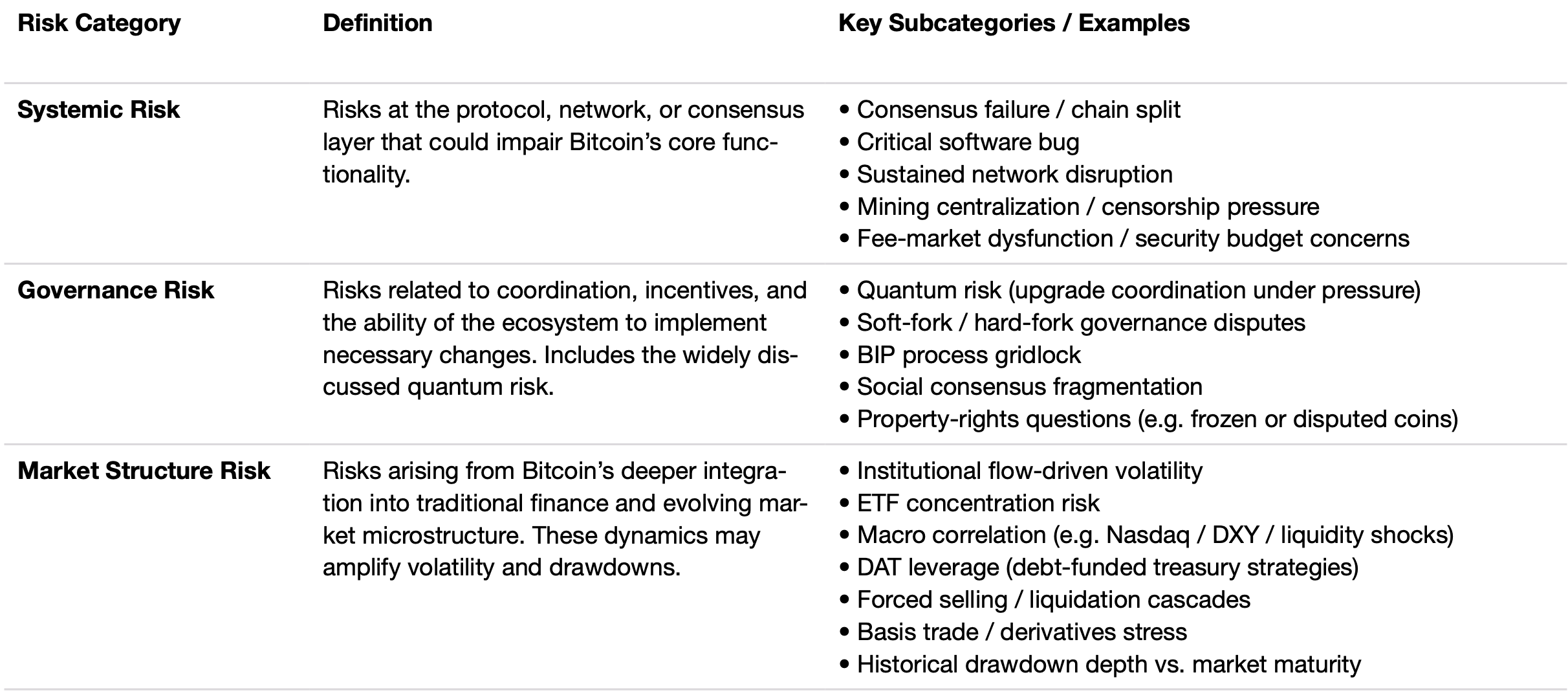
- With the early challenges now largely behind us, we identify three categories of Bitcoin risk: systemic risk, governance risk, and market structure risk.
- Quantum risk, currently the most widely discussed Bitcoin risk, is in our framework a subset of governance risk. It is less about an imminent cryptographic break than about Bitcoin’s ability to coordinate timely upgrades under stress.
- Bitcoin’s financial integration has increased the relevance of market structure risk, with deep drawdowns remaining possible during liquidity shocks. At the same time, the February 2026 sell-off showed that long-term allocators stepped in to buy the dip.
- Gold and Bitcoin remain complementary hard assets, not competitors. Their distinct demand drivers continue supporting low correlation and strengthen a combined debasement-trade allocation.
- At its core, Bitcoin addresses one of the defining challenges of our time: the erosion of trust. Between nations, between citizens and states and within monetary systems themselves. As a neutral and rulesbased network, Bitcoin may become one pillar of the future of money.
Bitcoin is almost eighteen years old, and like all newly minted adults, it is very different from when it was born. As it enters adulthood, its institutional phase is beginning to seriously hit its stride. While its core fundamentals remain unchanged, Bitcoin is no longer the same asset it was just a few years ago. The cast of characters holding it, the infrastructure surrounding it, and the risks embedded in it have all transformed.
If the leitmotiv of this year’s In Gold We Trust report is “Back to the Monetary Future,” then gold stands at the center of that vision. We believe its role within the global monetary system is set to grow more important again, as trust, neutrality, and monetary resilience are being repriced. Yet the future of money is unlikely to belong to gold alone.
With the discovery of Bitcoin, the monetary timeline was already altered. Its emergence cannot be undone, and its implications will continue to unfold from here. Having come a long way during its adolescence, Bitcoin has risen into the ranks of the world’s ten largest assets by market capitalization in less than two decades. Looking ahead, one can envision a future in which institutional investors allocate to it in earnest, credit markets are increasingly built around it, and sovereign nations begin to stockpile it. In such a system, Bitcoin could complement gold as an alternative reserve asset and settlement medium, offering distinct advantages in portability, divisibility, verifiability, and ease of transfer in an increasingly digital and interconnected world.
For investors, this new phase of Bitcoin’s life presents both risks and opportunities. Where will the next waves of demand come from? Does institutionalization introduce new vulnerabilities that investors should understand? Which legacy concerns can be retired, and which deserve renewed scrutiny?
Beyond the investment case, Bitcoin may also be gaining relevance as a response to a broader global trust deficit. In a world marked by geopolitical fragmentation, trade frictions, and growing skepticism toward sovereign currencies and state institutions, a neutral, borderless, and rules-based monetary network could become increasingly valuable. In the pages that follow, we examine what has changed for Bitcoin over the past year, the key risks debated in this new market regime, the institutional demand reshaping market structure, and why the “digital gold” narrative deserves both defense and refinement.
Growing Pains: The Three Risk Categories of Bitcoin’s Maturation
Over the years, Bitcoin has weathered a rotating cast of existential threats. The following represent some of the major concerns that were intensely debated in past years but now appear to have been resolved or to have faded in importance:
- For years, the prospect of a Bitcoin ban hung like a Damoclean sword over the asset, and was frequently cited by potential investors as a key reason to stay on the sidelines. With the approval of spot Bitcoin ETFs in the United States, it became clear that – at least across Western jurisdictions – outright prohibition was no longer a credible base case for Bitcoin.
- Exchange risk, once synonymous with Bitcoin itself after the Mt. Gox collapse, has been substantially mitigated by regulated custody infrastructure and the spot ETF regime.
Environmental criticism long ranked among the most persistent objections to Bitcoin, often cited as evidence that large-scale adoption would face political and institutional limits. The environmental narrative lost significant traction as the share of sustainable energy in Bitcoin mining rose above 50%, according to recent Cambridge estimates.
What is remarkable is that every major risk identified in the early years has either been resolved or significantly reduced.
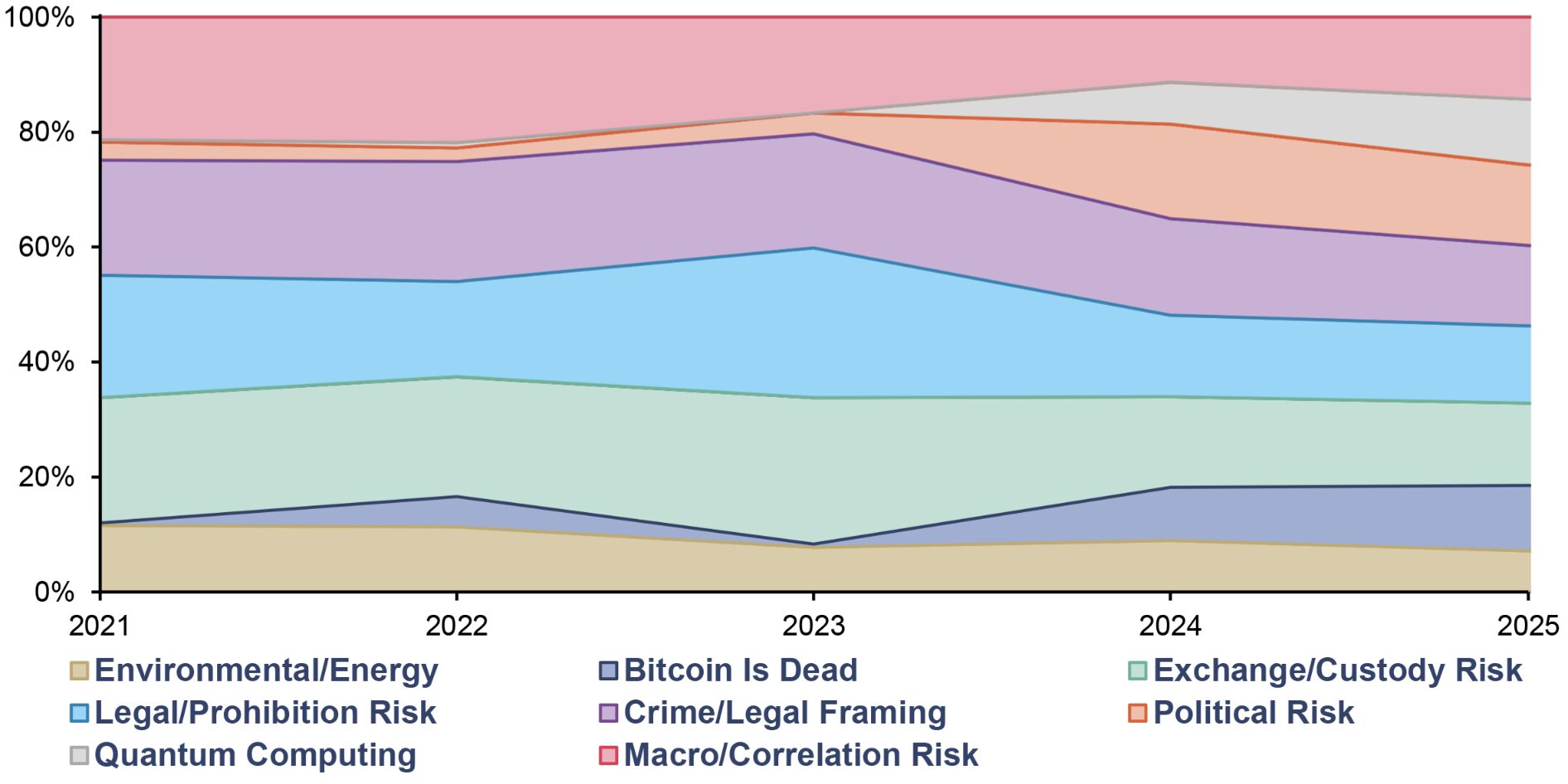
One might assume that Bitcoin FUD (fear, uncertainty, and doubt) would decline as the asset matures. The data tells a different story: FUD rotates. Perception Research’s analysis of 356,000 media mentions across 653 sources found that total negative sentiment remained structurally stable at 12–18% throughout 2025. The media appears to allocate a roughly fixed “negativity budget” to Bitcoin coverage. What changes is not the volume of criticism but its target.
FUD Attention Rotation: Share of Total FUD Mentions, 2021–2025
Source: Perception Research, Incrementum AG
The stacked area chart illustrates how Bitcoin-related FUD has rotated over the past five years using Perception Research data. The categories that dominated 2021– 2023 – environmental criticism, prohibition fears, and macro correlation concerns – accounted for the majority of negative attention. By 2025, their combined share had fallen, though they still command mindshare.
Environmental FUD, once a primary attack vector, lost relevance as newer data on mining’s energy mix challenged the narrative. Likewise, the recurring “Bitcoin is dead” trope has increasingly become contrarian clickbait around new all-time highs rather than a serious line of critique.
In their place, new narratives have absorbed attention. Political risk has risen sharply – no longer centered on fears of an outright ban, but on claims that Bitcoin is politically aligned with figures such as President Trump or the broader political right. Quantum computing has emerged as a new category of concern. Meanwhile, crime and legal framing remained persistent and, according to Perception’s sentiment data, turned significantly more hostile during 2025.
The broader shift is telling: Critics once argued Bitcoin had no value and would disappear. Increasingly, the debate has moved toward how Bitcoin should be governed, regulated, or politically interpreted – itself a sign that the asset is now treated as durable rather than temporary.
Today, it seems as if the most widely discussed risk is quantum risk. NIST finalized three post-quantum cryptography standards in 2024, and has recommended that organizations begin migrating away from quantum-vulnerable algorithms well before 2035. For Bitcoin, the threat is real but not imminent: Cryptographically relevant quantum computers capable of breaking elliptic curve cryptography are estimated to emerge between 2030 and 2035, and the Bitcoin developer community is already evaluating quantum-resistant signature schemes. Beyond the widely discussed quantum risk, which we classify primarily as a governance risk, we identify two additional categories that deserve investor attention: systemic risk, relating to network, protocol, or consensus failure; and market structure risk, in which institutional flows, macro correlation, and DAT leverage could amplify volatility and deepen drawdowns.
Bitcoin Risk Framework
Source: Incrementum AG
Finally, volatility itself remains a permanent feature of Bitcoin – not a bug to be engineered away, but a structural characteristic of an asset still in the early stages of global price discovery. As with gold, any noninflationary bearer asset that is not denominated in fiat currency will, by definition, remain volatile so long as it is not widely used as a unit of account. As long as goods, liabilities, and financial contracts are required to be primarily denominated in state currency, the sovereign monetary standard continues to anchor relative pricing.
Governance risks: quantum computing as more than a technical threat
The prospect of quantum computing breaking Bitcoin’s cryptography has attracted increased attention, driven by technological progress and amplified by behavioral biases among institutional investors. In 2025, quantum concerns contributed to greater institutional caution – driven more by loss aversion and herd mentality than by a sober assessment of the technology’s actual state.
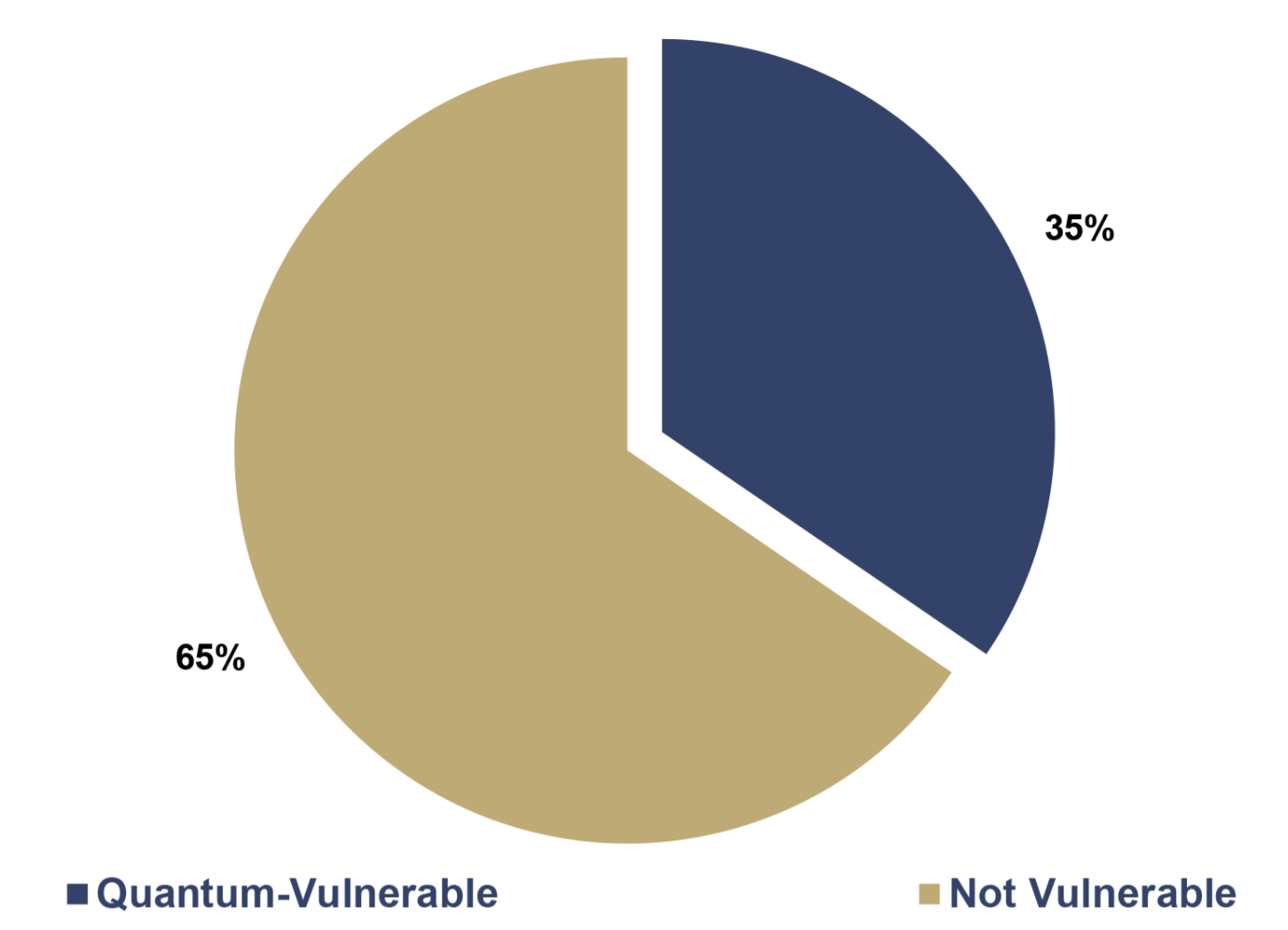
It is important to distinguish clearly between what quantum computing can and cannot threaten. Bitcoin’s 21mn supply cap is enforced by consensus, not cryptography, and quantum computers cannot create counterfeit Bitcoin. Coins whose public keys have never been revealed remain substantially better protected because the information needed to attack them has never been revealed. The exposure lies in Bitcoin’s earliest transaction formats: Project Eleven’s tracker estimates a vulnerable supply of 1.7mn BTC in legacy P2PK addresses (including 1mn tied to Satoshi-era mining). Per CoinShares’ analysis, this represents roughly 8% of total supply – well below the 4mn BTC frequently cited in popular discourse.
The quantum debate is often framed as a cryptographic emergency, but its most challenging dimension is governance. Bitcoin has made only two major protocol upgrades in the past decade, each taking years. A post-quantum soft fork would be far more complex. Nic Carter claims that Bitcoin’s development culture has been slow to address this risk, with BIP-360 – the primary quantum-safe proposal – led by a relative outsider. Yet core developer Matt Corallo stated in an interview in February 2026 that 30–40% of Bitcoin-dev mailing list posts now address post-quantum proposals, with consensus forming around hash-based signatures as a first step – an effectively zero-cost insurance policy that could be activated when the threat becomes urgent.
Percent of Circulating Bitcoin Supply Potentially Vulnerable to Quantum Attacks, 05/2026
Source: Galaxy Research, Project Eleven, Incrementum AG
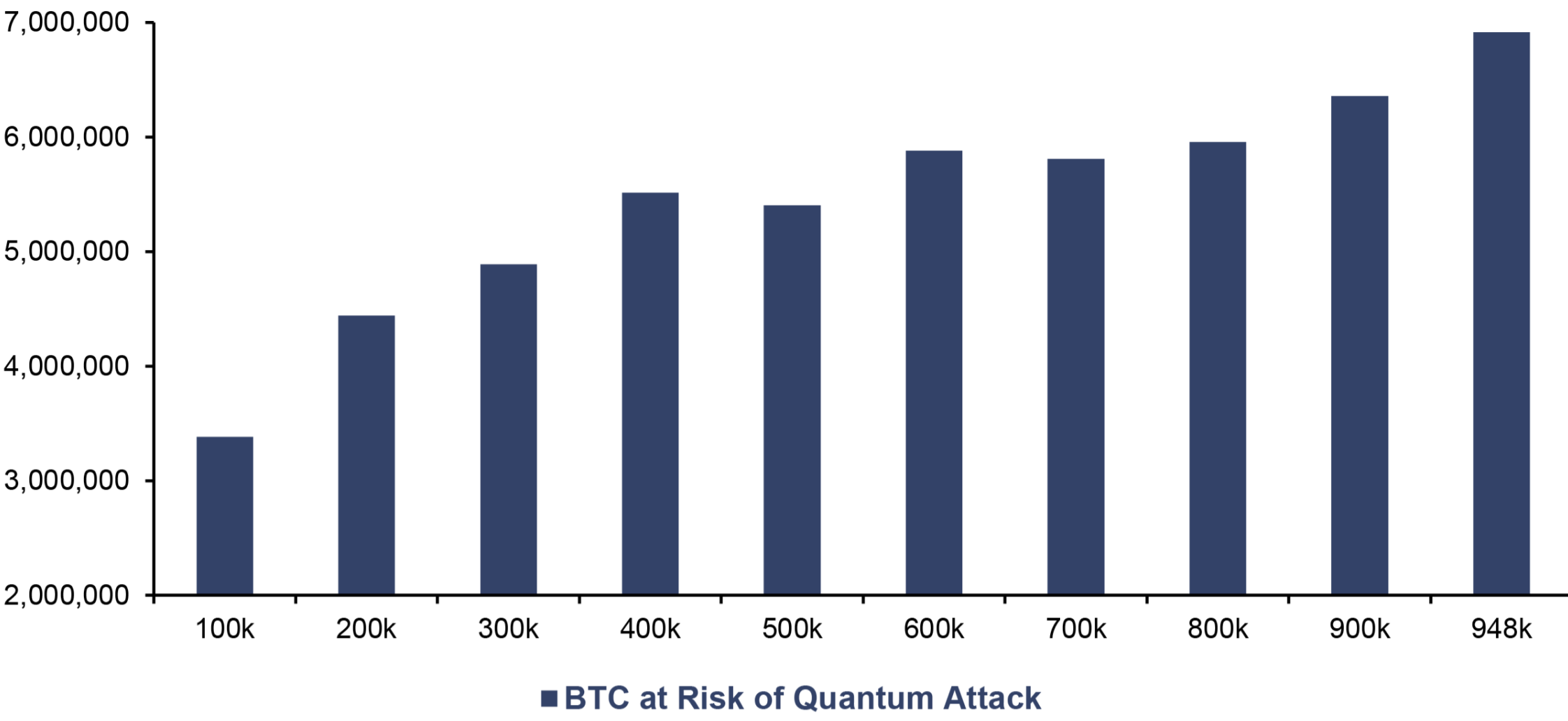
Galaxy Research’s comprehensive March 2026 analysis distinguishes between two categories of quantum exposure that investors should understand. “Long-exposure” coins are those whose public keys are already visible on-chain – legacy P2PK outputs, reused addresses, and previously spent outputs. An attacker with a CRQC would have effectively unlimited time to derive private keys from these exposed public keys. “Short-exposure” coins, by contrast, only reveal their public keys at the moment of spending, meaning an attacker would need to derive the key and front-run the transaction during the brief confirmation window in the mempool. This distinction matters because it means the vast majority of Bitcoin held in modern wallet formats is not vulnerable to a “harvest now, decrypt later” strategy – only the long-exposure category faces that threat.
BTC at Risk of Quantum Attack (y-axis), and Block Height (x-axis)
Source: Galaxy Research, Project Eleven, Incrementum AG
Perhaps the most interesting question is what happens to coins that cannot be migrated. Satoshi’s coins and those of early participants who lost their keys will never move to new address formats. Most assume these coins will simply be recovered by quantum-capable entities. But as Jameson Lopp writes, the community will face a choice between two property rights violations:
- Allowing quantum recovery redistributes wealth toward the few organizations with billion-dollar quantum capabilities, or
- Freezing vulnerable coins permanently burns property without consent.
Either way, an inviolable property of Bitcoin gets violated. Lopp frames this as the most significant governance decision Bitcoin will face since the block size wars. Investors should watch this issue closely, but remember that plans are being discussed well in advance of any actual threat.
Quantum computing is often presented as an existential threat to Bitcoin. That framing is overstated. The more immediate challenge is not whether quantum machines can break signatures tomorrow, but whether Bitcoin’s decentralized governance can coordinate a credible response before they can. The good news is that the issue is being debated years in advance of any demonstrated large-scale threat. Technical pathways exist, and the share of truly vulnerable coins is far smaller than many headline figures suggest.
For investors, the key takeaway is clear: Quantum risk should be monitored seriously but understood correctly. It is less a sudden extinction event than a long-dated governance test for a maturing monetary network.
Market structure risk: “regular volatility” vs. max drawdowns
The February 5, 2026, sell-off was a masterclass in how Bitcoin’s new market structure can amplify volatility. Bitcoin’s 13.2% decline in a single day was not a Bitcoin-specific event – it was a multi-asset cascade that revealed just how deeply integrated Bitcoin has become into the traditional financial plumbing.
The mechanics were instructive. Goldman Sachs’ prime brokerage desk reported that February 4 was one of the worst daily performance events for multi-strategy funds, with a z- score of 3.5, a 0.05% probability event, ten times rarer than a three-sigma move. When risk managers at multi-strategy pods ordered indiscriminate de-grossing, Bitcoin was caught in the crossfire. The CME basis trade, a favorite of institutional players like Millennium and Citadel, was unwound – the near-dated basis leapt from 3.3% on February 5 to a staggering 9% on February 6th, one of the largest jumps observed since the ETF launch.
Yet the most remarkable feature of the episode was what did not happen: There were no net outflows. Despite record IBIT trading volume (over USD 10bn, double the prior high) and options activity led by puts, IBIT saw approximately 6mn new shares in creation, driving USD 230mn in new AUM. The broader Bitcoin ETF complex added USD 300mn in inflows.
The catalyst came from traditional finance de-risking, which pushed Bitcoin down to levels where short gamma accelerated the decline, but the dip was met with buying by what appear to be authentic long-term allocators.
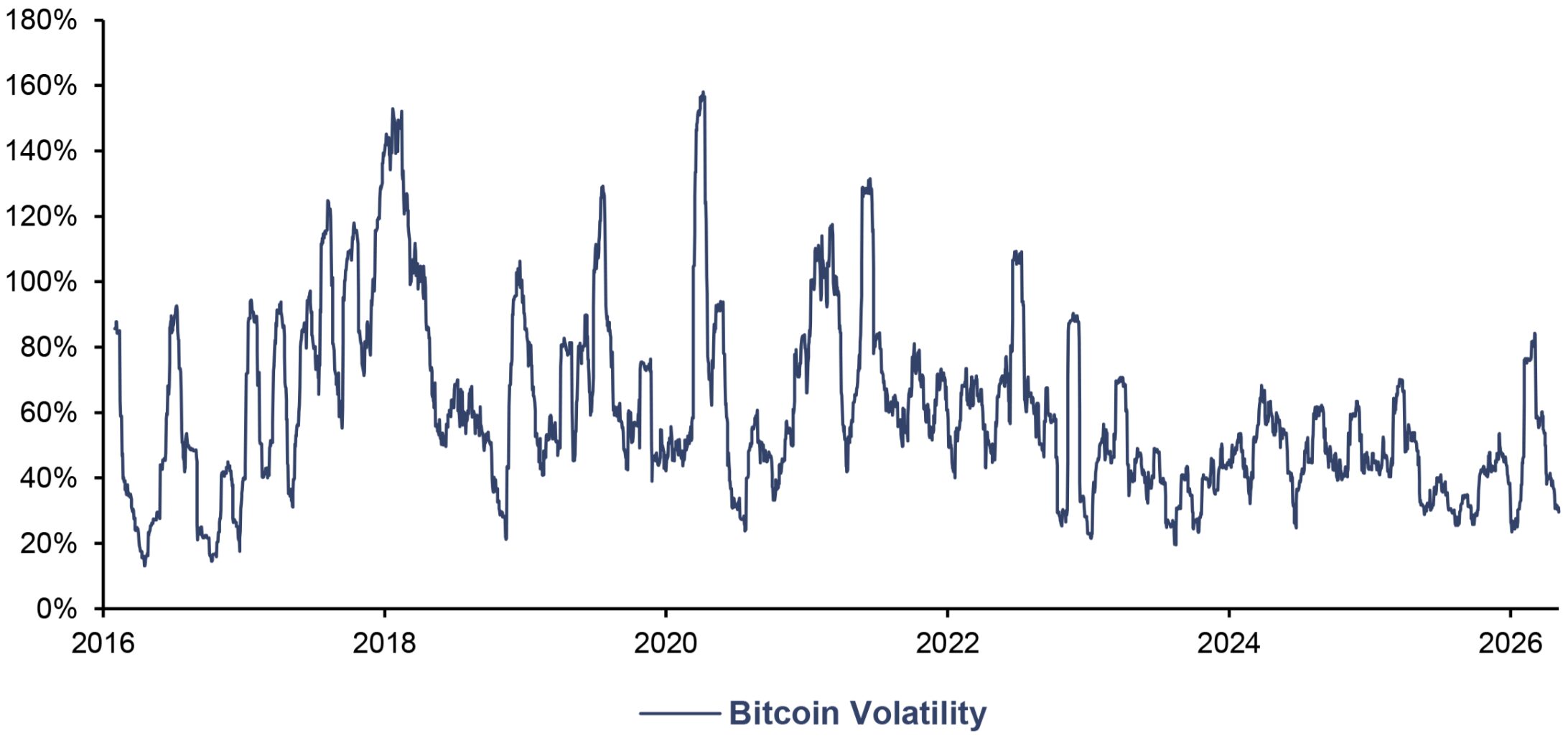
Nevertheless, a longer-term view of Bitcoin’s volatility shows that volatility has not declined in line with rising market capitalization. Rolling volatility has largely moved sideways even as market capitalization expanded during the most recent bull market.
Rolling Bitcoin Volatility (30 days), 01/2016–05/2026
Source: LSEG, Incrementum AG
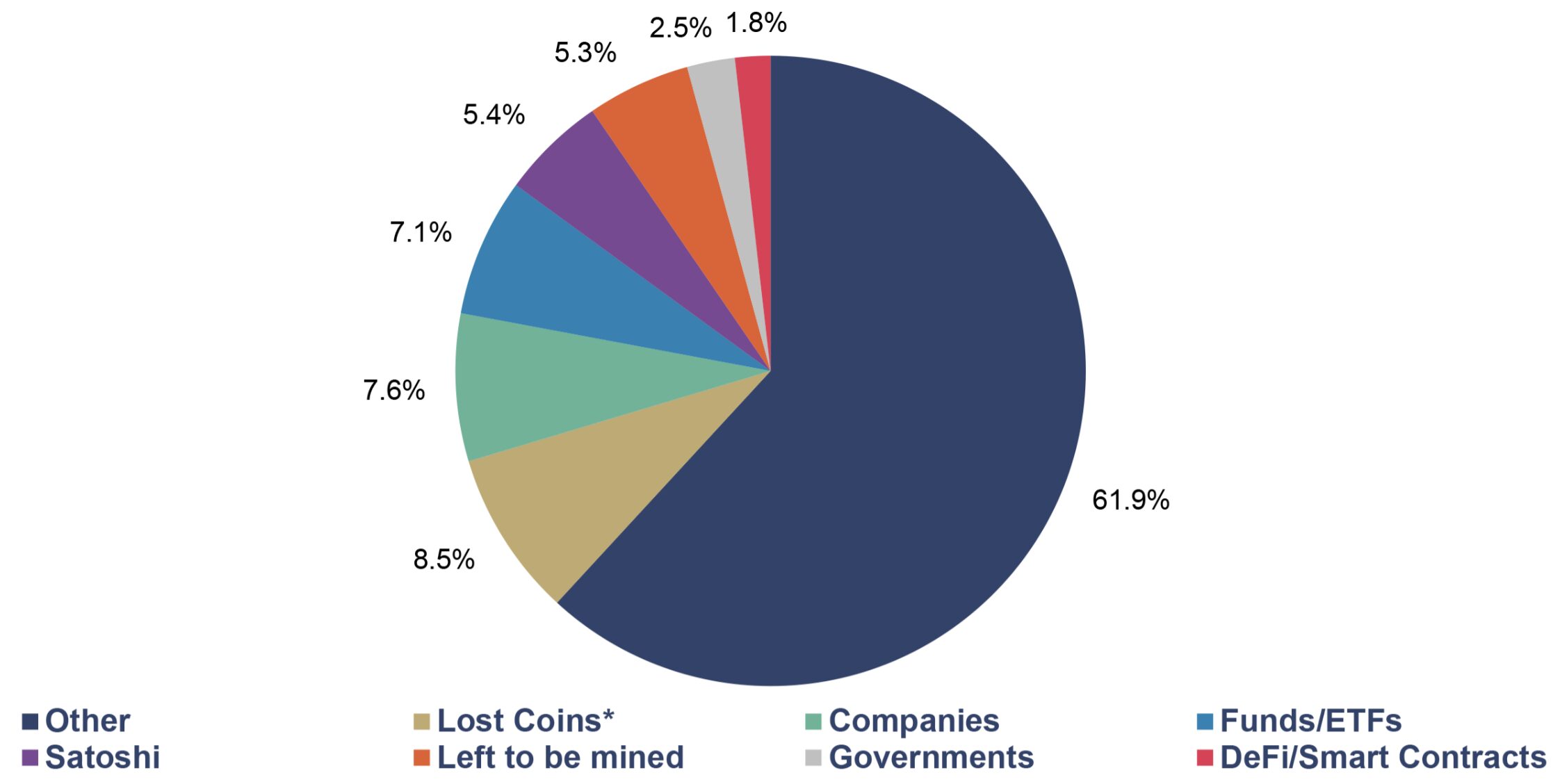
However, the market structure has changed significantly in recent years. ETF holders and corporate holders – mostly via digital asset treasury companies (DATs) – have increased their holdings of the total Bitcoin supply dramatically. Together these two groups currently hold more than 14% of all Bitcoin available. The concentration of Bitcoin among relatively homogeneous investor groups raises the risk of an excessive drawdown should an event trigger widespread selling in one or both groups.
Distribution of Bitcoin Holdings, in % of Total Supply, Q1/2026
Source: bitcointreasuries.net, Chainalysis, Fortune, Incrementum AG
*Estimation by Chainalysis and Fortune
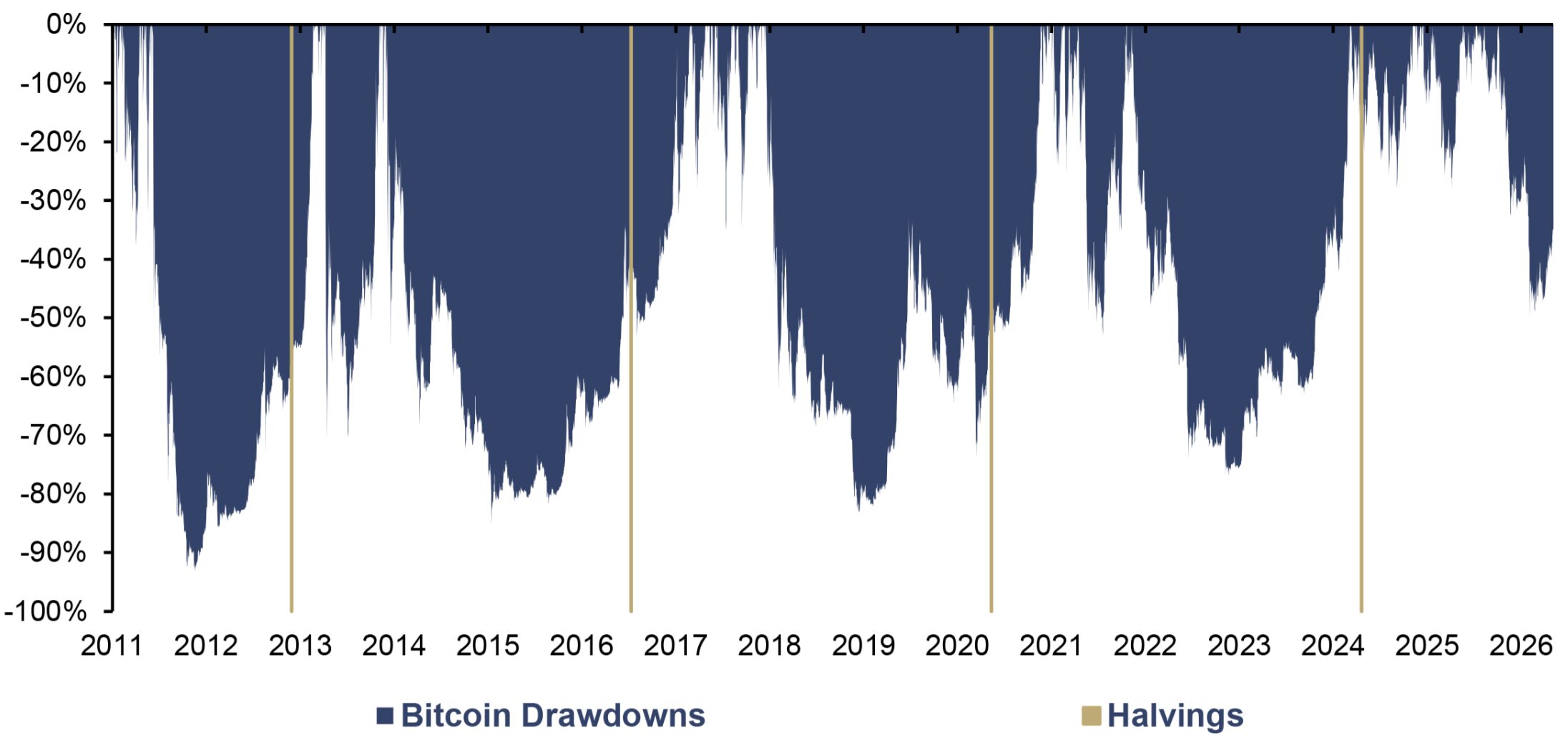
The current bear market has so far been less brutal than previous downturns. One could argue that each successive bear market has historically been somewhat shallower than the one before it. We would, however, highlight the possibility that this pattern of reduced drawdowns could be broken if a liquidity event were to trigger a wave of selling by ETFs and/or DAT s. It is equally possible that such an event occurs only in a future cycle, and that the current bear market is already closer to its end than the traditional fouryear cycle would suggest, absent such a liquidity shock.
Bitcoin Drawdowns from ATH, in USD, 01/2011–05/2026
Source: blockchain.com, LSEG, Incrementum AG
To match the magnitude of previous bear markets, the current drawdown would still need to deepen materially from current levels. A decline toward the historical range of prior cycle troughs would imply significantly lower prices than those seen so far in this downturn. Past cycles have seen drawdowns of over 80%; if this cycle is consistent with a “typical” historical bear, then BTC would hit USD 25,254 if it were to decline 80% from its USD 126,272 high in October 2025. While such an outcome is not our base case in the absence of a catalyst, it would become considerably more plausible in the event of a broader liquidity shock that forces indiscriminate selling across ETFs, leveraged structures, and digital asset treasuries.
The lesson for investors is not to avoid Bitcoin but to prepare for a different kind of volatility. The fragility of traditional finance’s margin rules – and the volatility they can generate – will be particularly interesting to observe when the next melt-up arrives. With Nasdaq already having increased open interest limits on IBIT options, any upside squeeze could prove just as violent as prior downside episodes.
Macro correlation risk: correlation regimes and the orange swan
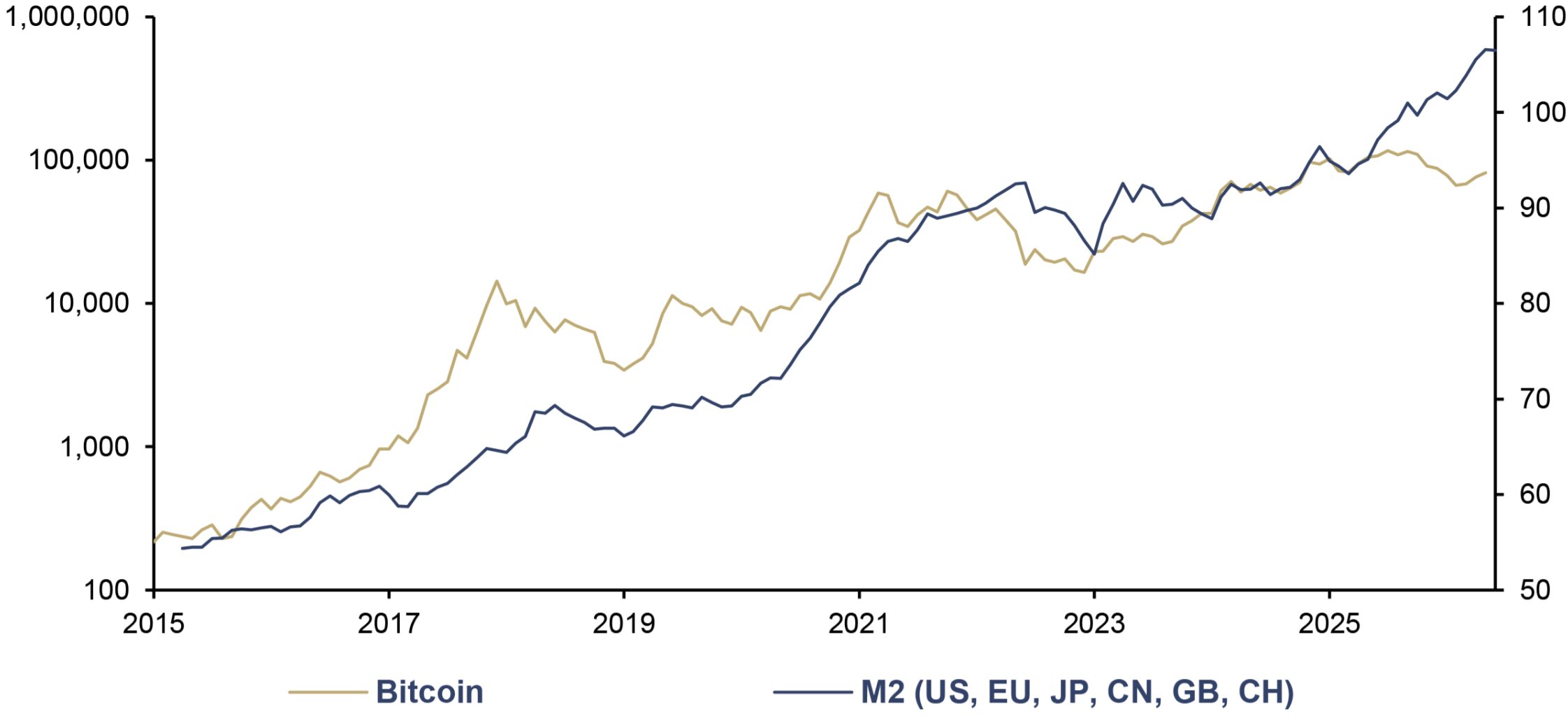
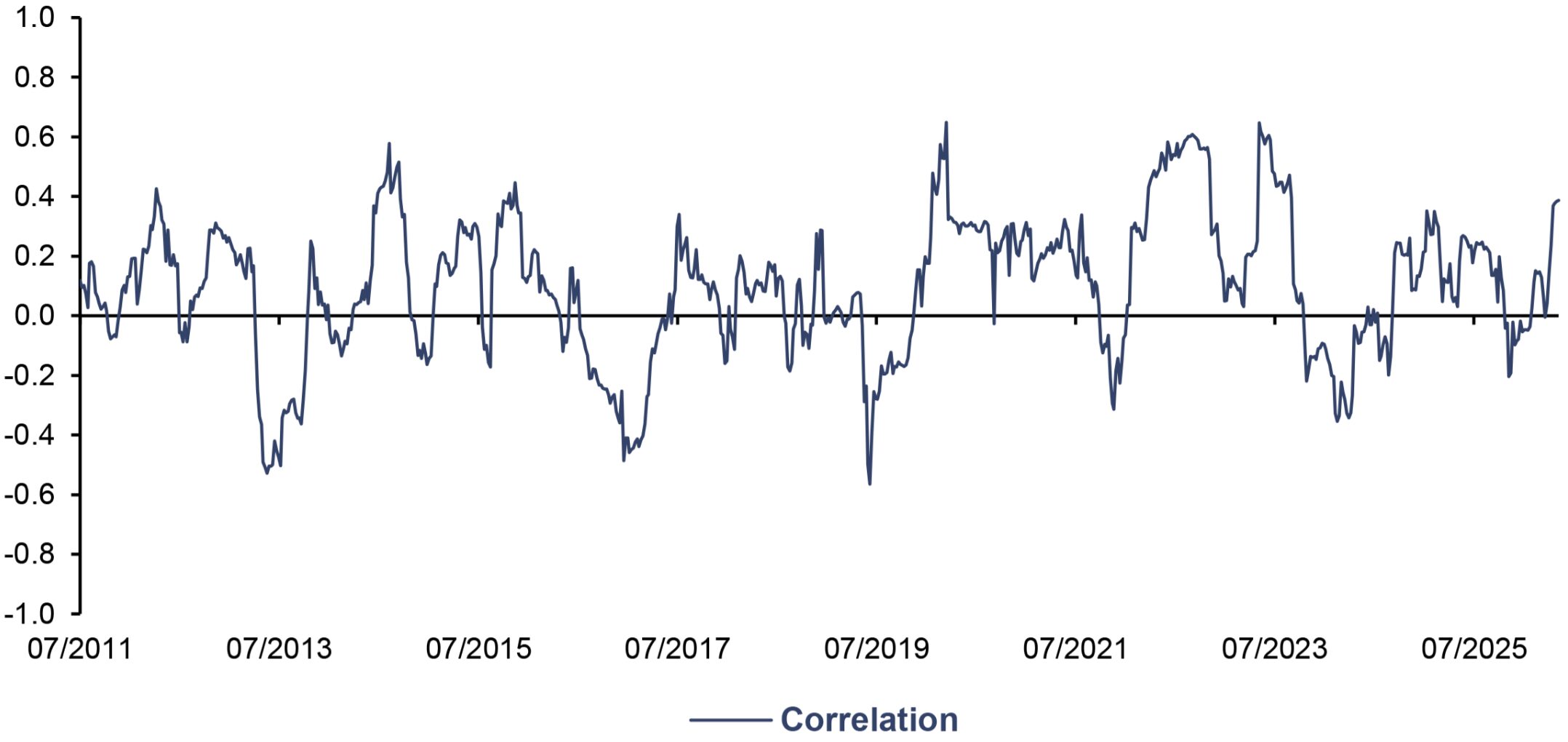
Under our updated categorization, macro correlation risk is treated as an important subcategory of broader market structure risk, reflecting Bitcoin’s growing sensitivity to cross-asset liquidity and risk regimes. Before 2025, Bitcoin’s correlation with global M2 money supply was approximately 83% on a lagged basis. That relationship has since deteriorated, and Bitcoin now tracks the Nasdaq 100 more closely than the dollar index. For investors who anchored their Bitcoin thesis to the M2 narrative, this shift demands attention.
Bitcoin (log, lhs), in USD, and M2 (US, EU, JP, CN, GB, CH) (3 month lead, rhs), in USD trn, 01/2015–06/2026
Source: LSEG, Incrementum AG
The Trump administration’s unpredictable policy decisions – the “orange swan” – add an additional layer of macro risk. When traditional risk assets sell off sharply on geopolitical or policy shocks, Bitcoin sells off with them, at least in the short run. The hawkish appointment of Kevin Warsh as Fed Chair further complicates the outlook for all risk-sensitive assets.
However, the macro backdrop also contains powerful tailwinds. We are not at the beginning of a hiking cycle but at the end of one. Even if Western central banks, faced with renewed inflation risks, may find it harder to deliver rate cuts and may refrain from easing aggressively, the decisive variable for investors is real yields. As inflation outpaces nominal rates, real yields are likely to decline – a de facto form of easing. Against the backdrop of the structural US deficit trajectory, which we have examined extensively in this and previous In Gold We Trust reports, the medium- to long-term outlook continues to favor hard assets.
If the simultaneous bid for gold and Bitcoin truly constitutes a “debasement trade,” as JPMorgan has suggested, then anyone who believes the structural factors making this trade attractive will persist should consider: Why are virtually all long-duration savings vehicles still denominated entirely in the currency being debased?
Weekly 6-Month Rolling Correlation of Bitcoin and Nasdaq 100, 07/2011–05/2026
Source: LSEG, Incrementum AG
Digital asset treasury companies: boom, bust, and beyond
Under our updated categorization, the rise of digital asset treasury companies (DATs) feeds directly into a changing market structure through leverage, capital markets dependence, refinancing needs, and reflexive balance-sheet demand.
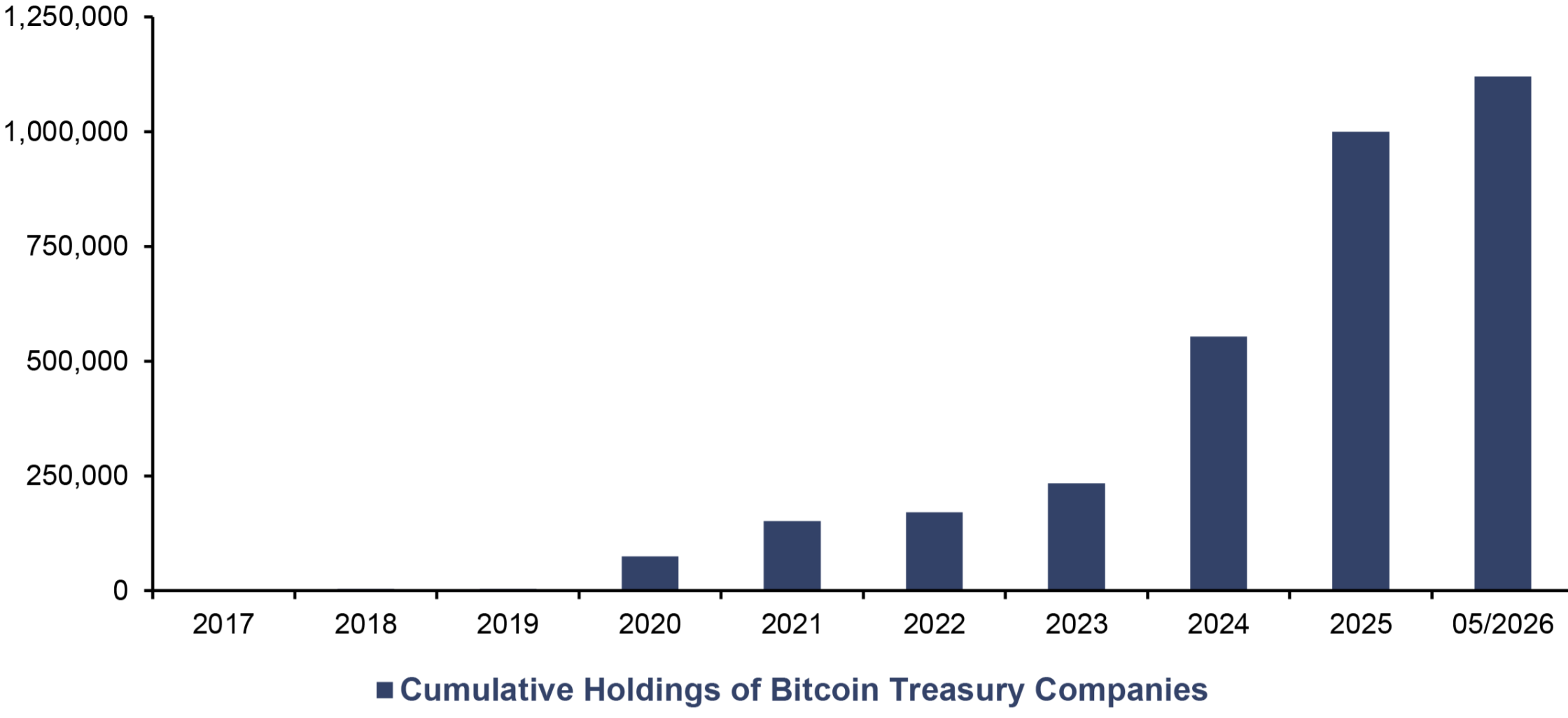
2025 was the year of the DAT; 2026 will determine which of them endure. By DATs, we mean listed companies that use Bitcoin as a core treasury asset and access equity or debt markets to expand that exposure, whether through simple balance-sheet accumulation or more structured capital vehicles. Public company Bitcoin holdings rose 82% year-over-year to 1.08mn BTC, while the number of listed holders increased from 69 to more than 191. Corporations now control at least 6.4% of total Bitcoin supply. Strategy remains dominant with 818,334 BTC, around 75% of all public company holdings, but the trend has broadened significantly. Excluding Strategy, corporate holdings grew 189% year-over-year, with new entrants such as Twenty One Capital and Bitcoin Standard Treasury Company joining the top ranks.
Cumulative Holdings of Bitcoin Treasury Companies, in BTC, 2017–2026
Source: Coingecko, The Block, Incrementum AG
DATs did not emerge by accident. They offer many investors a familiar equity wrapper for Bitcoin exposure, can fit mandates that restrict direct token ownership, and may benefit from tax, liquidity, or capital-markets advantages unavailable in spot markets. In that sense, they represent one pathway through which Bitcoin is being integrated into traditional finance. The model, pioneered by Strategy – raising capital to acquire Bitcoin and measuring success via BTC per diluted share – has spawned a global ecosystem of imitators.
In 2025, DATs became the market’s speculative proxy trade: surging to euphoric highs before collapsing sharply, while Bitcoin itself again proved the more durable asset.
A central concept is mNAV: the ratio of a company’s market value to the net value of its Bitcoin holdings. A premium can allow accretive capital raises, while a discount can shut that window entirely. Premiums may reflect liquidity, options-market demand, management credibility, index inclusion, or easier access than direct Bitcoin owners have.
The model is also evolving. Strategy’s STRC preferred stock, designed to trade near par while paying a variable dividend, marked a shift toward Bitcoin-linked credit products. Other firms followed with their own preferred structures, while new vehicles now package DAT securities into ETPs and even stablecoins backed by baskets of DAT preferred shares. What began as corporate Bitcoin accumulation is becoming a broader capital-markets ecosystem.
Some firms are better positioned than others. Stronger DATs are likely to combine low funding costs, deep liquidity, disciplined issuance, and credible management. Weaker issuers may rely on expensive capital, repeated dilution, shallow trading liquidity, or fragile market confidence.
The 2025 DAT cycle demonstrated these dynamics clearly. Companies trading at extreme mNAV premiums could issue stock and boost BTC-per-share metrics, but the process depended on continued multiple expansion. By year-end, several major DATs had fallen more than 90% from their peaks even as Bitcoin reached new highs.
At its core, the DAT phenomenon is financial engineering: the securitization of different Bitcoin risk/return profiles into equities, preferred shares, convertibles, structured products, and synthetic yield vehicles. There is likely room for a small number of credible, well-capitalized issuers. Beyond that, the model risks saturation. For many investors, leverage, rollover risk, and interlocking counterparty exposures may be far less transparent than direct Bitcoin ownership. Direct Bitcoin ownership removes layers; DATs add them back. The opportunity is real, but so is the return of the financial complexity Bitcoin was designed to escape.
Digital Gold Revisited: Complementary, Not Competitive
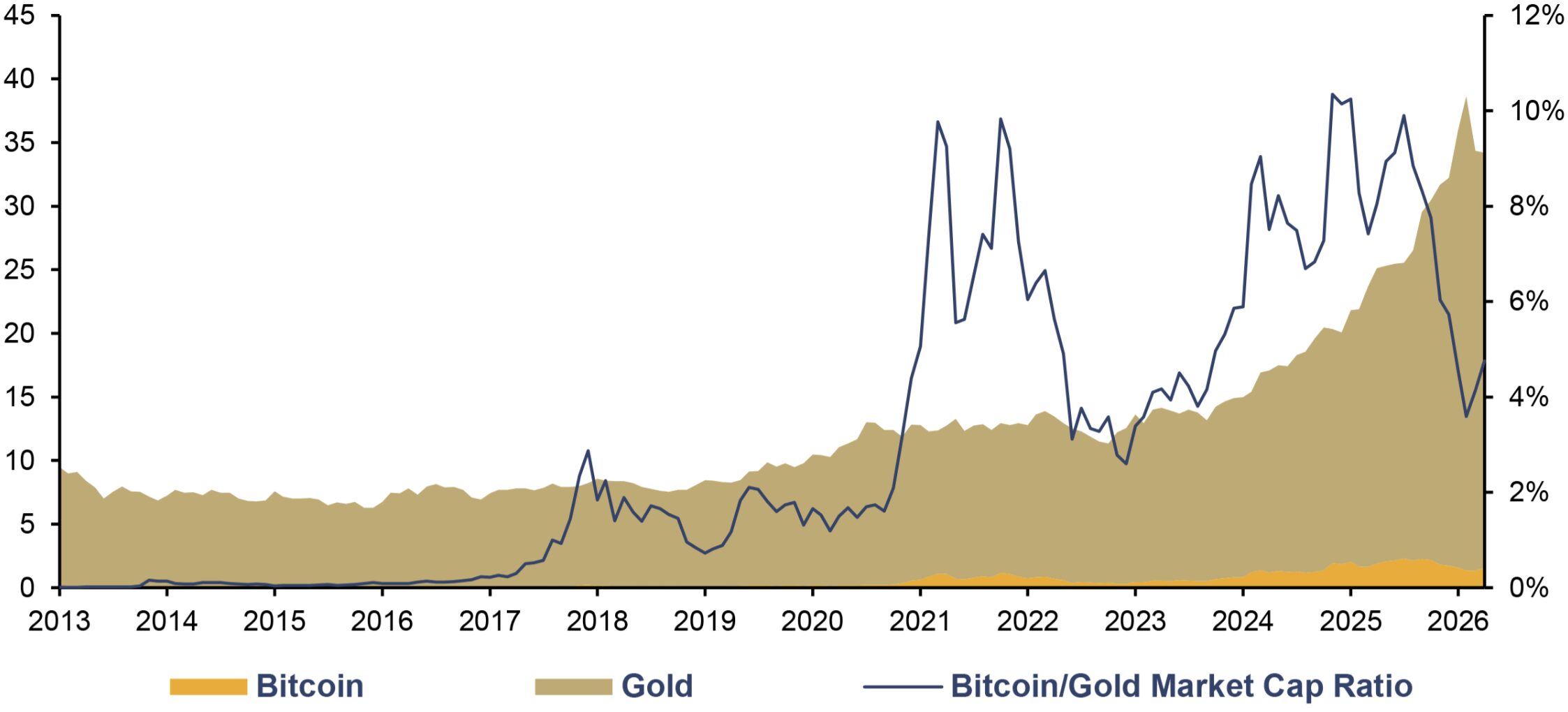
The “digital gold” narrative has come under fire in 2025 and early 2026, as gold dramatically outperformed B itcoin over the period. Critics have seized on the divergence as proof that the thesis is failing. This criticism confuses similar monetary properties with identical market behavior.
Gold and Bitcoin share scarcity, durability, and resistance to debasement, but they exist within entirely different market structures. Gold is experiencing extraordinary demand from Eastern central banks – a geopolitical bid from conservative institutional capital.
This divergence in demand drivers is not a weakness of the dual hard-asset thesis; it is its greatest strength from a portfolio construction perspective. Gold’s demand is anchored in central bank reserve accumulation, jewelry consumption in Asia, and its role as a crisis hedge with millennia of institutional trust. Bitcoin’s demand, by contrast, is driven by retail adoption in Western markets, the generational wealth transfer from boomers to digitally native millennials, ETF integration into model portfolios, and its emerging role as a neutral settlement layer for sovereign actors. Because these demand drivers are structurally independent – central bank gold purchases do not compete with millennial Bitcoin accumulation, and jewelry demand in India has no bearing on the pace of ETF inflows – the two assets respond to different catalysts and stress scenarios.
For investors, this means that a combined allocation to gold and Bitcoin captures exposure to the broader monetary debasement trade while diversifying across two distinct adoption curves, buyer bases, and risk profiles. Both assets are hard money; they are simply hard money for different constituencies and different use cases.
Market Capitalization of Bitcoin and Gold (lhs), in USD trn, and Bitcoin/Gold Market Cap Ratio (rhs), 01/2013–04/2026
Source: coinmarketcap.com, World Gold Council, LSEG, Incrementum AG
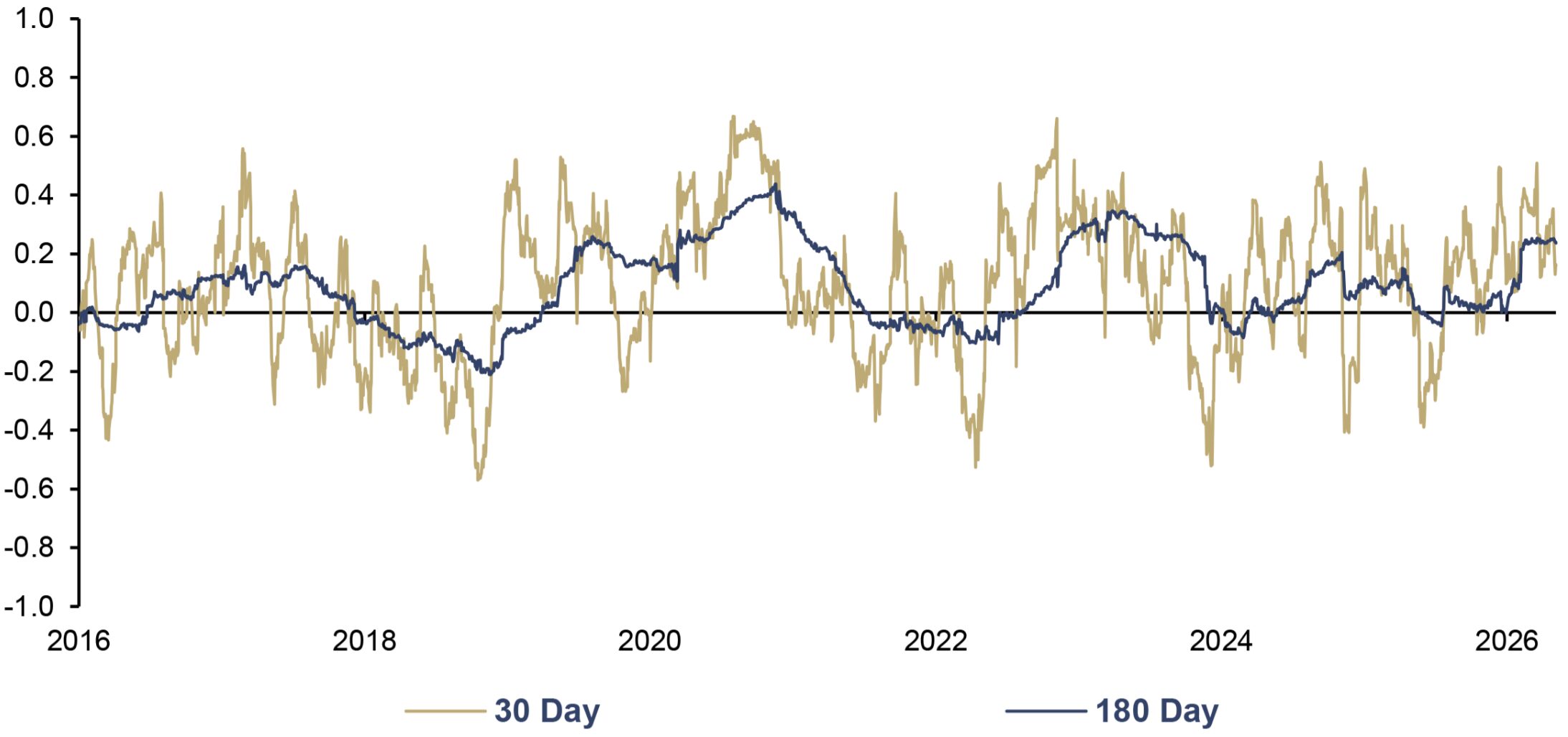
The rolling correlation between gold and Bitcoin has historically been low and unstable. Since 2015, the 90-day rolling correlation has oscillated between –0.37 and +0.57, with a long-term average hovering around 0.10. In March 2026, the correlation reached –0.88, its lowest level since the November 2022 bear market. This persistent lack of correlation is not a failure of the “digital gold” thesis; rather, it is one of its strongest arguments. Two assets that share the same monetary properties (scarcity, durability, resistance to debasement) but exhibit low correlation to each other offer genuine diversification benefits within a portfolio. We do not expect this correlation to rise meaningfully in the near term. For Bitcoin’s price behavior to converge with gold’s, its market capitalization would need to grow to a comparable order of magnitude – and even then, the different buyer bases and market microstructures would likely preserve significant divergence.
Rolling Bitcoin/Gold Correlation, 01/2016–05/2026
Source: LSEG, Incrementum AG
In contrast, Bitcoin is heavily traded by retail in the West, by hedge funds treating it as risk-on, and through ETF structures integrated into model portfolios alongside software equities. The fact that Bitcoin tracks the Nasdaq more closely than gold reflects different buyer bases at different stages of adoption.
The Demand Drivers of the Next Twenty Years
Looking forward over the 20-year horizon, several structural demand drivers for Bitcoin become difficult to ignore.
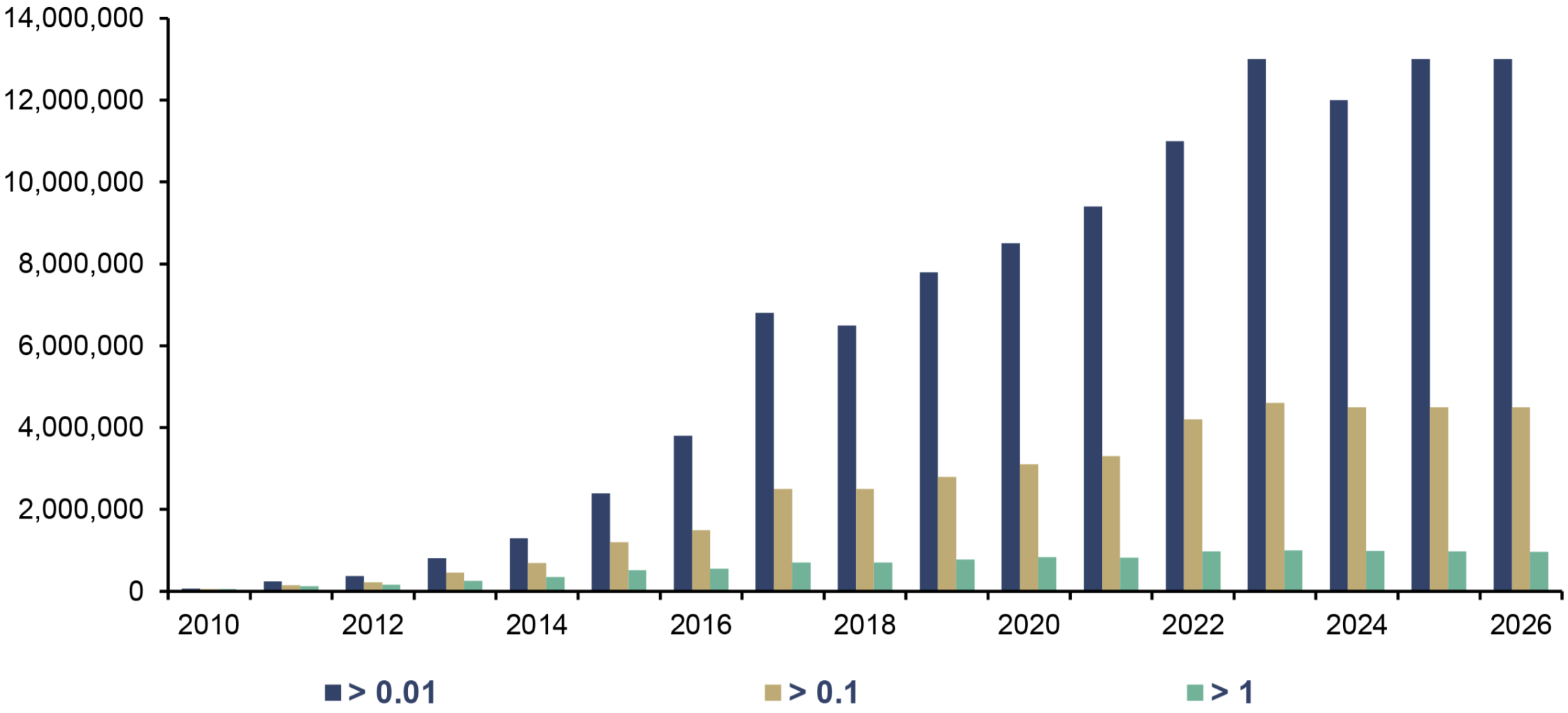
First, the demographic pyramid is inverting. As the Epoch VC team documents, aging demographics in the Western world will provide a natural tailwind to Bitcoin over the next two decades as USD 105trn passes to heirs through 2048. Less than 5% of people over 65 own Bitcoin, while Gen X ownership is 5–10% and Millennials are 20–25%. As younger generations gain control of inherited wealth, Bitcoin will likely be a beneficiary. Epoch estimates that inheritance-driven inflows alone could cumulatively generate USD 1.2 to USD 2.3trn through 2035 and as much as USD 9.6trn by 2048.
Addresses Holding > X Bitcoin, 2010–2026
Source: lookintobitcoin.com, Incrementum AG
Second, wealth inequality is approaching levels that historically trigger confiscatory policy responses, which could drive demand toward assets like Bitcoin. When the Netherlands passed legislation in February 2026 imposing a 36% tax on unrealized gains in stocks, bonds, and cryptocurrencies, it signaled the direction of travel. As fiscal pressures mount globally and politicians propose wealth taxes, the demand for “outside money” – portable, jurisdictionless capital beyond the reach of discretionary rule changes – will likely intensify. Bitcoin was designed from its first line of code to serve precisely this function.
Third, the spot ETF channel continues to widen. Bitcoin ETFs have become the most successful launch in ETF history, with cumulative net flows projected to reach USD 100bn by 2027. Bank of America, Morgan Stanley, Vanguard, and Citi are all now allowing or actively recommending Bitcoin allocations to clients — a reversal that would have been unthinkable two years ago. Morgan Stanley, the largest US wealth management platform with USD 8trn in client assets, is now building native Bitcoin custody and exchange infrastructure, and has filed for its own Bitcoin ETP – a level of commitment that goes well beyond passive distribution.
Yet the gap between access and allocation remains enormous: Over 90% of top US-registered investment advisors now have Bitcoin allocations, but only 0.006% of total RIA assets under management have been deployed – a figure orders of magnitude below the 2–5% allocations recommended by leading firms.
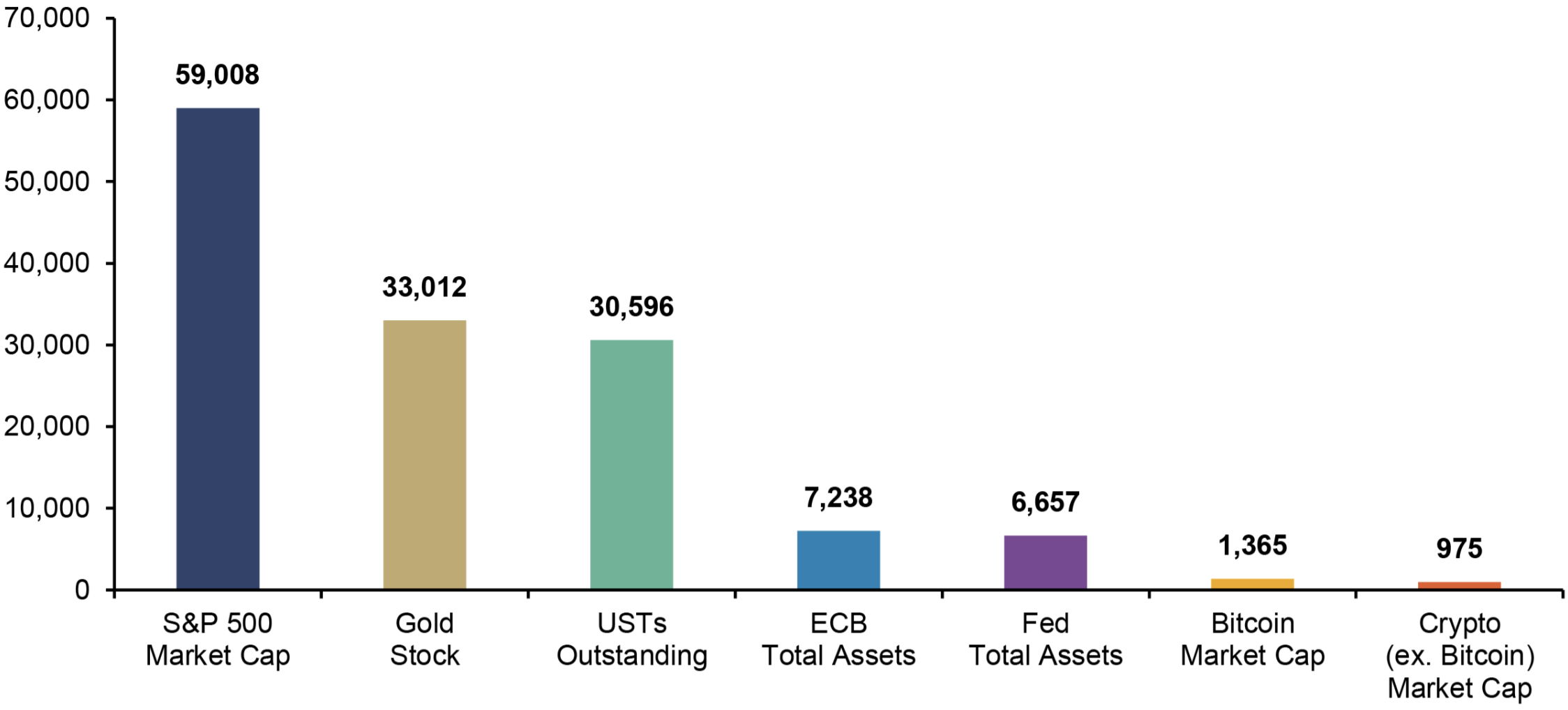
Market Capitalization of Bitcoin vs. Various Assets and Central Bank Balance Sheets, in USD bn, Q1/2026
Source: coinmarketcap.com, World Gold Council, US Treasury, Fed, ECB, LSEG, Incrementum AG
Applying the suggested allocations from the top 13 wealth management firms to their assets under management yields potential inflows of USD 400bn to USD 835bn, according to Epoch’s analysis. The top 15 companies by market capitalization hold USD 1.15trn in cash; just 10% allocated to Bitcoin would nearly equal the entire current ETF complex.
And, finally, sovereign accumulation may prove to be the most powerful demand driver of all. Nations currently hold approximately 643,000 BTC — roughly 3.1% of total supply — through seizures, purchases, and the newly established US Strategic Bitcoin Reserve. But here is the thought experiment that should keep Bitcoin bears awake at night: Global central bank gold reserves total approximately USD 4.4trn, representing about 17% of above-ground gold supply.
If nations were to accumulate Bitcoin at a comparable 17% of supply, that would imply roughly USD 253bn in sovereign inflows — nearly double the entire current ETF complex.
The BRICS nations have spent the past two years building alternative settlement infrastructure, from the mBridge wholesale CBDC project connecting China, Hong Kong, Thailand, the UAE, and Saudi Arabia, to the proposed BRICS Unit, a settlement currency backed 40% by gold and 60% by member currencies. These efforts reflect a fundamental problem: In a multipolar world, surplus nations need a way to settle trade and store reserves that is not controlled by any single counterparty. Gold has historically served this function, but it is slow, expensive to transport, and difficult to use for real-time settlement.
Bitcoin, by contrast, offers final settlement in minutes, is natively digital, operates on a decentralized network beyond the control of any single government, and has a credibly fixed supply. For nations seeking to settle trade surpluses, manage reserves outside the dollar system, or simply hedge against the weaponization of the existing financial infrastructure, Bitcoin provides a solution that no state-sponsored CBDC can replicate – precisely because it is controlled by no state.
In April 2026, Iran provided the most vivid demonstration yet of a nation turning to Bitcoin, because it is neutral and it works. During the Strait of Hormuz ceasefire, Tehran announced that tankers crossing the waterway would be required to pay a USD 1-per-barrel toll in Bitcoin, payable in seconds to avoid sanctions traceability. At pre-crisis transit volumes of 130 ships per day, the implied daily accumulation would dwarf the 450 BTC the entire network mines daily.
As Nick Szabo observed, “Iran is no longer effectively under sanctions. Do try to keep up with events.” Bitcoin’s censorship resistance is not an abstract property but an operational one, and sanctioned nations now have a structural incentive to maintain it. Gold has many benefits, but its physical nature makes it easier, in some respects, to steal in transit. Stablecoins, with their centralized issuers, don’t work, either. Iran is opting for neutral digital money that sits outside the purview of Team USA and Team China.
Conclusion
The enthusiasm surrounding Bitcoin’s institutional adoption and growing sovereign relevance should not obscure some risks that remain. These risks can now be broadly divided into three categories: systemic risks, which could impair Bitcoin’s core protocol or network functionality; governance risks, which relate to coordination and the ecosystem’s ability to adapt under pressure; and market structure risks, which primarily manifest through volatility, correlation shifts, and drawdowns. As we have argued throughout this chapter, however, no imminent systemic risks are currently evident. This includes quantum computing, where the more relevant challenge appears to be one of governance rather than an immediate technical threat.
Severe drawdowns have been a feature of every major Bitcoin cycle, even if the current bear market has so far been less brutal than prior episodes. There is no guarantee that the historical pattern of progressively shallower declines will persist. In particular, a broader liquidity event could still produce materially deeper drawdowns through forced selling across ETFs, leveraged structures, and digital asset treasuries. Absent such a liquidity shock, however, this cycle may prove different: The traditional four-year cycle appears to be weakening, while the period around the US midterm elections could bring renewed stimulus for risk assets in general and for Bitcoin in particular.
The proliferation of leveraged Bitcoin treasury strategies – while innovative – also introduces systemic fragility. Companies that have issued convertible debt or preferred equity to fund Bitcoin purchases are, in effect, making a leveraged bet on continued appreciation.
Investors should be thoughtful about position sizing, avoid the temptation to leverage what is already a volatile asset, and maintain the discipline to hold through drawdowns rather than panic-sell at the worst moment.
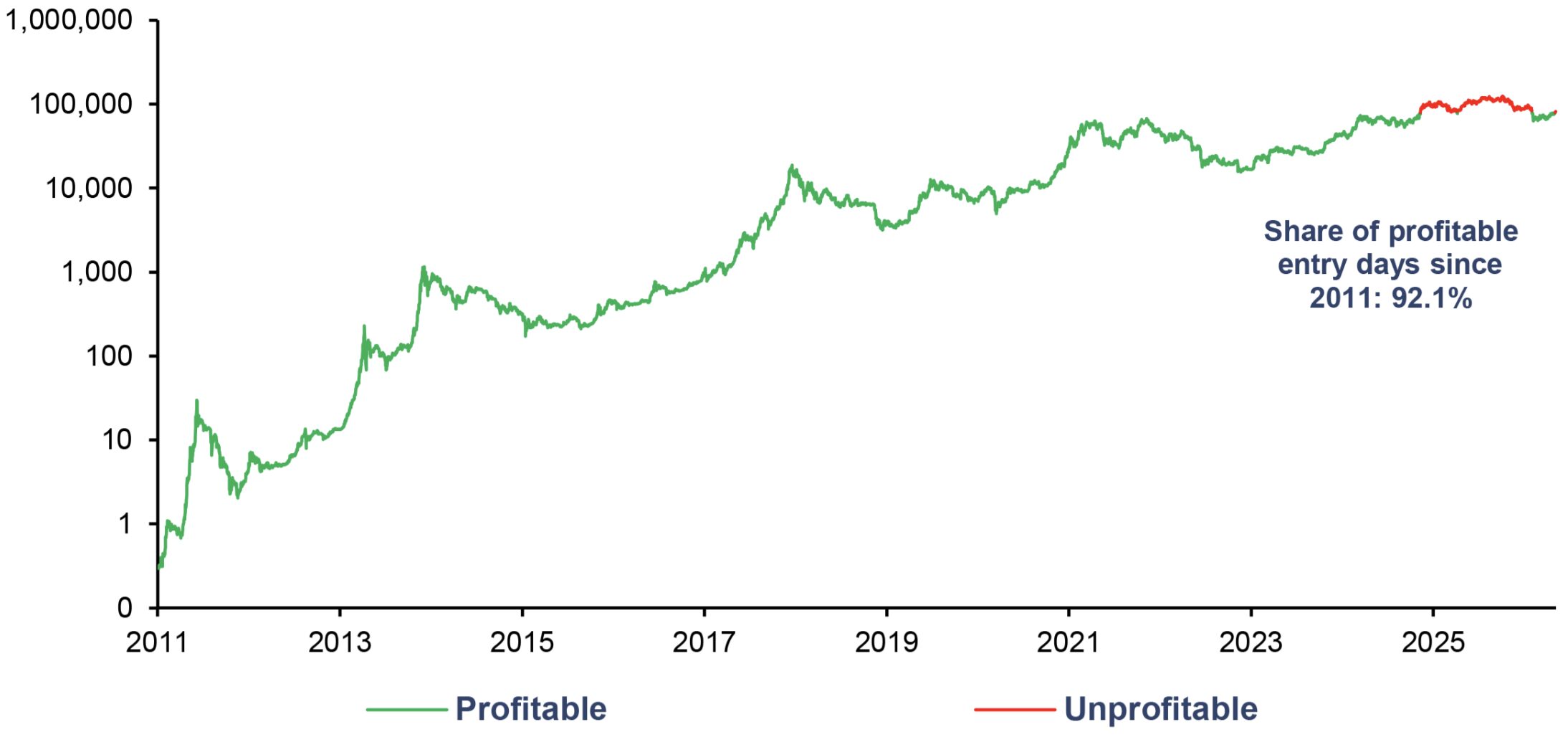
Bitcoin (log), in USD, 01/2011–05/2026
Source: blockchain.com, LSEG, Incrementum AG
The long-term thesis for Bitcoin is compelling, but the path to get there will not be a straight line. Being right about the destination matters far less if you are forced out of your position along the way.
In 2021, when Bitcoin was a teenager trading at roughly USD 60,000, it was less battle-tested, to say the least. No serious institutional adoption, existence only in the ZIRP era, no ETFs, and a hostile administration made it seem quite speculative from an outsider perspective.
Yet here we are in 2026, with Bitcoin a young adult and in an external landscape that is different in every meaningful way. Bitcoin reached USD 126,000 not on a massive liquidity wave but despite the highest interest rates in a decade. We have ETFs that have become the most successful in history. We have an openly supportive administration, a Strategic Bitcoin Reserve, and major legislation either passed or in progress – including the Mined in America Act, introduced by Senators Lummis and Cassidy in March 2026 to codify the Strategic Bitcoin Reserve into law and establish a federal certification program for domestic mining operations. Major US banks are moving to custody actual spot Bitcoin. And we had a halving in April 2024, with the next one approaching. Perhaps most telling: Even amid a 40% drawdown that began in early 2025, institutional and corporate buyers set records for net Bitcoin accumulation – making this the first bear market in Bitcoin’s history in which institutional adoption actually accelerated while individuals were the net sellers.
There are significant demand drivers:
- inheritance-driven wealth transfer to Bitcoin-native generations
- growing appetite for hard and less-confiscable assets as wealth taxes emerge globally
- integration of Bitcoin into credit markets through BitBonds and mortgage structures
- steady accumulation through ETFs and traditional wealth management channels
As we have stressed in previous In Gold We Trust editions – and it remains one of our core convictions – Bitcoin and gold are complementary tools within the broader thesis that the future monetary system will be anchored not in credit but in collateral that cannot be printed.[1] The next 20 years will see Bitcoin’s market structure gradually converge with gold’s: deeper, broader, and increasingly driven by structural demand. That convergence will not be linearly “up forever”; there will be drawdowns, governance fights, and policy surprises. But the arc bends toward increased adoption.
For investors willing to take a clear-eyed view of the risks and opportunities, Bitcoin at the threshold of adulthood represents an asymmetric opportunity in the current monetary landscape.
Now is a perfect time for serious investors to re-underwrite their Bitcoin thesis, and the case for conviction remains strong.
Sam Lyman Interview
This interview was conducted on April 8, 2026 by IGWT.
Sam Lyman is Head of Research at the Bitcoin Policy Institute. He served previously as senior advisor and chief speechwriter to Treasury Secretary Scott Bessent. Prior to working at Treasury, he served as public policy director at Riot Platforms, a leading digital assets and AI infrastructure company; policy director of a DC-based think tank; and chief speechwriter to Senator Orrin G. Hatch. Sam holds a master’s in public policy from Princeton University.
IGWT: We are joined by Sam Lyman, Director of Research at the Bitcoin Policy Institute and previously an advisor at the US Department of the Treasury, where he worked directly with Secretary Scott Bessent. Sam, thank you for being here.
Sam Lyman: Thank you so much for having me.
IGWT: Getting right into it, you were at Treasury during the most significant period of pro-Bitcoin policy in US history. How would you compare where things stand today relative to that initial wave of activity when the Trump administration first came into office in 2025?
Sam Lyman: I would describe the current moment as a consolidation phase. That first year was a period of tremendous excitement and development in the Bitcoin policy space. The Strategic Bitcoin Reserve became the de facto policy of the United States through the executive order that President Trump signed.
Since then, Treasury and other executive agencies have been focused on how best to implement that reserve. I expect to see meaningful action in the next year or so, though it is more likely to come out of the Commerce Department at this point, simply because Treasury has so many competing policy priorities right now, including the implementation of the One Big Beautiful Bill.
President Trump is wholly committed to making the United States the Bitcoin capital of the planet, as he has said himself. The key sticking point in the executive order’s language is the requirement that the United States find or study budget-neutral pathways to creating the reserve. That is the central question federal agencies are weighing right now.
BPI is very much focused on this as well. As the premier Bitcoin think tank, we see it as our responsibility to educate policymakers on Bitcoin’s benefits as a strategic asset and to help develop policies that advance the administration’s efforts.
IGWT: You mentioned that Commerce may be involved in implementation, which will be news to many readers. Could you share some examples of budget-neutral pathways that you see as realistic for stocking the reserve?
Lyman: The most compelling budget-neutral pathway, in my view, is monetizing stranded energy on federal lands and waterways. The perfect case study is Bhutan, which has been mining Bitcoin since 2019. Bhutan is a landlocked country with far more hydropower than it has customers for. By leveraging that stranded energy to mine Bitcoin, Bhutan has earned hundreds of millions of dollars – enough to double the salaries of its civil servants. Bitcoin mining now accounts for roughly a third of Bhutan’s GDP.
The United States has an abundance of stranded energy. Mining Bitcoin on federal lands advances multiple objectives that President Trump has publicly committed to: making the US the Bitcoin superpower, becoming the energy capital of the world, and monetizing the country’s assets.
The stranded energy sources are diverse – methane venting on federal lands where oil drilling takes place, hydropower, wind power. Hydropower is probably the most untapped resource at this moment.
You could envision a public-private partnership model in which established Bitcoin miners bid for contracts to mine using stranded energy from, say, the Hoover Dam or other federal waterways – similar to how defense companies bid for Pentagon contracts. The miners would share a portion of their proceeds with the US government, making the arrangement budget-neutral. In some cases, the competition for exclusive access to the energy resource could drive bids low enough that the arrangement effectively pays for itself.
This model has already been proven to work by Bhutan. There is no reason the United States could not emulate it.
IGWT: Many of the proposals for funding the reserve have centered on revaluing gold reserves and allocating the difference to Bitcoin. Is that less feasible than what you just described? And how does the proposed sovereign wealth fund fit into this framework of leveraging the asset side of America’s balance sheet?
Lyman: From my experience at Treasury, there is not much appetite within the building to revalue gold in order to stock the Strategic Bitcoin Reserve. I know it is something Senator Lummis has favored, and it is a compelling idea – but I think it is unlikely. That is precisely why I believe pro-Bitcoin policymakers should look at alternative budget-neutral pathways, such as mining on federal lands and waterways, which is more politically feasible.
As for the sovereign wealth fund, there are two good models to consider. The first is Bhutan, where it is effectively the country’s sovereign wealth fund that engineered the Bitcoin mining operation using hydropower – and Bitcoin has been among the most lucrative of all its investments. The second is Norway, which has built one of the most successful sovereign wealth funds in the world by monetizing its oil reserves. Norway recognized that oil was its foremost national asset and found a way to turn it into long-term wealth for its citizens.
American policymakers have the same opportunity. They need to recognize that one of the country’s most powerful untapped assets is stranded energy. Thanks to Bitcoin’s digital alchemy, you can take that stranded energy and turn it into digital gold. Bitcoin could be a powerful component of the strategic wealth fund that has been proposed within the administration.
IGWT: BPI has done remarkable work bringing the idea of nation-state Bitcoin strategies into the mainstream, particularly with the research report on Taiwan. Today we are also seeing reports of Iran using Bitcoin for settlement, presumably because it is a neutral asset. How do you think about Bitcoin within the broader global monetary framework – especially as the de-dollarization tug of war between Team China and Team USA intensifies?
Lyman: Every day that passes, it becomes harder to deny that Bitcoin is a strategic asset. A few years ago, many people would have relegated Bitcoin to the realm of internet playthings. Today, countries are creating their own Bitcoin reserves and using it to facilitate commerce.
On this front, it is worth noting that our BPI fellow Matthew Ferranti – a Harvard-educated PhD economist and one of the first academics to make a rigorous case for Bitcoin as a reserve asset – recently had his paper cited by one of China’s premier financial think tanks, the International Monetary Institute. They posted about it on WeChat and stated that they would continue to monitor Bitcoin’s potential use as a reserve asset.
That China is paying attention makes sense. BPI recently published a paper making the case for a Taiwan Bitcoin reserve. We know that China has its eyes set on Taiwan, and in the event of an invasion, one of the very first things it would confiscate is Taiwan’s gold reserves. If Taiwan held some of its reserves in Bitcoin, that seizure becomes impossible.
Then there is Iran. We learned today that some of the tolls Iran is exacting for ships to transit the Strait of Hormuz are being paid in Bitcoin. Iran has claimed that one benefit is that these payments cannot be traced – though that is mistaken, since the blockchain is a public ledger. Regardless, the strategic intent is clear: More and more nations are recognizing the benefits of a dematerialized form of gold that can move across the world almost instantaneously at very little cost.
One of the largest pieces of misinformation out there is the socalled Chinese Bitcoin ban. China famously banned Bitcoin mining in 2021, yet China today remains the third-largest country for Bitcoin mining activity. A lot of that mining is happening to monetize stranded energy, just as we discussed earlier.
The broader picture is becoming clear. China is going all-in on the digital yuan – leveraging blockchain technology to surveil and control its population. The digital yuan is now an interest-bearing instrument, which is a direct play to compete with US dollar-based stablecoins. Conversely, the United States, true to its ideals of individual liberty and the right to transact freely, is leaning toward Bitcoin and stablecoins.
The CCP despises both Bitcoin and stablecoins because they represent the greatest threat to China’s capital controls. The entire Chinese economic model depends on maintaining those controls. Few people realize that the Bitcoin bull market of 2015– 2017 was primarily driven by wealthy Chinese investors buying Bitcoin to move wealth out of the country. That capital flight precipitated the mining ban a few years later – in the same way that China erected the Great Firewall to wall off its internet from the rest of the world.
American policymakers are waking up to the fact that China has been playing a game of unrestricted warfare for decades. This concept, articulated by members of the CCP military in the late 1990s, holds that any domain – economic, financial, technological – can be a battlefield. The future of monetary competition is the digital yuan versus Bitcoin and stablecoins. I do not think China can win that contest, because you cannot compete with permissionless, decentralized assets that anyone can access with no strings attached.
IGWT: That is a compelling framing – stablecoins and Bitcoin as part of Team USA’s monetary stack. Shifting to the domestic side: US institutions are getting much deeper into Bitcoin, and Morgan Stanley just launched a spot Bitcoin ETF. But we are still some distance from a world where you can hold dollars and BTC in the same Bank of America account. From a policy perspective, what is holding traditional financial firms back?
Lyman: There is a huge obstacle: the Basel 1,250% risk-weight rule. Under current Basel requirements, any bank that wants to hold Bitcoin on its balance sheet must collateralize it with 100% reserves. If you hold USD 100mn worth of Bitcoin, you need USD 100mn of liquid cash standing behind it. That makes it nearly impossible for banks to realistically hold or custody Bitcoin. BPI is working hard to educate policymakers on how detrimental this rule is to Bitcoin adoption.
If that rule is fixed and banks can treat Bitcoin according to its actual risk profile, I believe we will see dramatically greater institutional adoption. This is something Michael Saylor’s Strategy is very much focused on as well.
The second major barrier is taxation. Bitcoin aspires to be a medium of exchange, but in the United States, every Bitcoin transaction – even buying a USD 4 cup of coffee – is a capital gains taxable event. You have to calculate the cost basis, determine the gain or loss, and report it to the IRS. That administrative burden makes spending Bitcoin incredibly cumbersome.
Congress is currently looking at a de minimis exemption for small Bitcoin transactions – say, under USD 200 – that would exempt them from capital gains reporting. Together with fixing the Basel rule, this would lead to what I would call a Cambrian explosion in Bitcoin financial activity.
These two reforms also have significant geopolitical implications. As Bitcoin grows in adoption as a medium of exchange, it also grows as a tool for people in countries like China who have access to circumvent capital controls via technologies like Starlink. What is good for Bitcoin is arguably good for America, because America is positioning itself as the Bitcoin superpower. Policymakers need to see the bigger picture.
IGWT: That requires a real mindset shift, particularly among the national security hawks who may still view Bitcoin with suspicion. You have covered the strategic, geopolitical, and institutional dimensions comprehensively. As a final question: where do the de minimis exemption and the Basel rule sit on the legislative timeline? And is there anything else you would flag for our readers?
Lyman: The de minimis tax issue will most likely be addressed after regulatory clarity. Once the clarity legislation passes, it will be broadly bullish for Bitcoin and the wider crypto market. The de minimis exemption is most likely to be included in what is called the Parity Act – so after clarity comes parity.
One other policy issue readers should pay attention to is the double taxation of Bitcoin miners. Under current IRS guidance, a Bitcoin miner is taxed both when they mine Bitcoin and when they sell it. But Bitcoin is classified as a commodity, and commodities are not treated this way. When a farmer harvests corn, he is not taxed on the harvest – only when he sells it. Our argument is that Bitcoin should receive the same treatment: taxed only at the point of sale.
If the Bitcoin community can get the de minimis exemption, the double taxation issue, and the Basel 1,250% rule fixed, that creates an incredibly strong regulatory environment for Bitcoin to flourish – both in the United States and globally. Every country is now looking to the United States as the gold standard for Bitcoin policy. If we set the right example, it will be replicated around the world.
IGWT: It sounds like there is still a great deal of work ahead, even in the most pro-Bitcoin administration in history!
Sam Lyman: There is. Even with this level of support, there are still battles to be fought and a lot of education to do. But the momentum is unmistakable.
[1] See “A Monetary Turning Point: Bitcoin’s Ascent as a Strategic Reserve Asset,” In Gold We Trust report 2025; “The New Playbook for Bitcoin,” In Gold We Trust report 2024; “Showdown in Sound Money,” In Gold We Trust report 2023; “Bitcoin: Bull Market in Adoption, Bear Market in Price,” In Gold We Trust report 2022; “Crypto: Friend or Foe?,” In Gold We Trust report 2018