

Back to the Founders: Dr. Shelton on the Constitution, Gold, and the Future of the US Dollar
“We have the most gold reserves of any country. I’ve always thought it would be a power move for the United States to reassert some kind of link between our currency and gold.”
Judy Shelton
- Dr. Judy Shelton, citing her friend Jacques de Larosière, describes today’s US dollar system not as a non-system but as an anti-system. Gold has displaced the euro as the world’s second most valuable reserve asset held by central banks, according to the ECB’s June 2025 report on the international role of the euro.
- Drawing on Robert Mundell, she argues: great powers have great currencies. If a gold anchor is coming, the United States should lead rather than let China get there first.
- Dr. Shelton proposes a 50-year gold-convertible US Treasury bond — her “Treasury Trust Bond” — timed to the 250th anniversary of the Declaration of Independence, using gold rather than CPI as the reference for preserving purchasing power.
- Pledging physical gold as collateral would prevent future administrations from selling off reserves, as Gordon Brown did for the UK. Treasury currently carries its 261 million ounces at USD 42.22 per ounce.
- Dr. Shelton favors ending interest on excess reserves and actively selling the MBS portfolio. This aligns with Kevin Warsh’s disposition to shrink the Federal Reserve’s balance sheet.
- She grounds her case in the Founders. Jefferson defined the US dollar by the weight and purity of gold and silver. Madison argued that paper money is unjust and unconstitutional, “for it affects the rights of property as much as taking away equal value in land.”
- Looking twenty years out, Dr. Shelton envisions sovereign debt issued with gold-convertibility features, gold-linked stablecoins, and gold and silver settlement at the state level — as Florida is set to recognize as legal tender from July 2026, and as Texas has begun building through its state bullion depository. A classical gold standard, take two.
The video of this interview you find on our YouTube channel here.
Ronald-Peter Stöferle: Dr. Shelton, it’s a great pleasure having you here for this conversation. It is March 19th, 2026. Gold is now trading at USD 4,600.
I remember very well our last conversation, in 2017, when gold was trading at around USD 1,200.[1] Back then, talking about gold-linked bonds was something of an interesting initiative. But now gold has become much more mainstream.
We know that Scott Bessent was talking about the Bretton Woods moment. And you wrote in the Wall Street Journal that it would be a power move to introduce a gold-linked bond, especially with the 250th anniversary of the Declaration of Independence just a few months away.
As we navigate through so many different crises – a global energy crisis, a security crisis, and a crisis of central bank independence – your vision of a monetary reset is more interesting than ever. Dr. Shelton, welcome back and thanks for taking the time.
Judy Shelton: I’m delighted to be with you. And I recall that earlier conversation and agree with everything you said about the amazing things that have happened since then.
Stöferle: So let’s start right away with the big question. We are obviously at a unique moment. Secretary Bessent recently said that he wanted to engineer a US dollar shortage in Iran. We’ve seen that in the light of the Strait of Hormuz closure and the shift to yuan-denominated oil, this whole de-dollarization tendency, the big fight between dollarizing and de-dollarizing countries, is escalating.
Dr. Shelton, do you believe that this Iran crisis is kind of a black swan event that could force a global economic reordering, a Bretton Woods moment, as Scott Bessent described?
Shelton: Well, I think we have seen that the fact that the US dollar is the dominant global reserve currency has provided a very strong form of soft power for our country. And that we can almost engineer difficulties for countries, especially if they produce commodities that are denominated in the US dollar and through the SWIFT system and other global banking networks that are pretty powerful. Now, that’s not historically unusual.
Robert Mundell, the Nobel Prize winner, whose views most closely align with my own, always said great countries have great currencies. And he’s also said there’s a correlation between military power and having a dominant currency. So it’s not a new thing.
Certainly, we saw in 2022, after Russia went into Ukraine, that the freezing of Russian assets became a big issue, even considered going nuclear in the financial world. I was concerned, because President Putin, having gone through the collapse of the Russian ruble and their financial system in the early years under Yeltsin, witnessed Russia fall into an abyss that was very painful.
We can understand why some countries, particularly Russia, when they feel very threatened financially, seek to establish an alternative monetary union such as the BRICS approach. Brazil, Russia, India, China, maybe South Africa, these countries intermittently discuss proposing some kind of alternative to the US dollar. China is probably the most thoughtful about it.
In fact, I was invited by Secretary Bessent to talk over some of these issues earlier this year. We spent an hour in his office at Treasury. He’s interested in dollarization, and we did talk about gold. I ended up emailing him an article written by Kwasi Kwarteng, who was Chancellor of the Exchequer for Britain. He wrote an article in The New York Times saying that China might be the first country to relink to gold, and what a coup that would be. I sent it because I’m adamant: It shouldn’t be China. It had better be the United States.
We’re certainly in a better position. We have the most gold reserves of any country. I’ve always thought it would be a power move for the United States to reassert some kind of link between our currency and gold.
My friend Jacques de Larosière, who was Managing Director of the International Monetary Fund, thinks that what we have today is not just a non-system; he calls it an anti-system. And he pointed out to me in recent weeks that gold has displaced the euro as the second most valuable reserve asset held by central banks around the world.
Stöferle: That is obviously true, and we always stated that before de-dollarization, there has been de-euroization happening, and gold has now taken over from the euro.
Now, being from Europe, my grandparents lived through four currency reforms. If you’re from the US or the UK, a reorganization of the monetary system probably sounds much more uncommon than if you’re based in Europe.
Now, Dr. Shelton, you’ve proposed one of the most interesting ideas I’ve heard, a 50-year gold-backed bond to launch this July. Given your recent meeting with Secretary Bessent; his largest private position according to his filings is gold, and back in the day Stanley Druckenmiller called Scott Bessent a gold bug. He obviously understands gold and our monetary system and its flaws.
How realistic is this proposal of a 50-year gold-backed bond? And what would the consequences be for the US dollar, and perhaps for China?
Shelton: Well, first I want to say: In no way am I insinuating that he agrees with me or that Treasury is prepared to do anything. We just merely discussed these things.
Some time ago, President Trump said maybe he needed to tour Fort Knox and make sure the gold was there. Elon Musk has said the same thing. I reiterated those points and said I think it would be a public relations coup for the president to do that. Not that I doubt the gold is physically there, but I’m surprised at the number of queries I get from American citizens saying they don’t believe it. I take that as an indication they don’t trust our government. I do think it’s important to verify there are no encumbrances against that gold.
In the broad scheme of things, for a nation of our size, the physical gold is worth maybe USD 1.2trn, a big number; but with outstanding debt of 35x that, we have to keep perspective. Treasury Secretary Scott Bessent has called himself a gold bug in an interview, and he taught a course at Yale on the last century’s monetary and financial history.
So he’s quite familiar, not only with the end of the gold standard, because it ran from the late 1800s through about 1913, World War I. And he would have been extremely familiar with the Bretton Woods system, which ran from 1944 to 1971.
So he does appreciate all that. But I don’t want to suggest… I still would love to see it happen in July. I think it can happen quickly.
When we introduced TIPS bonds, Treasury inflation-protected securities, it was just an initiative by the Treasury Secretary. That was Robert Rubin, in 1999 under President Clinton. And he just said, well, there’s investor demand for some kind of a debt instrument where they’d be lending money to the government, but they’re concerned about losing purchasing power over the duration of the bond.
And so they want to be compensated for inflation as measured by the change in the Consumer Price Index. This would be the same idea, for people willing to make a loan to the Treasury, to the US government, but who don’t want to lose purchasing power over the life of the bond.
I’m suggesting that for some people, they see the price of gold as a more reliable surrogate for the general increase in the cost of goods and services. They think gold keeps up more than the dollar, especially a US dollar that is inflating away its value as a store of value. And I would want to give them that option. It would just be one instrument in an array of Treasury offerings, not the largest issuance, and there is already a floating-rate bond offering that is smaller.
This bond offering from Treasury would be smaller. It wouldn’t be the smallest category of US Treasuries that we could make available if we were to commit our holdings. The other benefit, in my view, of pledging the gold to support the issuance of long-term gold-backed US Treasury bonds is that you would be legally setting boundaries, providing that specific collateral for those bonds and effectively warehousing it, so that maybe the next administration or the one after that, if they’re spendthrift, wouldn’t suddenly get the bright idea of selling off the gold to make a quick profit.
We’re currently carrying gold at a value of USD 42.22 an ounce, so there’s a huge difference between its statutory rate and its market value. We saw what happened when Gordon Brown did something similar for the UK. He may have seemed bright at the time, but until you get your budget future in better condition, to me, that’s throwing money away. And I would want to bind the hands of an administration that would be inclined to do that.
Stöferle: So you’ve kind of led me to the next question – thank you for that. We are seeing incoming Fed Chair Kevin Warsh – though his nomination still has some hurdles, and he’s pretty vocal about wanting to shrink the Fed’s footprint.
Now, if the Fed were to revalue the US’s gold to market prices, as you alluded to, that would give the Treasury basically a windfall profit of USD 1.2trn. And if the Fed sterilizes that liquidity by selling off its mortgage-backed securities, would that be a backdoor way to return to a gold-anchored system without needing a formal international conference like Bretton Woods?
Shelton: I’m not sure; I would have to think through those mechanics as you’ve laid them out. I haven’t anticipated exactly that process. To me, the Fed’s role in this is somewhat nebulous. The Fed had to give up its gold to Treasury at one point and take in exchange gold certificates, which the Fed carries on its own books at the same USD 42.22 statutory price; so that the Fed shows its holdings as being worth USD 11bn, even as Treasury holds the gold; but the Fed’s own website says those certificates do not entitle it to anything.
So, in my view, if those certificates don’t entitle the Fed to repurchase or reobtain the gold, why are they carrying them at any value at all? And let alone at the huge discrepancy between market and book value. I think that needs to be straightened out; it’s kind of an odd arrangement.
But what I like about Kevin Warsh goes back to something he said last April, addressing the IMF annual meeting in Washington, D.C. He said empowering government agencies for the purpose of solving world problems was not something that aligned with his own disposition. And specifically: To be trusted, financial institutions need to be trustworthy; to be trustworthy, they need to be competent. I believe those words were aimed at the Federal Reserve.
He believes, as I do, that the Fed needs to shrink its presence, shrink its footprint, and its profile in financial markets. One way to do that would be to quit paying interest on reserves. That would cause banks to no longer get generous returns to park cash at the Fed, which I do not think is a healthy practice. I would get rid of that mechanism. But that would probably cause the banks to invest in US Treasuries. That’s what I see happening. And as they did so, with the price increase, that would bring interest rates down.
Which then the Fed might be concerned about that. But that is the point at which I would sell – start selling, not just run off. We already know they want to reduce the mortgage-backed securities, but most of those won’t mature for another 10 or 20 years, and they’ve never even met their monthly runoff quota.
They don’t sell the mortgage-backed securities; they just let them expire, and it happens very slowly. I would say actively sell those. The Fed has over USD 900bn in losses which, under Fed accounting rules, it doesn’t have to recognize until it sells the assets, which is why it prefers runoff. But at this point it doesn’t matter. Normally, if the Fed had to take a loss on its portfolio, that money would come out of what would otherwise be remitted to the Treasury.
The Fed isn’t making enough on its own portfolio to pay that interest rate. So my feeling is we’re already committed to having a Fed that offers no remittances to Treasury for the next few years. So just bite the bullet and do that. But meanwhile, you are reducing that USD 6.7trn portfolio, and that would be healthy, particularly in tandem with ending the practice of paying banks to keep close to USD 3trn in cash sitting at the Fed.
Stöferle: Thank you very much. Dr. Shelton, I would like to briefly talk about the stagflationary pressure the Federal Reserve is now facing. We are seeing a huge spike in energy prices, the PPI coming in much stronger, and on the other hand the labor market is deteriorating quickly.
If you were the successor of J. Powell, what would you do in that situation?
Shelton: Well, it’s kind of you to suggest that. I see my name somewhere on Kalshi, but I’m more like 3% and Kevin is like 93%. I think it will be Kevin Warsh. I just heard Secretary Bessent this morning push back a little bit, as did Chair Powell yesterday. It’s too bad he has to have a press conference after every single Federal Reserve meeting. That was his idea.
But stagflation would normally mean higher inflation and much lower growth, so higher unemployment as well. Our employment picture is really not bad. We’re sitting at about 4.4%, and it’s arguable whether the labor market is truly weak. At the prior Fed meeting, we kept hearing that the labor market had stabilized and was in pretty good shape.
The impact of the war with Iran could go either way from the Fed’s point of view, which is very Phillips curve-oriented. The higher cost of energy is potentially inflationary, but a weakening economy with higher unemployment is an offsetting factor. My own view is: steady as she goes. I think we’re still overly restrictive. I would much prefer not just a neutral rate but something closer to a market-determined cost of capital; let people in the real economy determine what it should cost to borrow money, based on their own judgment of how frothy things are or how positive growth prospects are.
My own view is: steady as she goes. I think we’re still overly restrictive. A lot of us believe the Iran conflict will be resolved quickly, that energy prices will come back down, and that the United States, which I believe was poised for growth at the end of last year, remains poised for growth. We have adopted supply-side approaches: lower taxes, less regulation, dramatically reduced energy costs, and a more savvy trade policy. All of those supply-side pillars were working in our favor. Demand would have been enhanced by the lower taxes, whose benefits people will start to feel in coming weeks.
If you unleash the private sector and give it access to capital at a reasonable rate, that’s the best of all worlds. That’s how you fight inflationary pressures, by increasing supply. You can increase output of goods and services when the entrepreneurs who produce those goods and services have access to capital. That’s why I think the Fed model, dictating that you fight inflation by curtailing economic growth and suppressing demand, is the wrong approach.
I think Kevin Warsh will be closer to this supply-side mode of thinking. At the Fed, I would phase out paying interest on reserves, go back to the Paul Volcker mechanism of open market operations, which, as I said, would mean selling off with deliberation as much of the portfolio as we can tolerate to bring rates steadily down to something closer to what I would consider a market rate.
Stöferle: Let’s briefly talk about the US dollar. Donald Trump has been quite openly saying he would appreciate a weaker US dollar for the renaissance of US manufacturing. And we’ve seen the US dollar being pretty weak before this liquidity crunch, with the DXY spiking above 100 again. I think that’s super interesting, because previous administrations never mentioned the reserve status of the US dollar.
So on the one hand, he wants a weaker US dollar. On the other hand, he clearly wants to defend the US dollar’s status as the world’s reserve currency.
Is there any way those two different targets can be achieved?
Shelton: That’s a great question. When I was working with the Treasury as US Executive Director to the European Bank for Reconstruction and Development under the first Trump administration, the Under Secretary of the Treasury for Monetary Affairs was David Malpass, who went on to become head of the World Bank. In G7 gatherings, the language we both favored was not “strong US dollar” or “weak US dollar” but a dependable US dollar. We worked closely with our Treasury Secretary, Steven Mnuchin, at the time, to try to bring that language into it.
A dependable US dollar means being consistent, coming closer to what our founders had in mind when they gave Congress the right to regulate the money, to have the US dollar function as a reliable measure of value. What we have now is hard to describe. I would not call it a floating-rate system, certainly nothing like what Milton Friedman had in mind when he introduced that concept. He and I were senior research fellows at the Hoover Institution at the same time. And he – that’s a nightmare for Milton Friedman.
Central banks have become so empowered by the current system that as soon as there’s an emergency, the Federal Reserve initiates currency swaps with G7 allies and other major central banks around the world, which absolutely defeats the whole idea [i.e. of a genuinely free-floating exchange rate system]. If you have a genuine floating-rate system, it doesn’t even make sense for governments to hold foreign exchange reserves, because the rate should be determined by demand and supply through people trading goods across borders. We have nothing like a free market in currencies.
What I appreciate about President Trump’s embrace is that he’s not calling for a weak US dollar. What he’s acknowledging is that there’s always been this tradition – when China was deliberately manipulating its currency against the dollar, or earlier in the 1980s when Japan was producing autos and our own auto workers, with bipartisan support from both Democrats and Republicans in Washington, were saying we should not allow currency manipulation. Our auto workers would say, we can compete with the best automobile makers in the world, but we can’t compete with the Bank of Japan or the People’s Republic of China. Trump came out early against currency manipulation, which was music to my ears. I’m for free trade.
If you have a level international monetary playing field, but your trade partners can move their currencies 20 or even 30 % against yours in the space of a year, as happened with Mexico in recent years, that’s highly unfair and distortionary. Paul Volcker famously said, you can work for years on a trade agreement to bring tariffs down to 5%, and then in 10 minutes of currency trading completely neutralize whatever you were trying to achieve.
So I appreciate that Trump senses this. When he says “weak”, he catches himself and says everyone prefers the word “strong”, but he’s acknowledging that an unduly expensive US dollar is a distortion to manufacturers and to free-trade principles.
Now, when the president, who cares equally strongly about the role of the US dollar as the global d ominant currency, talks about the strength of the dollar, he means sort of that original definition that I was laying out: a strong country, with the deepest markets for treasuries and sovereign appeal. The currency is dominant throughout the world, almost like English as a dominant language.
It’s like having American music playing on radio stations around the world. It gives you influence and soft power that’s very important for us to be effective in a geopolitical sense. And I think he properly values a dominant currency to the point that, in 2024, when Brazil hosted the BRICS meeting and countries talked about moving away from the dollar, he said, fine, if you don’t use the US dollar for your international transactions, we will tariff you. He sees that as a genuine threat to the US dollar’s standing.
So he recognizes both aspects. Maybe they seem hard to reconcile, “So what value do you want the US dollar to have?” But it’s acknowledging that there’s a huge gap in people who say they want free trade but won’t discuss how an artificial exchange rate changes the terms of trade in an unfair way. The president does recognize that.
Stöferle: I think having a weak currency is a very short-term view. A strong currency acts like a fitness program for your industry. Countries like Switzerland, arguably the gold standard of fiat currencies, have maintained an extremely strong export sector. In Austria, the pivotal decision at the end of the 1970s was whether to peg the schilling to the Italian lira or the Deutschmark. Choosing the Deutschmark was one of the most important decisions for our industry.
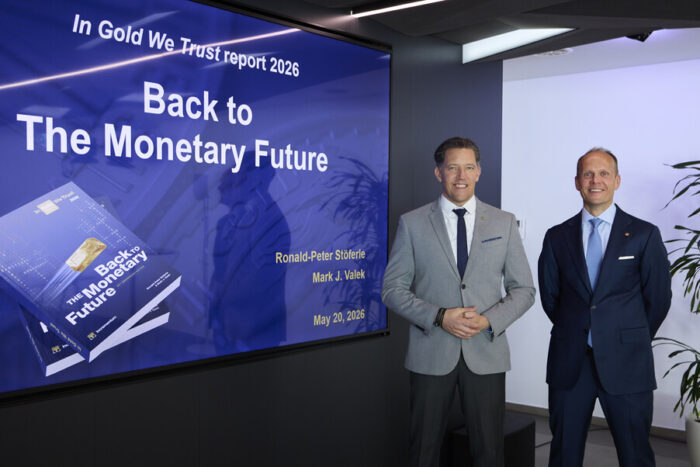
But Dr. Shelton, let’s come back to gold, because we are publishing the In Gold We Trust report. Between the Mar-a-Lago Accord and the move toward a Hamiltonian economic system, the era of global fiat statism is being challenged. If the US leads with goldbacked bonds and other nations follow, just as a thought experiment,
What would the international monetary architecture look like by 2030? The US issues gold-backed bonds on the 4th of July, there’s enormous interest, and other countries copy the idea. What do you say?
Shelton: Well, I think so. As you and I have discussed, for moral reasons I think that trade is a wonderful way for people to get along. Voluntary transactions, commerce, are a great way for people to live on Earth together. And an ideal, in a way, would be to have a common currency. And I mean, you could call it Earth money. Now, when I pose these thoughts, especially with students, their first response is, they like that, or they like Bitcoin. They love that idea of a common currency. They think that’s very futuristic.
But in fact, others might say it’s retro, because when we had the classical international gold standard, that’s exactly what we had: a common currency. Every country denominated its own currency according to its own sovereign aspirations, but they were all using the same global asset to measure value, not just across borders but through time, because they tended not to change those exchange rates. They were a physical weight of gold.
I really enjoy reading Thomas Jefferson’s notes on the establishment of a monetary unit for the United States. We’re going back to Hamilton, as you said, but it was Jefferson’s idea, right after the Revolution, for the United States to have a common currency among these 13 former colonies, now fully independent states. Since they were meshing into a single country, the United States of America, he thought a common currency would encourage voluntary transactions across the country and empower it.
And his aspiration was not only to make the money work for people, for the common man, which was in keeping with this American idea that common people were capable of self-government, that we did not have to have a king; we did not have to be ruled by an elite.
It was also that we could elect among ourselves competent people. They would serve, and then go back to their real lives. That whole experiment was really about giving not just political liberty but economic liberty to individuals.
So he felt it was so important that the dollar be carefully established. He said, if we make the US dollar our unit of account, we must define with precision what a US dollar is. He invoked the highest standards of measuring the purity and weight of gold and silver to establish the American unit of account as a monetary standard of the highest integrity.
Jefferson convinced President Washington that the US monetary unit should aspire to be the universal standard, because ours would be so good. These global monetary aspirations are part of our DNA, going back to our founders. And so the founders were granted the right to regulate the money in Article I, Section 8 of the US Constitution.
It’s in the very same sentence that the founders were granted the power to establish official weights and measures, because the monetary unit of account was meant to be an unvarying measure.
And so that is the ideal that I wish we could go back to. And I think it’s one worthy of defending far more than, say, the discretionary power of central bankers. I would much rather see money working in the interests of the citizens who use it and who generate value through productive effort.
Stöferle: I couldn’t agree more.
In a sound money world, would there be a need for a Federal Reserve or central bank in anything like its current form?
And we’re celebrating the 20th anniversary of the In Gold We Trust report. I started this little project in 2007, and little did I know that it would really become one of the most widely followed publications about gold. And we both know it’s not just about gold. It’s about interest rates. It’s about geopolitics. It’s about de-dollarization. It’s about inflation. It’s about monetary policy. It’s about everything. So actually, gold is just sitting there like it has done for thousands of years, but the world around seems to be spinning more and more dynamically now. Another question that really interests me: What would you say about 20 years from now? If we talk in 20 years, I’ll probably be completely bald by then, but hopefully I will still be writing the In Gold We Trust report.
So, looking 20 years out, will we be living in a sound money world where your proposed monetary revolution has happened, or in a monetary dystopia?
Shelton: Well, first, I congratulate you on your enormous success in identifying what clearly is important to people. I mean, the price rise for gold is astonishing, in a way. Maybe, in another way, it is inevitable.
It was Alan Greenspan, legendary central banker of the world’s most powerful central bank, who, in many private conversations with me, and publicly, often said that gold is a truly global currency, the only one truly accepted without question around the world. It’s a benefit for the US that the US dollar is also widely received, but he thought gold was the ultimate.
The European Central Bank holds gold. Why do they? In a Hamiltonian way, would they ever issue a gold-link bond on behalf of the members of the Eurozone, the countries that make it up – including Bulgaria, which I think just became a member?
I think that’s trickier for Europe. In the United States, all 50 states are the beneficiaries of the fact that our Treasury can issue debt that serves the needs of all states. Some are greater contributors to and some are bigger takers from the federal budget. But I don’t think Europe really has that. They have to wrestle with that. But the European Central Bank does hold large reserves of gold; and when questioned, their answer is essentially that it’s a traditional bulwark.
During my own nomination process, when I was being criticized for speaking favorably about gold in the world of monetary credibility, I had an e-mail from Alan Greenspan, who was watching. He said: If gold is such a worthless metal, why does the United States and so many other major countries hold so much of it? That question is never really resolved. I would like to see other countries emulate the United States, and that could become some kind of a trading union.
If the United States issued a gold-backed bond, maybe that could become a reserve for stablecoins, a one-to-one stablecoin where the collateral backing is a gold-backed Treasury certificate. Right now, most stablecoins have a one-to-one correlation with Treasuries or other readily marketable securities. So that would be tremendous. Or you could have stablecoins with varying percentages of gold and Treasury bonds as backing.
And you could likewise see other countries do the exact same thing. Then you already have the beginning. And looking 20 or 30 years into the future, you have the beginning of a new international monetary system where the members are all linked to the same common denominator, some kind of gold-link or convertibility feature embedded in sovereign debt. And if every country issued a gold-backed bond at the same time, all maturing in, say, 25 years, by that point you would know exactly what the exchange rate was among all those currencies, because though denominated in each country’s own currency, the bonds would be ultimately convertible into a prespecified amount of gold.
So the exchange rate is going to be a fixed one, depending on their effectively equivalent obligations. And people will price them accordingly if they can all be converted into gold on the same day.
I don’t anticipate that happening precisely, but that’s the direction I’d like to see us moving, harnessing the power of the market to make judgments about the reliability of each government to honor its commitments, with demand for that currency always dependent on whether it can be converted into gold.
This could ultimately become a classical gold standard, take two. And with the digital platform opportunities available, stablecoins or other digital mechanisms linked to gold, and with gold convertibility already happening at the state level in Texas and Florida, where daily transactions with gold and silver holdings on digital platforms are permitted, I think that’s all very encouraging.
I think that’s all very interesting. And I hope it brings about this revolution of thinking that the money you earned is your private property. Now I’m going back to one last founder, James Madison. He said, if the government can debase the currency, a depreciating currency is the same as stealing your land and therefore unconstitutional. That is the attitude I would like American citizens to adopt and to reassert, along with the value of those original founding principles.
Stöferle: That was a very strong closing statement. Thank you very much, Dr. Shelton. I love that you bring these creative ideas backed by an enormous amount of knowledge about monetary history, that you’re talking about this moral contract between government and its people. I truly hope we will see some sort of a July 4th reset and your ideas actually being introduced. So thank you, thank you very much for your work. Thank you for your time. And I look forward to staying in touch with you and wish you all the best.
Judy Shelton: Thank you for your interest, and I appreciate your audience very much. Thank you.
Ronald-Peter Stöferle: Thank you very much.
The video of this interview is available on our YouTube channel here.
[1] See “The De-Dollarization: Good-bye Dollar, Hello Gold?,” In Gold We Trust report 2017